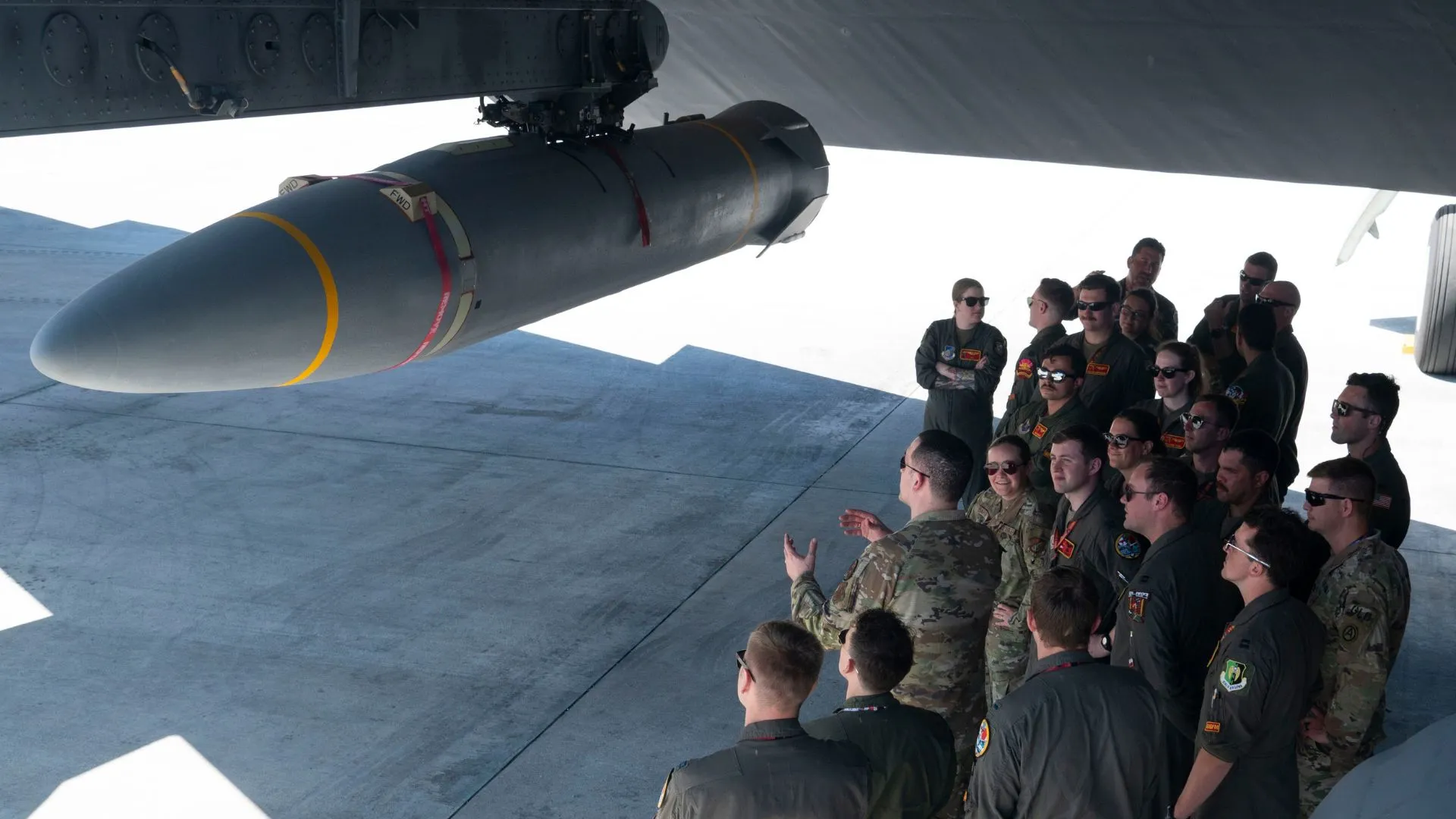
The Department of the Air Force has awarded Lockheed Martin a $694 million contract to produce and field the AGM-183A Air-Launched Rapid Response Weapon (ARRW), moving the boost-glide hypersonic missile from flight testing into production. Awarded on September 29, 2026, and announced on October 26, 2026, the award withholds quantities and delivery dates for operational security reasons. Secretary of the Air Force Troy Meink called it “a turning point in our advanced weapons roadmap.”
The award completes a sharp reversal. Lockheed Martin began ARRW development in 2018 under a design contract worth up to $480 million, then a $988.8 million modification in December 2019 for critical design review. After repeated test failures, then-acquisition chief Andrew Hunter told lawmakers in March 2023 that the Air Force would not buy the weapon, and the fiscal 2025 request zeroed it out. Then-Chief of Staff Gen. David Allvin signaled the program’s revival at a June 2025 House hearing, and the fiscal 2026 request sought $387.1 million to begin procurement.
ARRW Hypersonic Missile Design, Performance, and Test Record
ARRW is a two-stage, bomber-launched boost-glide weapon. After release, a solid-fuel rocket booster accelerates the all-up round beyond Mach 5; a protective shroud then separates and an unpowered hypersonic glide vehicle maneuvers to the target. The glider draws on the Defense Advanced Research Projects Agency (DARPA) Tactical Boost Glide program, and Pentagon test officials describe its payload as a kinetic energy projectile warhead for high-value, time-sensitive land targets.
Air Force officials put ARRW’s range at roughly 1,000 miles, and service leaders have cited average speeds of 5,000 to 6,000 miles per hour, roughly Mach 6.5 to Mach 8, enough to cover that distance in 10 to 12 minutes. Publicly available estimates put the all-up round at about 22 feet and roughly 6,600 pounds; the Air Force has not released official dimensions, weight, or guidance details. Operationally, a 1,000-mile standoff keeps the launch aircraft outside most integrated air defense engagement zones, while a flight time under 15 minutes shrinks the window for an adversary to relocate mobile launchers or cue interceptors against a maneuvering glider.
All three booster flight tests in 2021 failed during the launch process, and Congress struck the nearly $161 million in fiscal 2022 procurement funding, cutting about half and shifting the rest to research and testing. ARRW first reached Mach 5 on May 14, 2022, and the first all-up-round shot on December 9, 2022, completed its flight path and detonated in the terminal area, according to the Air Force. A March 2023 all-up-round test failed when a shroud malfunction prevented collection of glide and terminal-phase data. The Pentagon’s weapons tester reported nominal conditions on an August 2023 flight, and another all-up-round test followed in October 2023. The final prototype launch followed on March 17, 2024, from a Guam-based B-52H over the Reagan Test Site at Kwajalein Atoll.
B-1B Integration, Increment 2 Seeker, and the Funding Path
ARRW will initially be fielded on the B-52H Stratofortress, which carried every prototype test round. The B-1B Lancer has also flown with the weapon, and Air Force budget documents identify the B-1B as the testbed for the Load Adaptable Modular (LAM) pylon. Each of its six LAM stations can carry two 2,000-pound-class weapons or one 5,000-pound-plus store, the class into which ARRW falls. The service plans to spend $342 million from fiscal 2027 to 2031 modernizing its 44 remaining B-1Bs and expects the fleet to remain operational until at least 2037.
The production order was placed under the Department of War’s Enterprise-Wide Agile Acquisition Contract (EWAAC), a multiple-award indefinite-delivery/indefinite-quantity vehicle run by the Air Force Life Cycle Management Center’s Armament Directorate at Eglin Air Force Base, Florida, with a $46 billion ceiling through 2031. The fiscal 2027 request includes $452 million for ARRW procurement, up from the roughly $362 million Congress provided in fiscal 2026. Budget documents treat quantities as controlled unclassified information.
Development continues in parallel. The fiscal 2027 request seeks about $346 million in hypersonic prototyping funds: $296 million to start ARRW Increment 2, adding a terminal seeker, a datalink, and cost-reduction measures, and nearly $50 million for design work on a new Air-Launched Ballistic Missile (ALBM) funded in the same program element. Budget documents list the Increment 2 seeker work under the Pacific Deterrence Initiative. Pentagon test reports describe the current AGM-183A as a weapon against fixed land targets; a seeker and datalink would point toward moving targets, potentially including surface combatants in the Western Pacific.
What ARRW Production Means for Air Force Hypersonic Strike
Analysis: The production decision reflects timing as much as maturity. The prototype record mixes clean shots with failures, and early setbacks limited assessment against the full range of targets. Yet the Raytheon-built Hypersonic Attack Cruise Missile (HACM) only completed its first flight test release, confirmed on October 5, 2026, after slipping from 2024, leaving ARRW the only Air Force hypersonic weapon with a completed prototype test campaign. Applying Congressional Budget Office (CBO) unit-cost estimates of $15 million to $18 million, $694 million covers at most about 38 to 46 missiles, fewer once tooling and fielding costs are counted: a niche magazine for the most defended, time-critical targets, not a campaign-sustaining inventory.
Next comes congressional action on the fiscal 2027 budget. The Pentagon is operating under a continuing resolution at fiscal 2026 levels through December 11, which generally bars new starts and leaves Increment 2, planned from the second quarter of fiscal 2027 through fiscal 2030, exposed. The Air Force has not disclosed an initial operational capability date, a delivery schedule, or the first receiving unit.