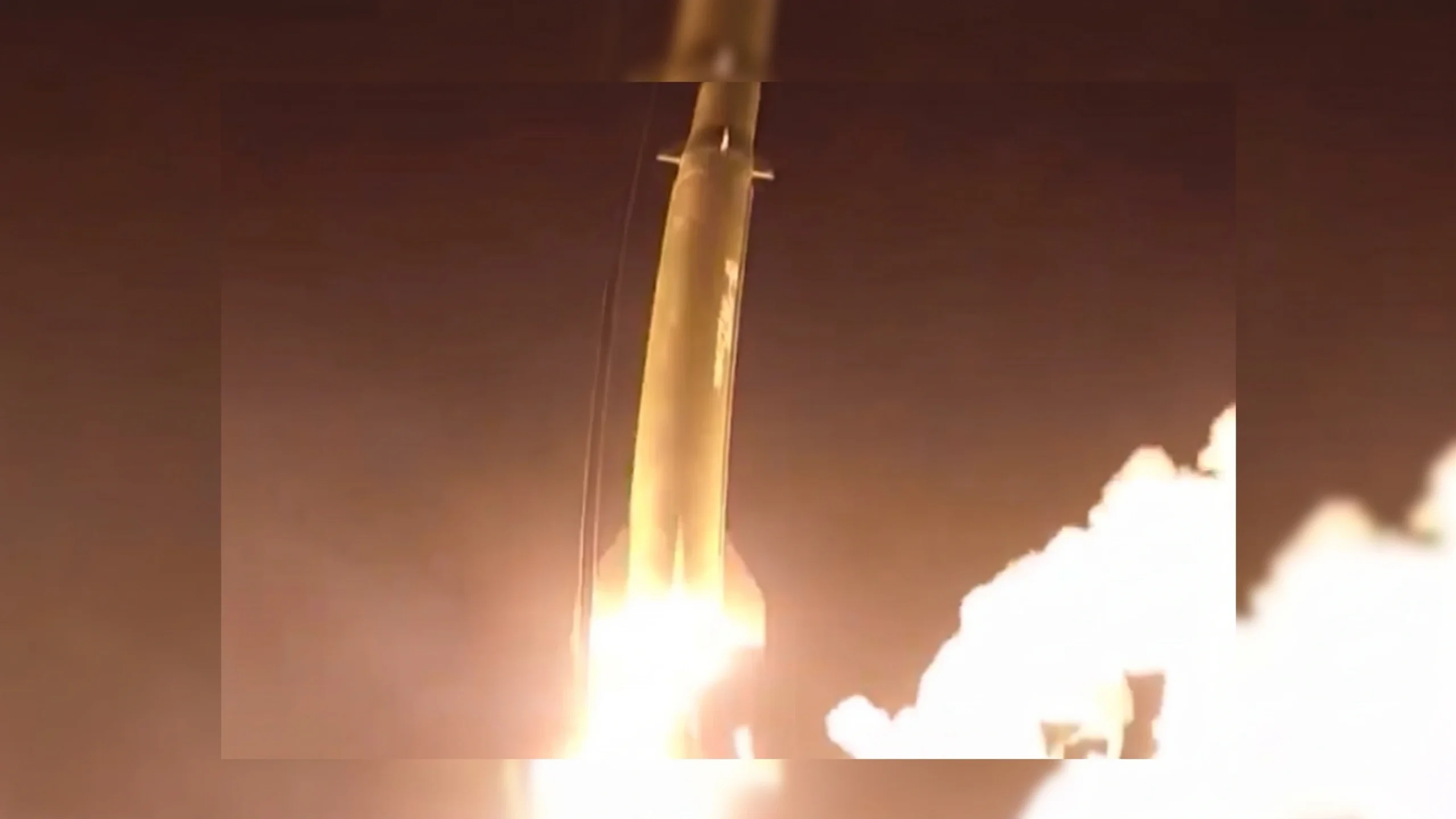
China Central Television (CCTV), China’s state broadcaster, on October 26, 2026, aired footage of a “no-notice” missile launch by People’s Liberation Army (PLA) troops in mountainous terrain, the second such release this month as Beijing uses state media to showcase PLA rapid-response capabilities. CCTV said the troops received no advance warning but disclosed no date, location, unit or missile designation.
The clip aired as the Communist Party’s 20th Central Committee opened its fifth plenary session in Beijing, a meeting focused on party discipline and loyalty. It followed Beijing’s October 25 observance of Taiwan Restoration Day and landed midway through Keen Sword 27, the biennial US-Japan exercise running from October 19 to 29 across Japan’s southwestern islands.
What CCTV Showed in the Second No-Notice Missile Launch Video
The October 26 clip is believed to show a missile from the Dongfeng (“East Wind”) family fielded by the PLA Rocket Force (PLARF), but CCTV did not name the type, and the footage does not allow independent identification. No launch timeline, target area or impact data accompanied the broadcast.
The October 11 release was more explicit. It showed launches of DF-26 intermediate-range ballistic missiles (IRBMs) that CCTV said took place during the early-October National Day holiday in southeastern China, a description consistent with Fujian, the mainland province facing Taiwan. The footage carried the slogan “Sharpening blades across multi-domains, safeguarding national reunification.” It aired a day after Taiwan’s leader, William Lai Ching-te, used his October 10 Double Tenth address to say the island would not give up its freedom or accept subordination. Beijing’s Taiwan Affairs Office accused him of clinging to separatist thinking and exaggerating the mainland threat.
In June, CCTV aired the first public footage of a DF-17 hypersonic missile launch from an exercise in the Gobi Desert, alongside what analysts assessed as an upgraded DF-26 with control fins near the warhead, a feature that may allow terminal maneuvers. The “no-notice” label adds a narrower claim: that launch units can move from garrison to firing on short alert. With no alert-to-launch times shown, that claim cannot be independently verified.
How the DF-26’s Range and Dual-Capable Payload Put Guam in Reach
Publicly available specifications describe the DF-26 as a two-stage, solid-propellant IRBM with a range of about 4,000 km, carried on a road-mobile transporter-erector-launcher (TEL). Chinese sources cite a length of 14 m, a diameter of 1.4 m and a launch weight of roughly 20,000 kg; open-source estimates put the payload at 1,200 to 1,800 kg. The missile debuted at the September 3, 2015, parade in Beijing.
Guam lies roughly 3,000 km from Fujian, well inside that envelope, and hosts Andersen Air Force Base and Naval Base Guam, the hub of US power projection at the second island chain. The DF-26 was China’s first conventionally armed ballistic missile able to reach the island.
The Pentagon describes three versions, covering conventional and nuclear strikes on land targets and conventional strikes on ships; the DF-26B anti-ship variant was tested in 2020. A modular design lets crews swap conventional and nuclear warheads in the field, so a launch toward Guam would not by itself reveal what the missile carries.
The Pentagon’s 2023 and 2024 China Military Power Reports credited the PLARF with 250 IRBM launchers and 500 missiles, a force that appears to consist entirely of DF-26s. Solid propellant and road mobility are what give a no-notice drill its meaning: with no fueling cycle, warning time depends on how fast crews disperse, erect and fire.
PLA Daily Links Rapid Response to Anti-Secession Law Triggers
On October 25, the PLA Daily, the military’s official newspaper, published an article by three researchers from the National Defense University and the Academy of Military Sciences urging stronger rapid-response capabilities to prepare for “major ‘Taiwan independence’ incidents.” The phrase mirrors one of three conditions in Article 8 of the 2005 Anti-Secession Law, which authorizes “non-peaceful means and other necessary measures.” The authors also called for warnings and punishments against independence advocates and “external forces” to be delivered in ways the targets clearly understand and fear.
The same day, Beijing marked Taiwan Restoration Day, which its legislature created in October 2025 to commemorate the end of Japanese colonial rule over the island in 1945. Taipei rejected the designation.
Keen Sword 27 involves about 56,000 personnel, roughly 45,000 of them from the Japan Self-Defense Forces (JSDF), along with 40 ships and 260 aircraft. The drills center on Japan’s southwestern Nansei island chain, which runs to just east of Taiwan, and include US Marine Corps Navy-Marine Expeditionary Ship Interdiction System (NMESIS) launchers on Yonaguni. Seven other nations, including Australia, France and Germany, are participating. Organizers describe it as dedicated to preserving peace and stability, without naming China.
Analysis: Two curated launch videos in 15 days serve more than one audience. At home, the October 26 release paired a display of Rocket Force readiness with a plenum on discipline, a pointed juxtaposition for a service whose commander and political commissar were replaced in mid-2023 amid a widely reported corruption investigation. Abroad, the message tracks Keen Sword’s geography: as US and Japanese forces rehearse dispersed operations along the Nansei chain, Beijing is advertising that it can hold Guam at risk with little warning. For US planners, the variable is time, not range: a credible no-notice capability would shrink the window to disperse aircraft and ships and cue missile defenses. State footage, however, proves nothing about readiness across brigades, night launches or salvo coordination.
The fifth plenum and Keen Sword 27 both end on October 29. The plenum communiqué and any changes to the Central Military Commission will show whether the discipline campaign reaches deeper into the PLA’s senior ranks. Unknowns include the missile type and launch site in the October 26 clip and whether either drill involved live impacts at sea. The Pentagon’s next China Military Power Report, typically released late in the year, may update IRBM counts. Further no-notice footage or a named joint exercise around Taiwan would signal sustained pressure beyond the plenum.