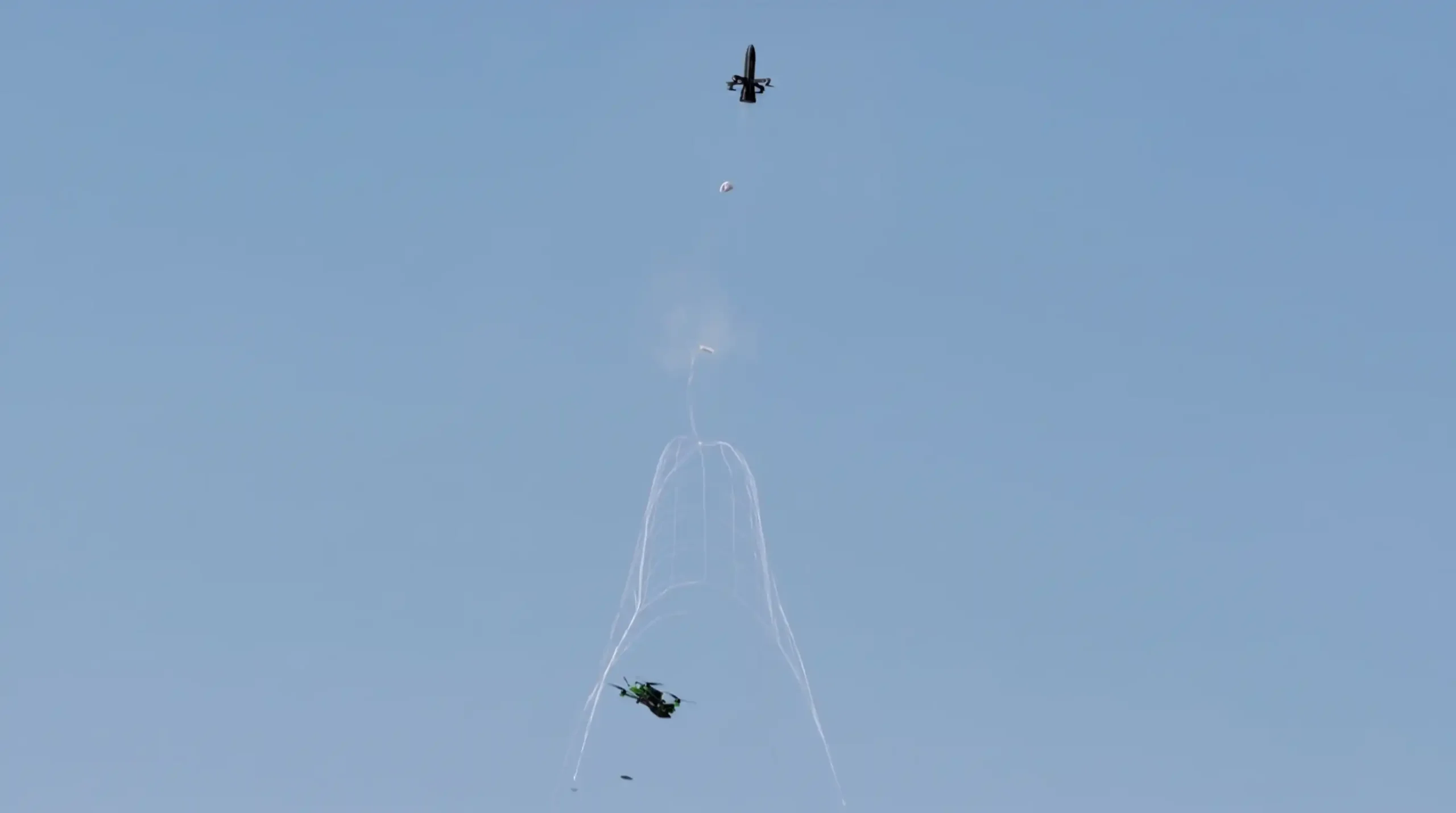
Israel’s ParaZero Technologies Ltd. (Nasdaq: PRZO) launched TillOnAIR on October 26, 2026, putting on sale an autonomous counter-unmanned aerial system (C-UAS) that detects incoming drones, steers a reusable quadcopter interceptor from the ground and captures the threat with a net. The Kfar Saba-based company says the system runs the full engagement cycle, from detection through launch, net deployment and interceptor recovery, without pilot or operator intervention.
The launch turns ParaZero, founded in 2014, from a supplier of DefendAir net-launching Net Pods into the provider of a complete detect-to-defeat system. It arrives as fiber-optic-guided first-person-view (FPV) drones, widely used in Ukraine and immune to radio frequency (RF) jamming, push armies toward physical defeat mechanisms for their innermost defensive layer. ParaZero’s DefendAir line already has traction: Israel’s Defense Export Controls Agency (DECA) cleared it for international marketing in January 2025, a major Israeli defense entity placed a first order on January 2, 2026, follow-on Israeli orders came in February, March and April, and an unnamed American defense manufacturer ordered on October 8, 2026.
How the ParaZero TillOnAIR Guides Interceptors From the Ground
TillOnAIR combines four elements: a patented detection-and-guidance technology, a ground-based mission control unit, a reusable quadcopter interceptor and a DefendAir Net Pod. The defining choice is architectural. The ground station detects and tracks the target, then steers the interceptor directly, so the airframe carries no GPS receiver, homing seeker, camera or beacon receiver. In missile terms, this is command guidance applied to a small drone: sensing and fire control stay on the ground, and the airborne component becomes a guided net launcher.
That design trades onboard autonomy for cost and electronic warfare (EW) resilience. With no satellite navigation receiver aboard, the interceptor offers no GPS signal to spoof or jam. The net-based kill also works against fiber-optic-guided, pre-programmed and autonomous drones because it does not depend on severing a control link the threat may not use. The approach inverts the logic of Fortem Technologies’ DroneHunter F700, a US net-capture interceptor that, according to its manufacturer, locks onto targets with an onboard TrueView R20 radar.
ParaZero has not disclosed the detection sensor modality, whether radar, electro-optical or otherwise, nor the waveform and anti-jam protection of the uplink between the ground unit and the interceptor. That command link is now the system’s most EW-exposed element.
Reusable Net Interception and the DefendAir Perimeter Layer
The interceptor engages from above, deploys its net and returns intact. Only the Net Pod needs replacing before the next engagement, which ParaZero presents as the basis for a low recurring cost per intercept. The mechanism carries no explosive warhead, avoiding fragmentation over friendly troops or civilian sites. Company literature describes the Net Pod as a single-shot interception magazine with configurable net sizes and adjustable launch power, and claims effectiveness against explosive drones flying at 70 mph and heavy-lift smuggling drones carrying up to 75 lbs.
Company figures for TillOnAIR include:
- A configurable 360-degree protection bubble of 50 to 100 meters around the defended asset
- Setup in approximately 20 minutes
- System weight of approximately 15 kg
- One ground system coordinating multiple interceptors against multiple incoming threats
Within DefendAir, TillOnAIR forms the autonomous perimeter layer, alongside personal protection systems, vehicle-mounted active protection applications and longer-range airborne integrations. Target sites include outposts, command posts and field hospitals, plus government buildings, energy facilities, radar stations and air-defense batteries. CEO Ariel Alon said the system expands ParaZero’s role “from providing the interception capability to delivering an entire autonomous defense solution.”
Key parameters remain undisclosed: interceptor speed and endurance, engagement altitude, detection range, interceptors per ground unit, whether the 15 kg figure includes interceptors, and pricing. No TillOnAIR customer has been announced.
Analysis: TillOnAIR is a terminal defense layer, not an area defense system. At the 70 mph threat speed ParaZero cites, a drone crosses 100 meters in roughly three seconds, so real-world performance hinges on how far beyond the bubble the ground sensor detects and tracks, a figure the company has not released. Moving guidance to the ground is a coherent answer to fiber-optic FPVs, which defeat the RF jammers much of today’s short-range C-UAS inventory relies on. The test is whether a cheap, sensorless interceptor holds accuracy against maneuvering targets when its only guidance arrives over a radio link an adversary will try to deny.
ParaZero plans TillOnAIR demonstrations in Israel during November 2026 for government, military and security organizations, and expects to present the system at the UVID DroneTech show in Tel Aviv on November 12, 2026, before a worldwide demonstration campaign. The system debuted at the Association of the United States Army (AUSA) Annual Meeting and Exposition, held October 12 to 14, 2026, in Washington, D.C., inside the Israeli Ministry of Defense’s SIBAT pavilion. Independent test data and a first launch customer are the milestones to watch.