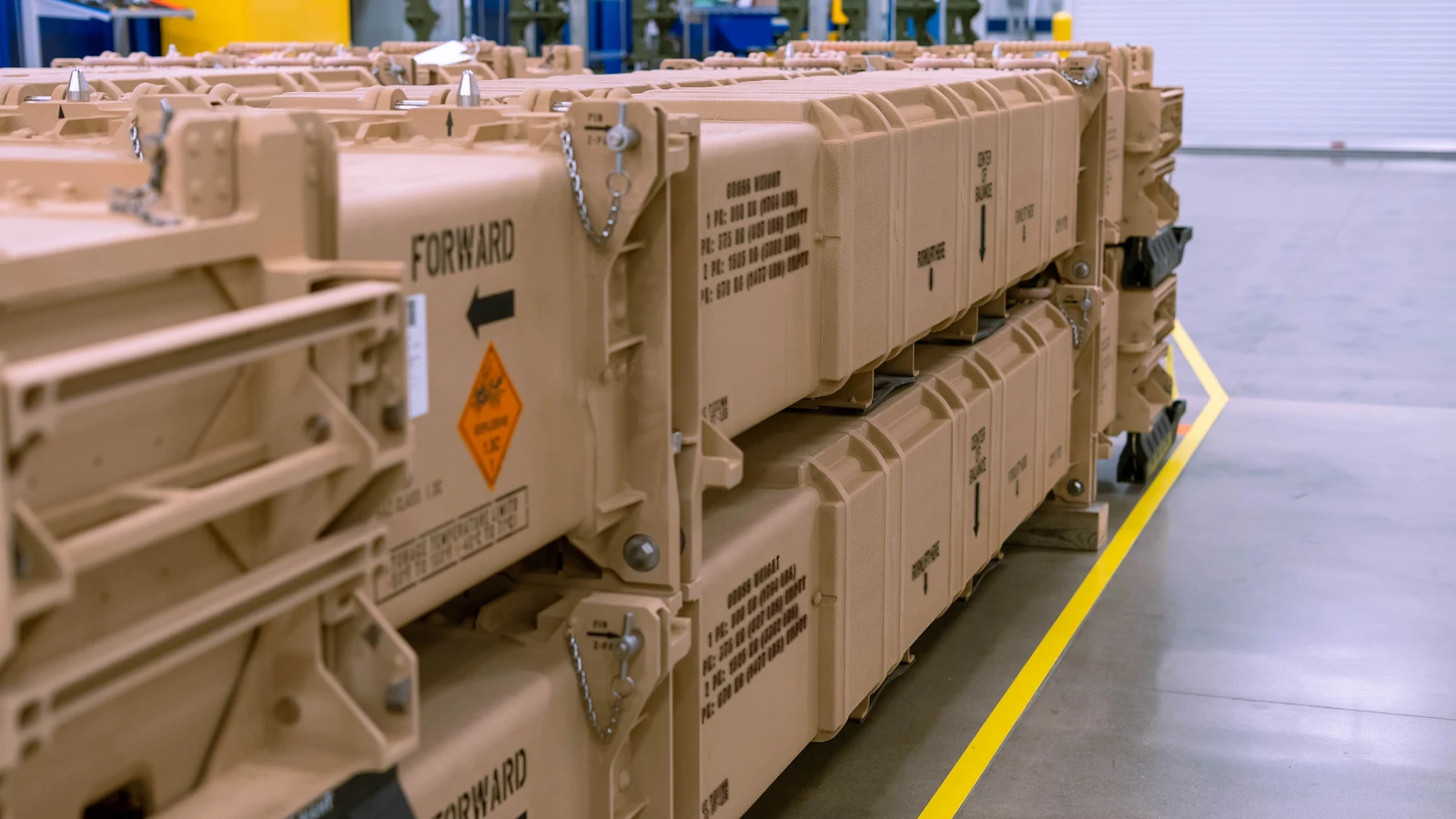
Poland will host a dedicated PAC-3 Missile Maintenance Facility (MMF) for NATO operators of the Patriot air and missile defense system, Lockheed Martin and the U.S. Department of War announced on October 27, 2026, on the margins of the NATO Conference of National Armaments Directors (CNAD) meeting in Brussels. The site will perform onsite repair, refurbishment, lifecycle support and re-certification of Patriot Advanced Capability-3 (PAC-3) interceptors, with Germany, the Netherlands and Sweden leading critical supply chain integration.
The decision closes a selection process opened on July 7, 2026, when the United States, Germany, the Netherlands, Poland and Sweden signed a government-to-government agreement at the NATO Summit Defense Industry Forum in Ankara, Türkiye, to explore an in-theater sustainment site for PAC-3 Missile Segment Enhancement (MSE) and PAC-3 Cost Reduction Initiative (CRI) rounds. Poland competed against Germany, the Netherlands and Norway to host it, according to Polish Deputy Defense Minister Magdalena Sobkowiak-Czarnecka. The Department of War ties the project to the industrial commitments adopted at the Ankara Summit under the “NATO 3.0” framework, which shifts primary responsibility for conventional defense toward European Allies.
Inside the PAC-3 Missile Maintenance Facility: Repair, Recertification, Testing
The MMF is a sustainment node, not a production line. Its stated mission covers onsite repair, refurbishment, lifecycle support and re-certification, with the explicit goal of rapid turnaround for resupply and integrated testing. Today, interceptors that require depot-level work or recertification must return to facilities in the United States, a transatlantic loop that pulls rounds out of European inventories for extended periods.
Shortening that loop has direct readiness value. A Patriot battery’s combat endurance depends on the number of serviceable rounds in its magazine, and recertification is a recurring requirement across a canisterized missile’s service life. Every round recovered in Europe is a round that does not have to be replaced from a production queue already committed through the end of the decade.
The announcement leaves major parameters open. Sobkowiak-Czarnecka put the investment at about 1 billion zloty ($253 million) and said the site should be operational in roughly a dozen months, but neither Lockheed Martin nor the Department of War disclosed the facility’s location within Poland, its construction schedule, annual throughput or the national work shares assigned to Germany, the Netherlands and Sweden. The July agreement referenced support for both MSE and CRI rounds; the October announcement did not specify which variants the Polish site will service at initial capability.
PAC-3 MSE Hit-to-Kill Design and Why Sustainment Drives Readiness
The PAC-3 family destroys targets by direct body-to-body impact rather than with a blast-fragmentation warhead. Publicly available specifications indicate that the PAC-3 MSE pairs a Ka-band active radar seeker with a two-pulse solid rocket motor of larger diameter than the CRI motor, enlarged control fins and forward-mounted attitude control motors for terminal maneuvering. Lockheed Martin credits the dual-pulse motor with expanding the engagement envelope in altitude and range against tactical ballistic missiles, cruise missiles and aircraft. An M903 launcher carries 12 MSE rounds, against 16 of the smaller CRI.
That architecture concentrates value in components that age and require periodic inspection: seeker electronics, propellant grain, attitude control motors and the launch canister. Those are precisely the elements a recertification line must test and, where needed, refurbish.
Demand explains the urgency. The PAC-3 MSE has been used in combat in Ukraine and during Operation Epic Fury, and on July 29, 2026, the Department of War awarded Lockheed Martin a seven-year undefinitized contract action modification worth up to $53.86 billion, bringing the multiyear total to $58.62 billion after a $4.7 billion first-year award in April. The company plans to triple production capacity by the end of 2030. Until that capacity materializes, maintenance is the fastest lever for keeping existing stocks available.
How the Wisła Program and Allied Supply Chains Anchor the Hub
Poland is building one of Europe’s largest Patriot forces. Under Phase 1 of the Wisła program, Warsaw acquired two batteries with 208 PAC-3 MSE missiles and the Northrop Grumman Integrated Air and Missile Defense Battle Command System (IBCS), declared fully operational with the 3rd Air Defense Missile Brigade at Sochaczew in December 2025. Phase 2, contracted in September 2023 for 47.6 billion zloty ($13.33 billion), adds six batteries, 12 Lower Tier Air and Missile Defense Sensor (LTAMDS) radars, 48 M903 launchers and, by published figures, 644 PAC-3 MSE missiles, with deliveries from 2026 to 2029. The end state is eight batteries and 64 launchers.
Polish industry already holds offset work on the program, including M903 launcher production at Huta Stalowa Wola and elements of the PAC-3 MSE missile. The MMF extends that footprint from manufacturing into depot-level sustainment. Germany, the Netherlands and Sweden, which fields the system as the Lvs 103, are all established Patriot operators, and Lockheed Martin says the arrangement will widen opportunities for American and European suppliers alike.
Analysis: The Polish MMF is the first concrete deliverable of NATO 3.0 burden-shifting applied to the alliance’s most contested interceptor stockpile. Final assembly of PAC-3 MSE all-up rounds stays in Camden, Arkansas, while Europe takes on sustainment closer to the threat. For Warsaw, hosting the hub converts a customer relationship into infrastructure serving every European PAC-3 operator, reinforcing Poland’s role as the industrial center of gravity on NATO’s eastern flank. The operational payoff depends on throughput: a facility that recertifies a few dozen rounds a year changes little, while one sized to the combined Polish, German, Dutch and Swedish fleets could materially raise the share of Patriot magazines that are combat-ready at any given time.
The next milestones are a site announcement, a construction timeline and a definition of the facility’s initial capacity and supported variants. The allocation of supply chain work packages to German, Dutch and Swedish firms will follow. The larger open question is production: U.S. officials have said they do not rule out building PAC-3 missiles outside the United States, and Polish officials have already positioned the country as a candidate site.