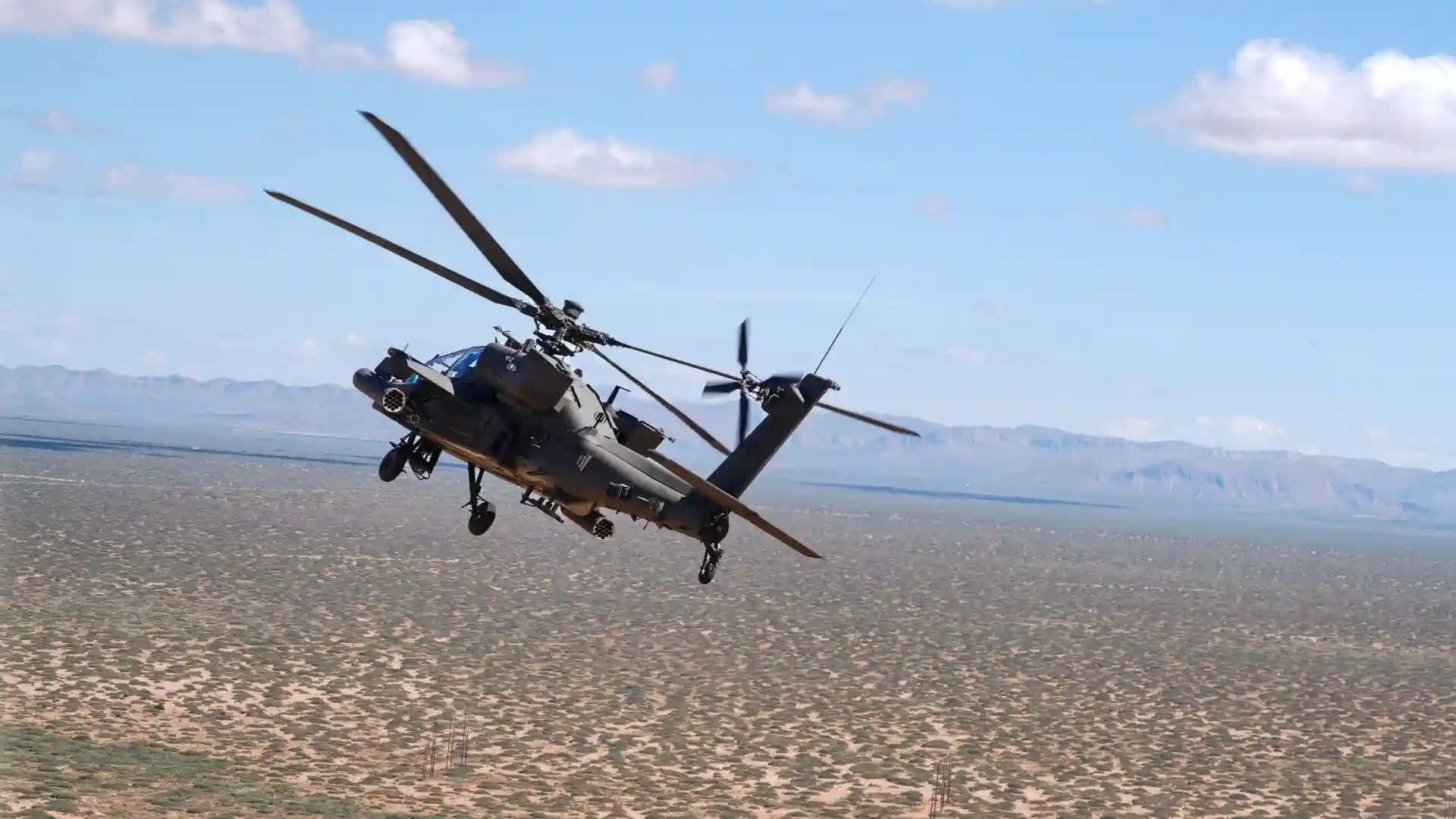
The US Army has awarded Boeing a $499,760,655 modification to its Apache AH-64 engineering services and technical support contract, extending the vehicle to an estimated completion date of February 20, 2031. The Pentagon disclosed the award on October 27, 2026, although the modification, designated P00006 to contract W58RGZ-21-D-0077, was signed on February 21, 2026. Army Contracting Command at Redstone Arsenal, Alabama, is the contracting activity, and Boeing’s Mesa, Arizona, rotorcraft business is the awardee.
The award lands as the Army reshapes its attack helicopter force under the Army Transformation Initiative (ATI), unveiled in late April 2025, which directed the service to cut manned attack helicopter formations, divest the AH-64D Longbow and lean harder on drones and launched effects. The Army requested only $1.7 million for the AH-64 Apache Block IIIA line in fiscal 2026, but appropriators added $360 million in the final fiscal 2026 spending bill. With new US airframes no longer the program’s center of gravity, engineering, upgrade and sustainment work now defines Boeing’s domestic Apache business.
Apache Engineering Services Contract Extended Through February 2031
The original contract, awarded in August 2021, was valued at $487 million on a cost-plus-fixed-fee basis with an estimated completion date of February 6, 2026. The new modification adds nearly $500 million and pushes the end date out five years. The announcement does not state the cumulative value of the vehicle after modifications P00001 through P00005 or any funding obligated at award; work locations and funding will be set with each task order.
Competition was nominal. The Army solicited bids online and received one. A 2019 presolicitation notice for the requirement justified a sole-source approach on the grounds that Boeing holds the proprietary technical data packages for the AH-64A, D and E models. Task orders issued under the vehicle illustrate its scope, including Common Infrared Countermeasures (CIRCM) transportability work for Version 4 aircraft and technical manual updates covering manned-unmanned teaming, according to federal procurement records. The award follows a separate $636.1 million performance-based logistics modification for Apache airframe components in August 2026.
The Pentagon has not explained the roughly eight-month gap between signature and public announcement for an award far above the $7.5 million disclosure threshold.
AH-64D Divestment Concentrates Engineering Work on the AH-64E Fleet
The contract covers all Apache generations, but the active force is converging on one model. In April 2026, Col. Tim Jaeger, director of Army aviation at the G-3/5/7, said the service had divested nearly 60% of its AH-64D fleet over the previous year. Fiscal 2026 budget documents put the active AH-64E fleet at 408 aircraft in fiscal 2025, outlined a transfer of nearly half of them to the Army National Guard and planned full AH-64D retirement by 2027. ATI also removes one air cavalry squadron from each combat aviation brigade.
Publicly available specifications indicate the AH-64E pairs two General Electric T700-GE-701D turboshafts of roughly 2,000 shaft horsepower each with an improved drivetrain and composite main rotor blades, giving it a top speed about 25 knots higher than the AH-64D. Its sensor suite combines the AN/APG-78 Longbow fire control radar with the Modernized Target Acquisition Designation Sight/Pilot Night Vision Sensor (M-TADS/PNVS). Armament includes the M230 30mm chain gun, AGM-114 Hellfire and AGM-179 Joint Air-to-Ground Missile (JAGM), and Hydra 70 rockets, while manned-unmanned teaming lets crews control unmanned aircraft sensors from the cockpit. Each subsystem demands recurring engineering for software releases, obsolescence and airworthiness changes, which is precisely what this vehicle buys.
Version 6.5 and T901 Engine Integration Define the Upgrade Roadmap
The largest near-term engineering task is Version 6.5. Awarded in December 2021, the upgrade establishes a common operational flight program across the E-model fleet, adds an Open Systems Interface and improves Link 16 functionality and route and attack planning. Its hardware insertions require a modification work order to retrofit all Version 4 and Version 6 aircraft. Retrofit fielding was targeted to begin in fiscal 2026, but Boeing said in April 2026 that the Army was still testing the configuration. In October 2026, Boeing reported integrating a launched effects capability through the Version 6.5 open architecture in its Mesa lab, using hardware-in-the-loop equipment.
The second track is the General Electric T901, developed under the Improved Turbine Engine Program (ITEP). According to the Army and GE, the 3,000-shaft-horsepower engine delivers 50% more power and 25% better fuel consumption than the T700 at the same size and weight. Boeing received a $239.6 million contract in December 2021 to integrate it on the AH-64E through 2026. ITEP was once targeted for an ATI cut, but an Army sources-sought notice now points to production beginning by 2031, the same year this engineering contract expires.
Analysis: The modification confirms that the Apache’s future in US service rests on modernization and sustainment rather than new airframes. Extending sole-source engineering support to 2031 secures continuity for Version 6.5 retrofit, potential T901 integration and launched effects work, but it also concentrates leverage with Boeing, whose ownership of the technical data packages leaves the Army without a competitive alternative. That dependency deepens as the active fleet shrinks and the National Guard absorbs more E models, while foreign demand keeps the Mesa engineering base busy, led by Poland’s 96-aircraft order under a nearly $4.7 billion Foreign Military Sales contract that will make it the 19th global Apache operator.
Next milestones include the Version 6.5 retrofit fielding decision, the outcome of the Army’s ITEP analysis of alternatives and any T901 production commitment, and the planned retirement of the last AH-64Ds in 2027. Task order values under the extended vehicle will show how much of the $499.8 million the Army actually spends. Poland’s first deliveries, expected in 2028, will then add the largest Apache order placed outside the United States to the sustainment base Boeing runs from Mesa.