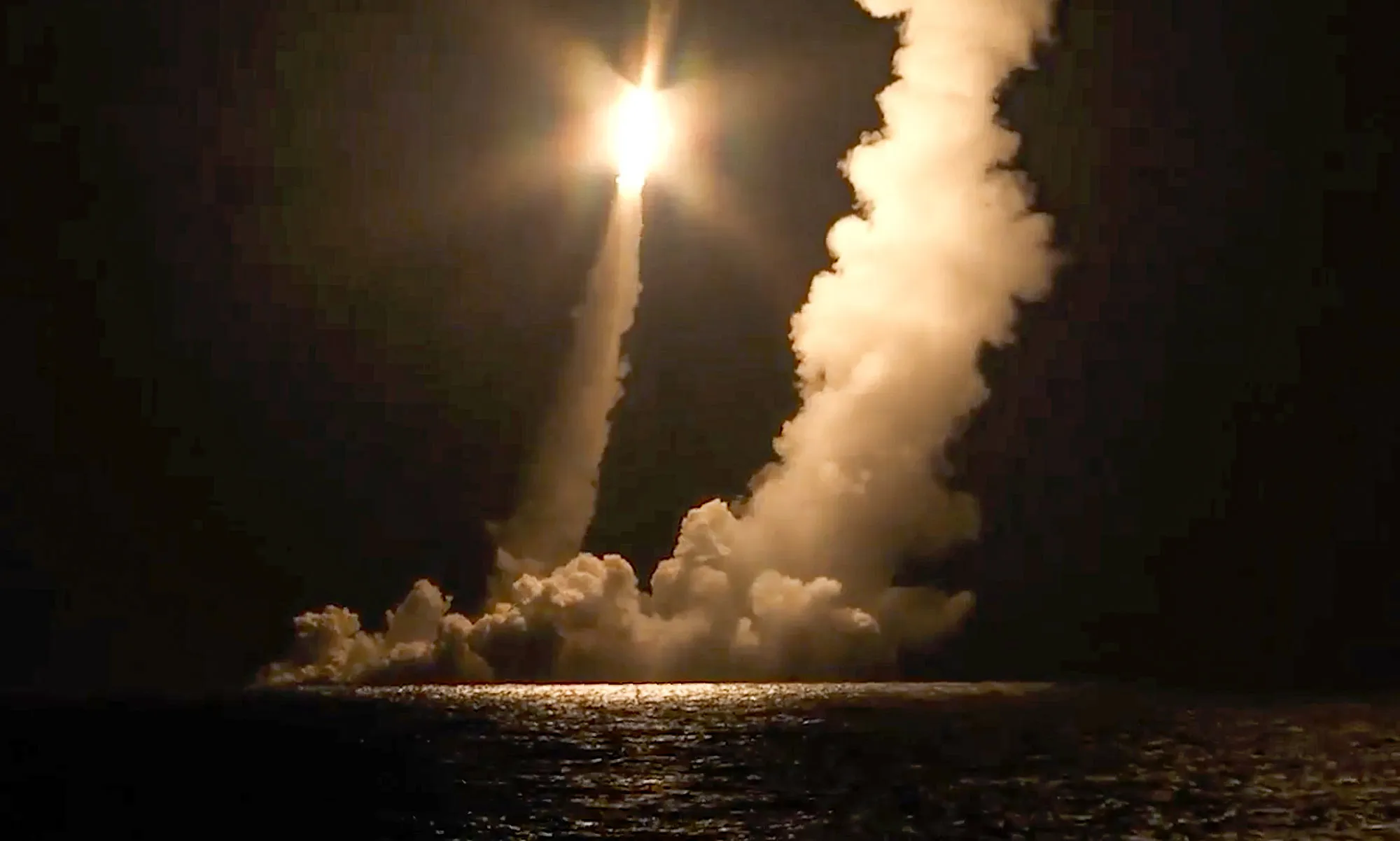
Russia’s Pacific Fleet test-fired a Bulava intercontinental ballistic missile from the submerged Project 955A Borei-A nuclear-powered ballistic missile submarine (SSBN) K-553 Generalissimo Suvorov in the Sea of Okhotsk, the Russian Ministry of Defense announced on October 28, 2026. Tracking data showed the warheads reaching the Chizha test range in the Arkhangelsk region on schedule, the ministry said.
The firing comes nearly nine months after New START expired on February 5, 2026, ending the last binding limits, data exchanges and inspections covering US and Russian strategic forces; Moscow says it will observe the treaty’s central limits only while Washington does. It also returns the Bulava to view after Russia’s October 2025 and May 2026 strategic exercises relied on the older liquid-fueled Sineva for their naval launches.
Bulava Missile Test Retraces the Okhotsk-to-Chizha Flight Route
The ministry framed the launch as part of the crew’s combat training plan rather than a declared strategic forces exercise, and did not give the date of the firing. The missile flew west across nearly the full breadth of Russia to the Chizha range on the Kanin Peninsula, on the Barents Sea coast.
The route has precedent. When the Borei-class Vladimir Monomakh fired a four-missile salvo from the Sea of Okhotsk toward Chizha on December 12, 2020, Russian officials put the flight distance at more than 5,500 km. That salvo was the first Bulava launch by a Pacific Fleet submarine and the second four-round Bulava salvo, after Yuri Dolgoruky fired four missiles from the White Sea toward Kamchatka in May 2018. Sister ship Knyaz Oleg also fired a Bulava from the Sea of Okhotsk on October 29, 2024, during Russia’s annual strategic deterrence exercise.
Generalissimo Suvorov has now launched the Bulava in both directions. On November 3, 2022, during final state trials, it fired a missile from the White Sea at the Kura range on Kamchatka. Firing from the Sea of Okhotsk carries operational weight: the semi-enclosed sea, screened by the Kuril Islands and Kamchatka, is the Pacific Fleet’s SSBN bastion, and a launch from inside it exercises the full fire-control chain from the boat’s expected wartime patrol area.
Borei-A Hull, Sensors and Propulsion on Generalissimo Suvorov
Generalissimo Suvorov is the third Borei-A and the sixth Borei-family boat overall, designed by the Rubin Central Design Bureau for Marine Engineering in St. Petersburg and built by Sevmash in Severodvinsk. Laid down on December 26, 2014, it was commissioned on December 29, 2022. It then transited to the Pacific along the Northern Sea Route, largely under Arctic ice, and reached its home port of Vilyuchinsk on Kamchatka on October 16, 2023, joining the 25th submarine division. Russian state media say its imported components have been replaced.
Publicly available specifications indicate a length of 170 m, a submerged displacement of about 24,000 t and a crew of roughly 107. A single OK-650-series pressurized-water reactor drives a pump-jet propulsor, with submerged speed reported at up to 29 knots. The 16 Bulava tubes sit in two rows of eight aft of the sail, supplemented by six 533 mm tubes for torpedoes, anti-submarine missiles and mines. The bow houses an Irtysh-Amfora-series sonar suite.
Compared with the three original Project 955 boats, the Borei-A adopts a refined hull form, a lower acoustic signature and digital control systems in place of analog ones. Eight Borei and Borei-A boats are now in service: five with the Pacific Fleet, giving it 80 Bulava tubes, and three with the Northern Fleet.
R-30 Bulava Range, Warhead Loadout and Service Acceptance Timeline
The R-30 Bulava, also designated RSM-56 and 3M30 (NATO reporting name SS-N-32), is the missile element of the D-30 weapon system. Developed by the Moscow Institute of Thermal Technology, which also produced the Topol-M and Yars land-based intercontinental ballistic missiles, and manufactured at the Votkinsk plant in Udmurtia, it is a three-stage solid-propellant missile. Publicly available specifications indicate a launch weight of 36.8 t and a length of 12.1 m in its launch canister. Range figures vary: Western analysts commonly cite about 8,300 km, while Russian sources quote 8,000 to more than 9,000 km.
Warhead loadout is the most contested parameter. Open-source reporting generally credits each missile with six independently targetable reentry vehicles, while Russian state media have cited six to 10 warheads of 100 to 150 kilotons each. Neither can be verified, and with New START gone, no treaty mechanism reports actual loadings.
Service entry was slow: the first flight test came on September 27, 2005, and repeated failures stalled the program until testing stabilized in 2010 to 2012. The missile entered trial service in January 2013, and a decree formally accepting the system was signed on May 7, 2024, according to chief designer Yury Solomonov. At roughly 37 t, the Bulava is far lighter than the US Navy’s Trident II D5, at about 59 t per publicly available data, trading throw-weight for a compact solid-fuel design easier to handle than the liquid-fueled Sineva.
Analysis: The launch is less a technical milestone than a readiness signal to an audience that no longer receives treaty data. With New START’s inspections gone, announced test firings are among the few observable indicators of the health of Russia’s sea-based deterrent. Basing five of eight Borei-family SSBNs on Kamchatka, and demonstrating a full-range shot from the Okhotsk bastion, confirms the Pacific leg can hold much of North America at risk from defended home waters, keeping US and allied antisubmarine and missile-warning priorities anchored in the northwest Pacific.
The ministry did not link the firing to the strategic deterrence drill Russia has staged each October since 2022, and no 2026 edition had been reported at the time of writing; whether one follows before year’s end is the immediate unknown. The last two Borei-A boats, Dmitry Donskoy and Knyaz Potemkin, remain under construction at Sevmash, where both were laid down on August 23, 2021. Navy commander Adm. Alexander Moiseyev said in March 2026 that both will join the fleet but gave no dates.