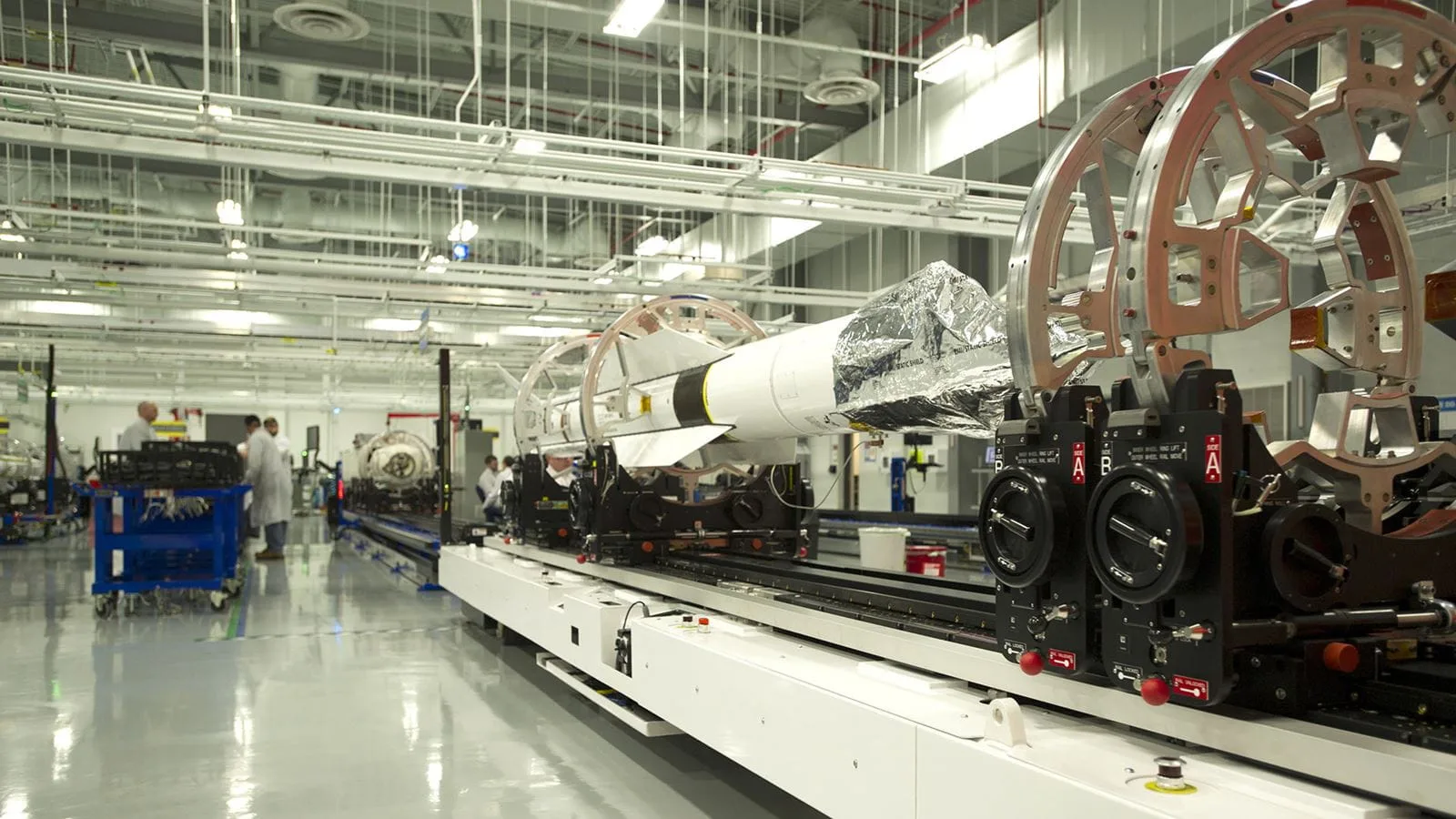
Raytheon has completed a 90-day surge production sprint for the Standard Missile-6 (SM-6), run with U.S. Navy support, that reached the most aggressive output benchmark its team considered and then cleared it by one additional round, the company disclosed. The exercise served as a live stress test of its Huntsville, Alabama, integration line ahead of a multiyear ramp toward more than 500 SM-6 rounds per year.
The sprint sits inside a dense contracting cycle. On February 4, 2026, Raytheon, an RTX business, signed five framework agreements of up to seven years with the Department of War covering Tomahawk, the Advanced Medium-Range Air-to-Air Missile (AMRAAM), the Standard Missile-3 (SM-3) Block IB and Block IIA interceptors, and SM-6, with many production rates set to grow two to four times. On October 1, 2026, the Navy followed with a five-year SM-6 award, plus two option years, valued at up to $24.4 billion. Consumption drives the demand signal: Navy surface combatants fired 80 SM-6 rounds between October 2023 and January 2025 against Houthi attacks on Red Sea shipping, and the Congressional Budget Office estimates that replacing U.S. munitions expended through August 1, 2026, will cost $21.7 billion, including $13.1 billion for missile defense interceptors.
How Raytheon Ran the 90-Day SM-6 Production Sprint
The Navy’s tasking was broad and open-ended: produce as many rounds as possible, as quickly as possible. A cross-functional team drawn from operations, engineering, supply chain and quality first audited three variables: hardware on hand, supplier readiness to accelerate deliveries, and the factory’s realistic throughput. After weighing several benchmarks, the team adopted the highest one and built a 90-day tracker that followed progress down to individual parts.
Paul Borboa, then a senior director for Naval Standard Missile Systems, framed the effort as a national requirement rather than routine acceleration. “This wasn’t a normal hurry-up. It was ‘The country needs hardware,’” he said. Raytheon took short-term measures to pull higher-than-normal volumes of parts into the plant, and Borboa said that once complete kits arrived together, “we finally saw what the line could actually do.”
Throughput did not come at the expense of verification. The full SM-6 acceptance test regimen stayed in force, with quality assurance and test teams adding staff and extending shifts into weekends. Each morning, production and hardware management leads set priorities from a visual management board that coded every major value stream green for on track, yellow for at risk or red for blocked. The Huntsville integration site ran three shifts a day, including weekends, while suppliers joined daily calls and received on-site visits when problems surfaced.
The line completed a run of missiles in the first month and accelerated in the second. On the final day of the window, the counter reached the target and the team built one more round. Raytheon has not disclosed the target quantity, the sprint’s dates or the baseline rate.
Huntsville Expansion and the SM-6 Supplier Base Constraint
The sprint ran through the Redstone Raytheon Missile Integration Facility, the final integration point for the Standard Missile family since 2012. A $115 million, 26,000-square-foot expansion completed on March 13, 2026, raised the site’s integration and delivery capacity by more than 50% and lifted Raytheon’s Alabama workforce above 2,200 employees.
Huntsville is the last step in a distributed chain: under a $335 million contract modification for SM-6 Tactical All-Up Rounds awarded by Naval Sea Systems Command (NAVSEA) on April 24, 2026, Tucson, Arizona, and East Camden, Arkansas, each perform 35% of the work, with deliveries due by May 30, 2030. Raytheon reports investing nearly $900 million over three years to expand capacity at key sites, including Tucson and Huntsville.
The sprint’s central lesson is that floor space was not the binding constraint. Output jumped once complete parts kits were on hand, which places the pacing items upstream, with sub-tier suppliers whose long-lead components gate kit completion. Raytheon’s stated focus on supplier resilience and value-stream evaluation reflects that diagnosis.
Why SM-6 Multi-Mission Reach Drives Navy Magazine Demand
Publicly available specifications indicate the SM-6 Block IA flies on a Mk 72 booster and Mk 104 dual-thrust rocket motor, reaches an estimated 200 nautical miles (370 km) at speeds of about Mach 3.5, and carries a 140-pound (64 kg) blast-fragmentation warhead. It pairs an active radar seeker derived from AMRAAM with semi-active homing, allowing engagements beyond the launching ship’s radar horizon on third-party track data under Naval Integrated Fire Control-Counter Air (NIFC-CA).
That combination explains the demand curve. Raytheon describes SM-6 as the only combat-proven weapon able to perform anti-air warfare, anti-surface warfare and ballistic missile defense. It launches from Mk 41 Vertical Launching System cells, from land-based launchers and, in its air-launched AIM-174B form, from the F/A-18E/F Super Hornet. Every round expended against drones or ballistic missiles draws from the same inventory that covers fleet air defense and maritime strike, so wartime consumption hits three mission sets at once. A Block IB variant with a full 21-inch-diameter rocket motor is in development; its place in the production ramp has not been publicly detailed.
Analysis: The sprint demonstrates surge capacity, not sustained rate. Three shifts, weekend testing and pre-positioned parts for 90 days show what the Huntsville line delivers when every input is present, but that posture consumes workforce margin and inventory buffers that a steady 500-round annual cadence cannot rely on. The $24.4 billion multiyear award matters because it converts a one-off surge into a contractual demand signal that suppliers can finance against. Whether sub-tier suppliers invest at the prime’s pace decides whether the February framework rate becomes sustained output or remains a ceiling reached only in sprints.
Raytheon says it will keep increasing annual SM-6 production through 2030. Quantities and delivery schedules under the October 1 contract have not been released, leaving fiscal 2027 lot sizes and subsequent obligations as the first hard indicators of the real ramp. “The urgency didn’t end,” said Abel Ghanooni, executive director of Naval Standard Missile Systems. “The team kept their foot on the gas.”