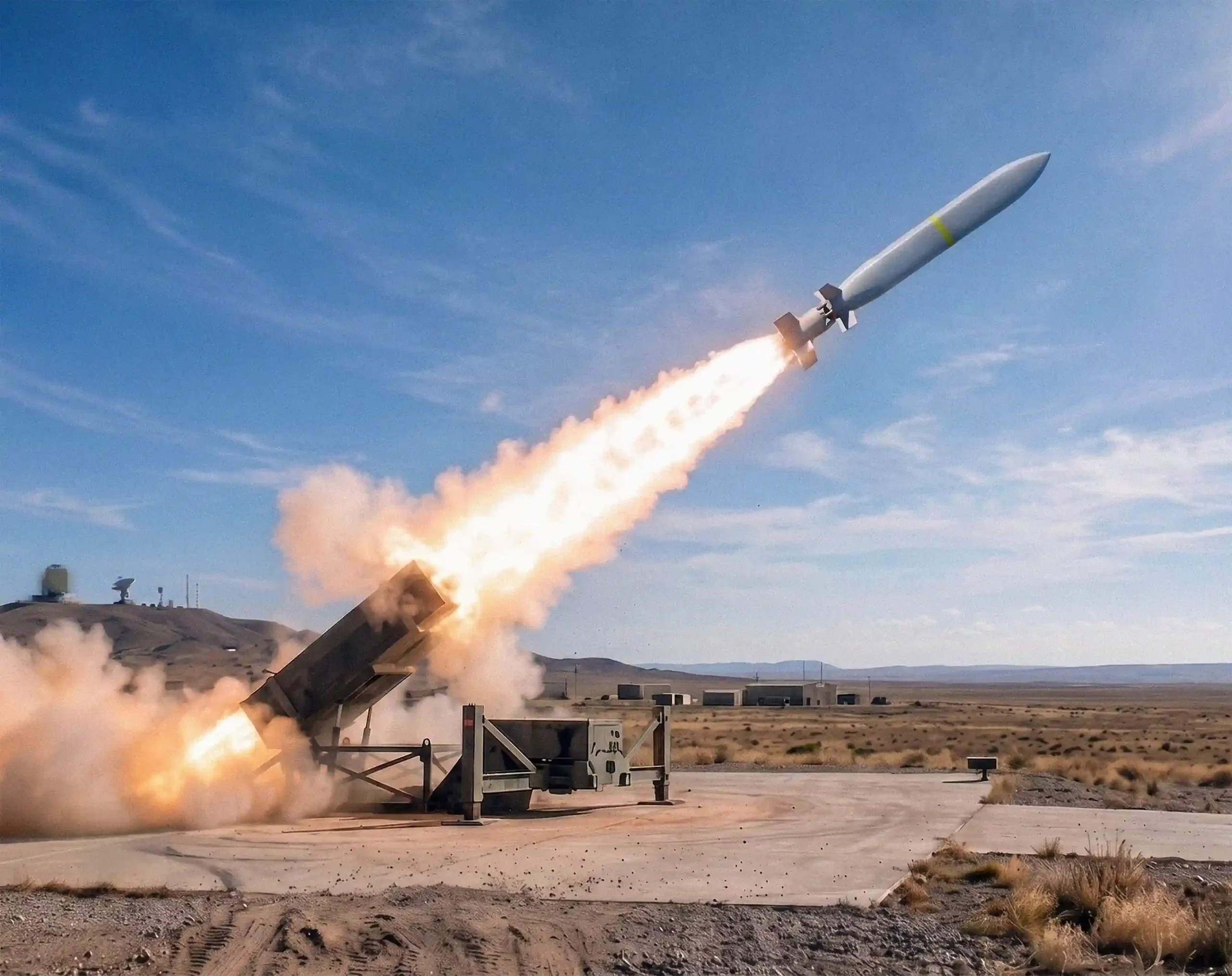
X-Bow Systems will develop and produce the ground-launched solid rocket booster motors for the U.S. Navy’s Coalition Heterogeneous Affordable Offensive Strike (CHAOS) cruise missile after prime contractor CoAspire selected the Albuquerque, New Mexico, propulsion maker, X-Bow announced on October 27, 2026. Naval Air Systems Command (NAVAIR) cleared the announcement for public release. Neither company disclosed the subcontract’s value or a delivery schedule.
The selection fills the propulsion slot on a weapon built primarily for export. CoAspire received a $70 million prototype Other Transaction Agreement (OTA) on July 17, 2026, for Phases 1 and 2 of CHAOS, managed by PMX-201, the Precision Strike Weapons office under the Portfolio Acquisition Executive (PAE) for Munitions. CHAOS descends from the Navy’s 2024 Coalition Affordable Maritime Strike (CAMS) concept, which sought a missile costing about $1.5 million able to hit ships at least 140 nautical miles away with a 500-pound-class warhead. Allies shape requirements through Foreign Military Sales (FMS) cases while the weapon is in development.
How the CHAOS Cruise Missile Pairs RAACM-ER With a Solid Booster
CoAspire’s CHAOS offering is the ground-launched variant of its Rapidly Adaptable Affordable Cruise Missile-Extended Range (RAACM-ER), unveiled in April 2026. The turbojet-powered missile uses a trapezoidal fuselage shaped, per the company, for fuel volume and survivability. Guidance pairs GPS-assisted navigation with a long-wave infrared (LWIR) seeker for terminal homing against fixed coordinates and moving ships. Because the seeker is passive, it emits nothing a target can detect and is immune to radio-frequency jamming and decoys, an edge over active radar seekers in a contested littoral.
An air-launched round borrows speed and altitude from its carrier aircraft; a ground-launched round has neither. The RAACM-ER therefore needs a tail-mounted solid rocket booster to push it clear of the launcher and up to turbojet operating speed before separating. Surface-launched Tomahawk, Harpoon and Naval Strike Missile (NSM) rounds use the same architecture. That stage is X-Bow’s work package. Booster dimensions, propellant, thrust and burn time have not been released.
Range remains unconfirmed; CoAspire declines to publish figures. Manufacturer-attributed claims of up to 1,000 nautical miles have circulated, while CEO Doug Denneny has said the missile roughly doubles the original RAACM’s reach, implying approximately 485 nautical miles based on publicly stated Extended Range Attack Munition (ERAM) requirements. Even that lower estimate would more than triple the CAMS floor and outrange extended-range Harpoon variants, reported at around 150 miles, and current NSM, at least 162 miles.
Publicly available data place current Harpoon variants between $1.4 million and $2.25 million per round and NSM near $2 million; CoAspire has not released a unit price. The Navy also holds a second option: on August 22, 2026, Zone 5 Technologies received a $65 million CHAOS OTA for a maritime-strike variant of its AGM-188 Rusty Dagger, a 500-pound-class, high-subsonic missile.
How X-Bow Is Scaling Solid Rocket Motor Production for Affordable Mass
X-Bow counts CHAOS as its seventh new propulsion program win of 2026, spanning the Navy, Army and Missile Defense Agency (MDA). The company builds motors with a proprietary process it calls Additive Manufacturing of Solid Propellant and says its first major production contract delivered more than 2,100 combat-ready rocket motors and that its revenue and backlog have more than doubled since 2023. “Rebuilding the nation’s arsenal demands a fundamentally different industrial base,” said Jason Hundley, X-Bow’s founder and chief executive.
The CHAOS selection follows an October 7, 2026, prototype agreement worth up to $69.7 million, administered by Army Contracting Command-Rock Island, to develop and qualify a booster for an unnamed next-generation Navy weapon slated for initial fielding in early fiscal 2031. It comprises a $50.4 million, 12-month development phase and a $19.3 million qualification option, and it funds tooling at X-Bow’s Luling, Texas, site for a line rated at up to 500 motors per year. X-Bow announced on October 12, 2026, that Leidos had selected it to supply booster motors for the Army’s Low-Cost Containerized Munition (LCCM), with full-rate production targeted for 2027. The MDA awarded the company an $11 million motor development contract in July, and X-Bow has held Navy development work on the Mk 72 booster and Mk 104 dual-thrust motor for the Standard Missile family since 2024.
That order book sits against a U.S. solid rocket motor base long concentrated in two primary suppliers, Northrop Grumman and L3Harris’ Aerojet Rocketdyne, whose output has paced production of interceptors and strike weapons alike.
Analysis: The booster is a minor line item on paper and a major source of execution risk. In an affordable-mass weapon, the solid rocket motor is often the long-lead component, and legacy capacity is heavily committed to interceptors and rocket artillery. Placing CHAOS propulsion with a non-traditional vendor keeps the coalition weapon out of that queue. It also concentrates exposure: X-Bow is now on contract for boosters on the Army’s LCCM through Leidos, CoAspire’s CHAOS round and a future Navy weapon, all leaning on one company’s ramp. If that ramp slips, several affordable-mass programs slip with it.
The Navy plans to begin producing an expeditionary ground-launched CHAOS configuration in 2028, followed by surface-launched versions and possibly an air-launched variant. The service has requested fiscal 2027 funds to start integrating the weapon on Navy platforms and is building CHAOS to Modular Open Systems Approach and Weapon Open Systems Architecture standards, leaving room for co-assembly in partner nations. Open questions include booster performance, the date of the first boosted flight test and which allies have opened FMS cases.