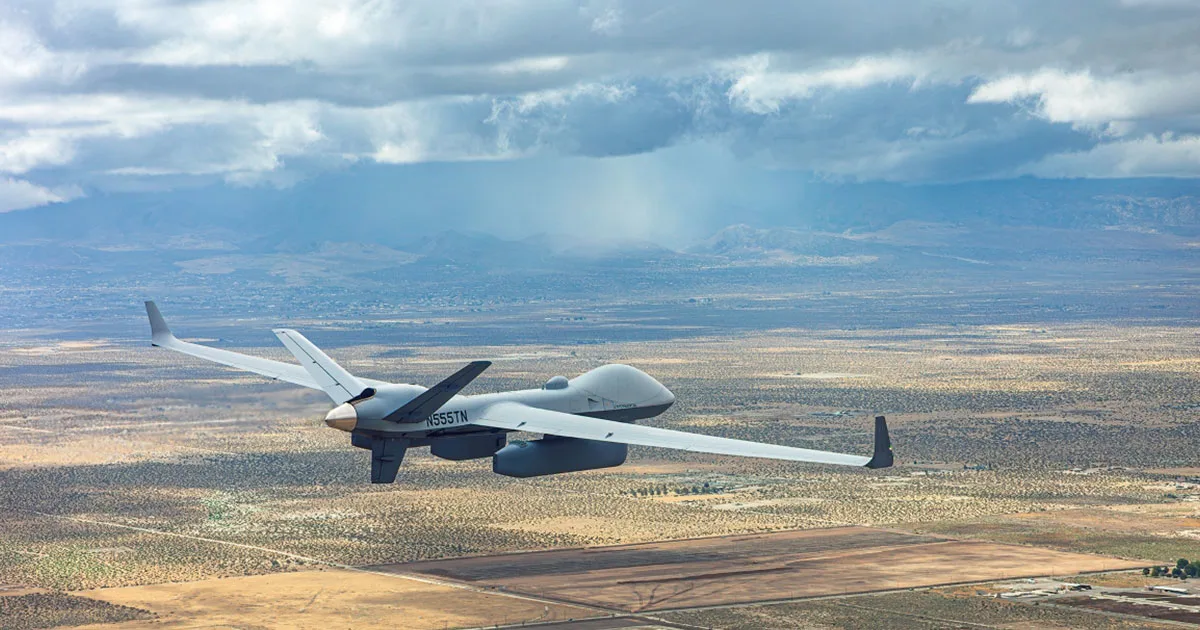
General Atomics Aeronautical Systems, Inc. (GA-ASI) and Saab have completed advanced flight tests of an airborne early warning (AEW) system on an uncrewed MQ-9B, tracking several airborne and maritime targets simultaneously at long range, GA-ASI announced on October 28, 2026. The trials, flown over recent months from GA-ASI’s Desert Horizon flight operations facility in Southern California, paired a company-produced MQ-9B carrying Saab’s LoyalEye radar against multiple instrumented fighter jets flying as adversary red air and several commercial aircraft.
The campaign follows a May 19, 2026, validation sortie from the same site, which GA-ASI described as the first step toward a full-capability demonstration before the end of 2026. The partnership, launched at the Paris Air Show in June 2025, targets a shrinking crewed AEW market: the US Air Force has been drawing down its E-3 Sentry fleet, the Pentagon’s attempt to cancel the E-7 Wedgetail in its fiscal 2026 request was reversed by Congress, and the UK Ministry of Defence has scheduled the Royal Navy’s Merlin-borne Crowsnest system for withdrawal at the end of 2029. GA-ASI says several unnamed customers are discussing uncrewed AEW on MQ-9B.
How the MQ-9B Airborne Early Warning Tests Tracked Fighters and Ships
According to GA-ASI, the LoyalEye radar flew on the MQ-9B in payload pods and held simultaneous tracks on several airborne and surface contacts at long range. Saab, in its own release, said the activity validated the integrated system’s ability to detect, track, and classify airborne targets, with stakeholders observing the capability in real time in a representative operational scenario. Neither company has disclosed detection ranges, the number of sorties flown, track counts, or the radar cross-section of the targets, so the releases establish simultaneous multi-domain tracking and airborne target classification but not the performance envelope behind it.
Imagery from the May first flight shows two underwing pods, likely housing the radar arrays, while earlier company renderings added a third centerline pod, likely for processing equipment. At the June 2025 launch, Naval News reported that the pods use the same core gallium nitride (GaN) active electronically scanned array (AESA) technology as Erieye ER, the S-band radar on Saab’s GlobalEye AEW&C aircraft; Saab has not published a detailed comparison. Neither company has published the pods’ weight, power draw, or cooling arrangements, all of which govern the endurance penalty of the AEW configuration.
GA-ASI lists the intended mission set as early detection and warning, long-range detection and tracking, simultaneous target tracking, and flexible systems integration. Earlier company material named tactical air munitions, guided missiles, drones, and fighter and bomber aircraft as the threat set, with data passed over both line-of-sight and satellite communications (SATCOM) links.
MQ-9B Endurance and Altitude: What the Airframe Brings to AEW
The sensor’s value rests on the platform. GA-ASI’s current MQ-9B SkyGuardian datasheet lists a 79-foot (24-meter) wingspan, a 12,500-pound (5,670-kilogram) maximum takeoff weight, 6,000 pounds (2,722 kilograms) of fuel, 800 pounds (363 kilograms) of internal payload, and 4,000 pounds (1,814 kilograms) of external stores, with endurance of up to 40 hours and a ceiling of 40,000 feet. Those figures describe standard configurations; GA-ASI has not stated endurance with the AEW pods fitted.
Altitude matters as much as persistence. Against a sea-skimming target, geometry alone puts the radar horizon of a sensor at 40,000 feet near 450 kilometers, roughly double that of a helicopter operating around 10,000 feet. That calculation describes line of sight, not LoyalEye’s detection range, but it frames the case GA-ASI makes against rotary-wing AEW at sea.
GA-ASI cites type certification and all-weather performance for the MQ-9B, which its datasheet describes as a type-certifiable design compliant with NATO’s STANAG 4671 airworthiness standard for uncrewed aircraft, easing peacetime surveillance flights over national territory. GA-ASI further argues that an uncrewed sensor lets operators distribute battle management command and control (BMC2) to ground stations, ships, or crewed AEW aircraft, and Saab says LoyalEye on MQ-9B can operate independently or alongside crewed AEW&C platforms.
MQ-9B STOL and the Royal Navy Carrier Strike AEW Requirement
The most visible near-term opportunity sits in the United Kingdom. In April 2025, the Ministry of Defence opened market engagement for a Carrier Strike Airborne Early Warning capability to operate from the Queen Elizabeth-class carriers and provide persistent 24-hour surveillance against anti-ship weapons and strike aircraft. The notice pointed to a possible contract in early 2027 and entry into service from 2030, and UK defence procurement minister Maria Eagle confirmed in May 2025 that the MQ-9 was being considered as a candidate for the requirement.
Because the Queen Elizabeth class lacks catapults and arrestor gear, it cannot operate fixed-wing AEW aircraft such as the E-2D Hawkeye. GA-ASI’s answer is the MQ-9B STOL, a short takeoff and landing configuration still in development that replaces the standard wings and tail through a conversion kit. The company’s Mojave STOL demonstrator flew trials aboard HMS Prince of Wales in 2023. GA-ASI presented the AEW package as compatible with both the standard MQ-9B and the STOL variant.
The installed base offers a second route. MQ-9B variants include the SkyGuardian, the maritime SeaGuardian, and the Royal Air Force’s Protector RG1, and a podded sensor could add AEW to existing fleets without new airframes. No operator has publicly committed to buying LoyalEye.
Analysis: The latest tests answer the threshold question for uncrewed AEW: a podded AESA on a medium-altitude, long-endurance (MALE) airframe can build a multi-target air and surface picture. They do not yet answer the operational ones. A turboprop MALE aircraft cannot outrun a long-range surface-to-air missile or an enemy fighter, so LoyalEye-equipped MQ-9Bs will need to orbit behind a defended screen or accept attrition, a trade made easier by the absence of a crew. The more consequential shift is architectural: by treating the radar as a sensor node feeding BMC2 elsewhere, operators could add persistent early-warning orbits without expanding small, expensive crewed AEW&C fleets. That model suits navies without catapult carriers and air forces facing E-3 retirements, but it depends on resilient SATCOM and datalinks that an adversary will target first.
Neither company has described this campaign as the full-capability demonstration promised after the May flight, although Saab says it validated the system in a representative operational scenario. The next markers are a launch customer, the UK Carrier Strike AEW procurement decision expected from early 2027, and the MQ-9B STOL’s progress toward shipboard trials. Until detection ranges, track capacity, and AEW-configured endurance enter the public record, LoyalEye remains a credible demonstrator rather than a defined operational capability.