Norway’s Kongsberg Gruppen ASA (KONGSBERG) reported on October 29, 2026 a record order backlog of NOK 174.2 billion ($18.1 billion) at the end of the third quarter, after booking NOK 23.3 billion in new orders between July and September. Revenue rose 50% year on year to NOK 11.3 billion, while earnings before interest and taxes (EBIT) climbed 66% to NOK 1.86 billion, lifting the margin to 16.4% from 14.8%.
The quarter is the first full one for a leaner Kongsberg. The group demerged its civil maritime business, listed separately as Kongsberg Maritime ASA on April 23, 2026, leaving three divisions: Defence Systems, Missiles & Aerostructures, and Discovery. The book-to-bill ratio reached 2.06, and the backlog grew by NOK 16.7 billion in three months and by NOK 55.7 billion year on year as European rearmament and US demand for anti-ship and stand-off weapons converge. Headline figures include Kongsberg’s proportional share of 50/50 joint ventures.
Kongsberg Order Backlog Climbs on NASAMS, JSM and NSM Contracts
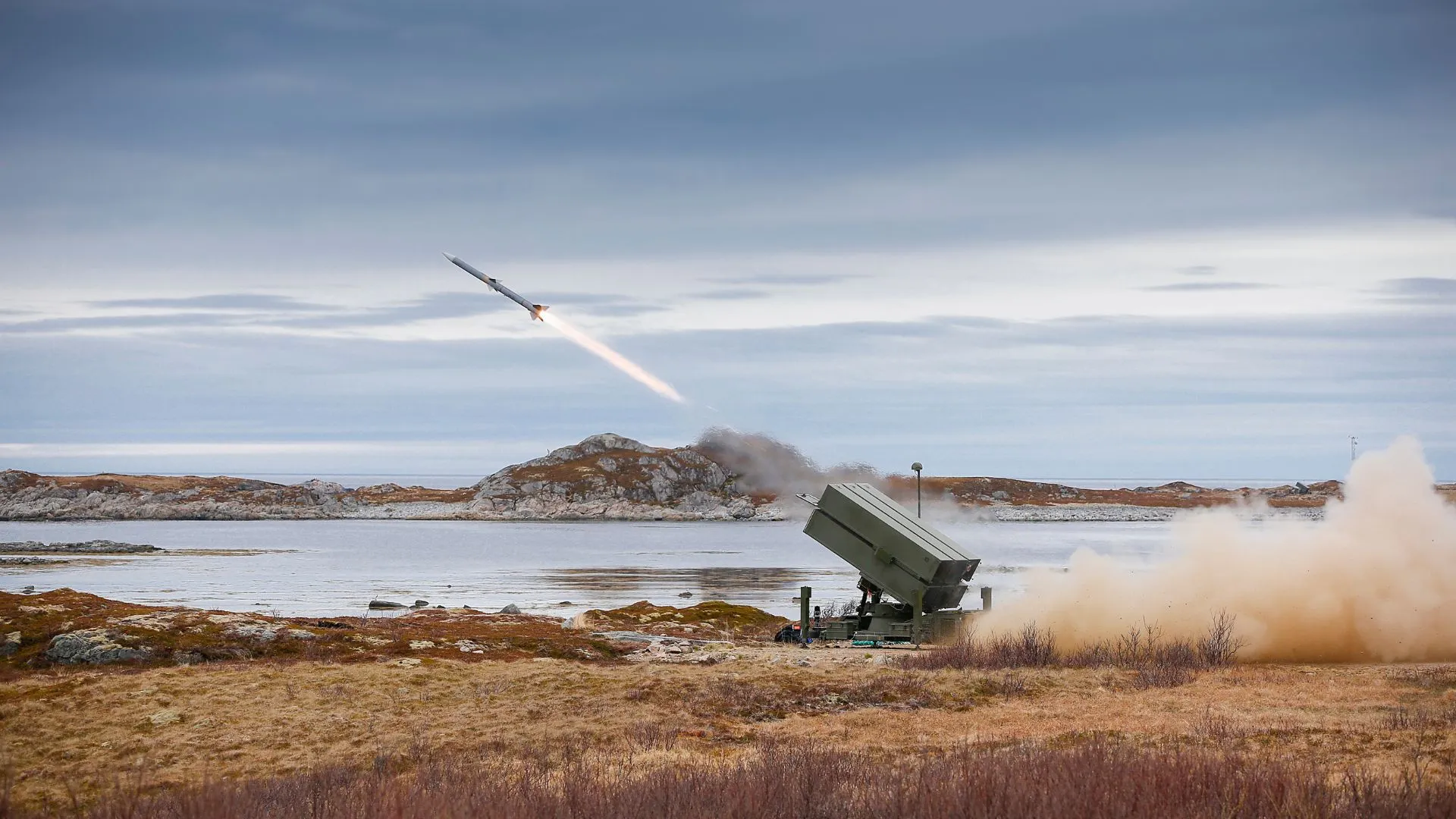
Defence Systems booked NOK 15.2 billion, lifting its backlog to NOK 86.9 billion. The anchor was Belgium’s purchase of the National Advanced Surface-to-Air Missile System (NASAMS), valued at NOK 9.8 billion in the quarterly report and about NOK 10 billion in the September 29 announcement. Kongsberg calls it the largest single NASAMS contract to date. The Dutch procurement authority signed on Belgium’s behalf for 10 systems, with the Belgian Air Force as end user. Belgium becomes the 18th nation to order or deploy NASAMS. The Netherlands separately added a NOK 1.5 billion follow-on order.
Missiles & Aerostructures booked NOK 4.6 billion. In July, the US Air Force ordered additional AGM-184 Joint Strike Missiles (JSM) for its F-35 fleet in a contract worth about $100 million, with deliveries due by mid-2030. In late September, Kongsberg signed a framework agreement with the US Marine Corps covering production and sustainment of Naval Strike Missile (NSM) launcher units, weapon control systems and support equipment, with a potential value of up to $404 million through 2034. Framework value enters the backlog only as individual call-offs arrive.
Discovery booked NOK 3.4 billion, driven mainly by HUGIN autonomous underwater vehicle (AUV) orders for defense customers, alongside a $54 million US government contract for a portfolio of AUV solutions. On October 22, after quarter-end, Denmark became the seventh nation to select the JSM; contract scope and value remain under negotiation.
How NSM, JSM and PROTECTOR RS4 Translate Into Fielded Capability
The NSM framework ties directly to the Marine Corps’ Navy/Marine Expeditionary Ship Interdiction System (NMESIS), the service’s top modernization priority. NMESIS mounts two NSMs on a remotely operated launcher built on the Joint Light Tactical Vehicle, giving Marine Littoral Regiments a mobile, ground-based anti-ship capability for dispersed operations along coastlines and island chains. Work under the agreement will be split 85% in Norway and 15% at the company’s Johnstown, Pennsylvania, site.
The JSM addresses a different gap. Sized for the F-35A’s internal weapons bay, the roughly 4-meter, 416-kilogram missile preserves the aircraft’s low-observable profile on stand-off strike missions. Publicly available specifications indicate a range exceeding 350 kilometers, with inertial and terrain-reference navigation, an imaging infrared seeker and a two-way datalink. The JSM customer base now spans Australia, Canada, Germany, Japan, Norway, the United States and, pending contract, Denmark.
On land, a NOK 1.1 billion order from General Dynamics Land Systems-Canada covers PROTECTOR RS4 remote weapon stations for the Canadian Army’s Armoured Combat Support Vehicle (ACSV). The RS4 mounts a heavy machine gun or automatic grenade launcher, with options for a coaxial weapon or missile, and uses a stabilized Detached Line of Sight architecture for accurate fire on the move. Kongsberg treats weapon stations as a core building block of its counter-drone offering.
Zone 5, Sonatech and New Factories Reshape the Industrial Base
Missiles & Aerostructures posted the sharpest growth, with revenue up 87% to NOK 4.0 billion on missile production and the first full quarter of Zone 5 Technologies, whose 90% acquisition closed on June 9, 2026. The cost shows in margins: divisional EBIT margin fell to 11.6% from 16.5%, which Kongsberg attributes primarily to Zone 5’s production ramp-up, including retention arrangements booked as personnel expenses. Zone 5 also won a $65 million US Navy agreement for a maritime strike variant of the AGM-188 Rusty Dagger under the Coalition Heterogeneous Affordable Offensive Strike (CHAOS) program. Defence Systems EBIT, by contrast, rose 103% to NOK 1.1 billion.
Underwater, Kongsberg closed the Sonatech acquisition on September 1, 2026, after US regulatory approval. The Santa Barbara acoustics specialist, with $34.4 million in 2025 revenue, has supplied the US Navy for over 50 years. Kongsberg paid NOK 1.25 billion, of which NOK 1.16 billion was booked as goodwill.
Capacity is expanding in parallel. Horten Horizon in Vestfold, Norway, adds 45,000 square meters of offices, laboratories and production space, and Kongsberg is building a plant in Poland to produce and maintain counter-drone systems, alongside new factories in Australia and the US.
Analysis: Kongsberg is converting NATO’s air defense and long-range strike priorities into multi-year revenue, with 63% of its backlog scheduled for delivery in 2028 or later. That depth concentrates execution risk: NOK 74.8 billion of missile backlog rests on a network that must scale high-end JSM and NSM production alongside Zone 5’s low-cost, high-volume munitions. The divisional margin dip shows affordable mass carries a near-term cost, and supply chain resilience, a risk Kongsberg itself flags, will decide whether orders become delivered rounds on schedule.
Kongsberg expects to deliver NOK 12 billion of its backlog in the fourth quarter of 2026, with its investment cycle running through 2028. President and CEO Eirik Lie said the security environment “requires industry to deliver rapidly, reliably and at scale.” Next milestones include the Danish JSM contract, Marine Corps NSM call-offs and the 3SM supersonic missile under development with German industry. The group maintains revenue targets of NOK 100 billion by 2029 and NOK 150 billion by 2033.