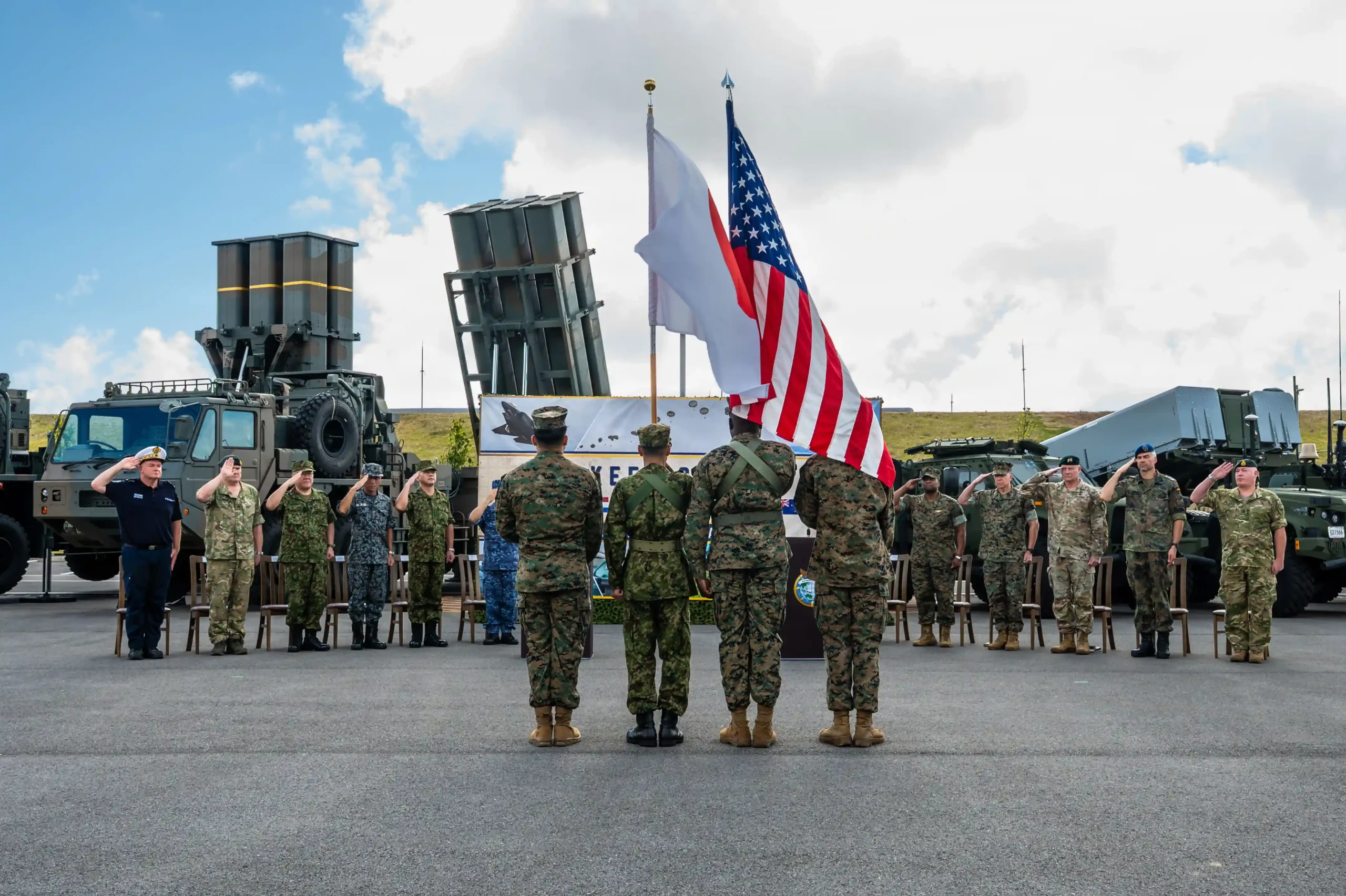
Japan and the United States opened Keen Sword 27 (Keen Sword 2027) with a ceremony on Ishigaki Island, Okinawa Prefecture, on October 19, 2026, launching the 18th field training iteration of their biennial bilateral exercise. Approximately 45,000 Japan Self-Defense Force (JSDF) personnel and 11,000 U.S. service members are training through October 29 alongside forces from Australia, Canada, France, Germany, the Netherlands, New Zealand and the Philippines, while the Republic of Korea and the United Kingdom attend as observers.
Japan’s Joint Staff traces the bilateral exercise series to fiscal year 1985, alternating field training years with command post exercises. The 2026 edition departs from its predecessors in two ways. France, Germany, the Netherlands, New Zealand and the Philippines, all observers in 2024, now train as full participants. And the exercise concentrates forces in the Sakishima Islands, Japan’s southwestern frontier east of Taiwan, where Tokyo has spent a decade building garrisons, radar sites and missile units.
Keen Sword 27 Scale, Command Structure and Training Events
According to Japan’s Joint Staff, the JSDF contribution alone comprises approximately 45,000 personnel, 6,100 vehicles, 40 vessels and 260 aircraft. Keen Sword 25 in 2024 reportedly involved roughly 33,000 Japanese personnel, 30 ships and 250 aircraft, so personnel rose by about a third while aircraft numbers held nearly flat.
Two four-star officers control the exercise: Adm. Tateki Tawara of the Japan Maritime Self-Defense Force (JMSDF), commander of the JSDF Joint Operations Command (JJOC), and Adm. Stephen Koehler, commander of U.S. Pacific Fleet. JJOC, the permanent joint headquarters Japan stood up in March 2025, gives Tokyo a single operational counterpart for U.S. commanders. Participating JSDF formations include the Ground Component Command, the Self Defense Fleet, Air Defense Command, the JSDF Cyber Defense Command and the JSDF Maritime Transport Group. The U.S. side draws on U.S. Pacific Command (USPACOM), U.S. Army Pacific, U.S. Pacific Fleet, Pacific Air Forces, U.S. Marine Forces Pacific and U.S. Forces Japan.
The Joint Staff lists 15 major training events, including integrated air and missile defense, bilateral joint offensive anti-ship operations, amphibious operations, cyber attack response, information warfare, space domain awareness, joint electromagnetic warfare, joint logistics, agile combat employment and distributed operations, and critical infrastructure protection. Activity extends to civilian airports, ports and private land, reflecting how heavily any Sakishima contingency would depend on dual-use infrastructure.
NMESIS and MADIS Deploy to Yonaguni for the First Time
The most consequential activity unfolds on Yonaguni, Japan’s westernmost island, roughly 110 km from Taiwan. The U.S. Marine Corps is deploying the Navy-Marine Expeditionary Ship Interdiction System (NMESIS), operated by the 12th Marine Littoral Regiment, to the island for the first time, together with the Marine Air Defense Integrated System (MADIS). According to Japan’s Okinawa Defense Bureau, U.S. and Japanese forces will establish a joint coordination center at the Japan Ground Self-Defense Force (JGSDF) garrison there. NMESIS also returns to Ishigaki, and Marine High Mobility Artillery Rocket System (HIMARS) launchers are operating from Camp Ishigaki, giving the allies several dispersed firing positions rather than a single concentration.
Publicly available specifications indicate that NMESIS carries two Naval Strike Missiles (NSM) on an unmanned launcher built on the Joint Light Tactical Vehicle (JLTV) chassis, known as the Remotely Operated Ground Unit for Expeditionary Fires (ROGUE-Fires). The NSM is a subsonic, sea-skimming anti-ship missile with an imaging infrared seeker and a reported range of about 185 km (115 miles). From Yonaguni, that envelope covers the waters off Taiwan’s east coast and a key passage between the East China Sea and the Philippine Sea. MADIS, also JLTV-mounted, combines Stinger missiles, a 30 mm cannon, radar and electronic warfare equipment to defeat drones, helicopters and low-flying aircraft, giving a dispersed missile site organic short-range protection.
The Marine systems arrive on islands Japan has already armed. Camp Ishigaki, opened in 2023, hosts JGSDF Type 12 surface-to-ship missiles and Type 03 Chu-SAM medium-range surface-to-air missiles. Yonaguni has hosted a JGSDF coastal surveillance unit since 2016 and an electronic warfare unit since 2024, and Defense Minister Shinjiro Koizumi announced in November 2025 that a Type 03 battery would follow.
Nine Nations Train as Commanders Stress Deterrence Through Readiness
“Keen Sword 27 is an exercise dedicated to preserving peace and stability,” Tawara said at the opening ceremony, adding that Japan, the United States and partner countries must “leverage each other’s strengths and transform our militaries into the capabilities and readiness to be able to act precisely in times of need.”
U.S. Marine Corps Lt. Gen. George Rowell, deputy commander of USPACOM and the ceremony’s keynote speaker, said participants would “test our concepts, refine our command and control, and validate our ability to deter aggression and prevail in crisis or conflict.” He added: “Deterrence in the 21st Century is not built on words or declarations, it is built through demonstrated competence, cohesion and warfighting readiness.”
Australia and the Philippines field forces that train regularly with Marine littoral units, while the French, German and Dutch contingents gain direct exposure to Japanese joint command arrangements. Partner force levels and committed platforms remain unpublished.
Analysis: Keen Sword 27 rehearses a specific theory of defense rather than generic readiness. Pairing NMESIS, MADIS and HIMARS with the Type 12 and Type 03 units already stationed in the Sakishima Islands, linked through a forward joint coordination center on Yonaguni, tests whether Japanese and U.S. ground-based fires can operate as one dispersed sea-denial and air defense network inside the First Island Chain. Expanding the event to nine participating nations signals that Tokyo and Washington want partner militaries familiar with that architecture before a crisis, not during one. The unresolved variable is sustainment: how long dispersed island units can be resupplied and protected under fire, which explains the weight given to joint logistics and critical infrastructure protection.
The exercise concludes October 29. Indicators to watch include how far NMESIS and HIMARS units maneuver between island firing positions, whether a Typhon launcher reportedly moving to Okinawa plays any role, and how the People’s Liberation Army responds around the Sakishima chain. The next Keen Sword field training exercise is expected in 2028.