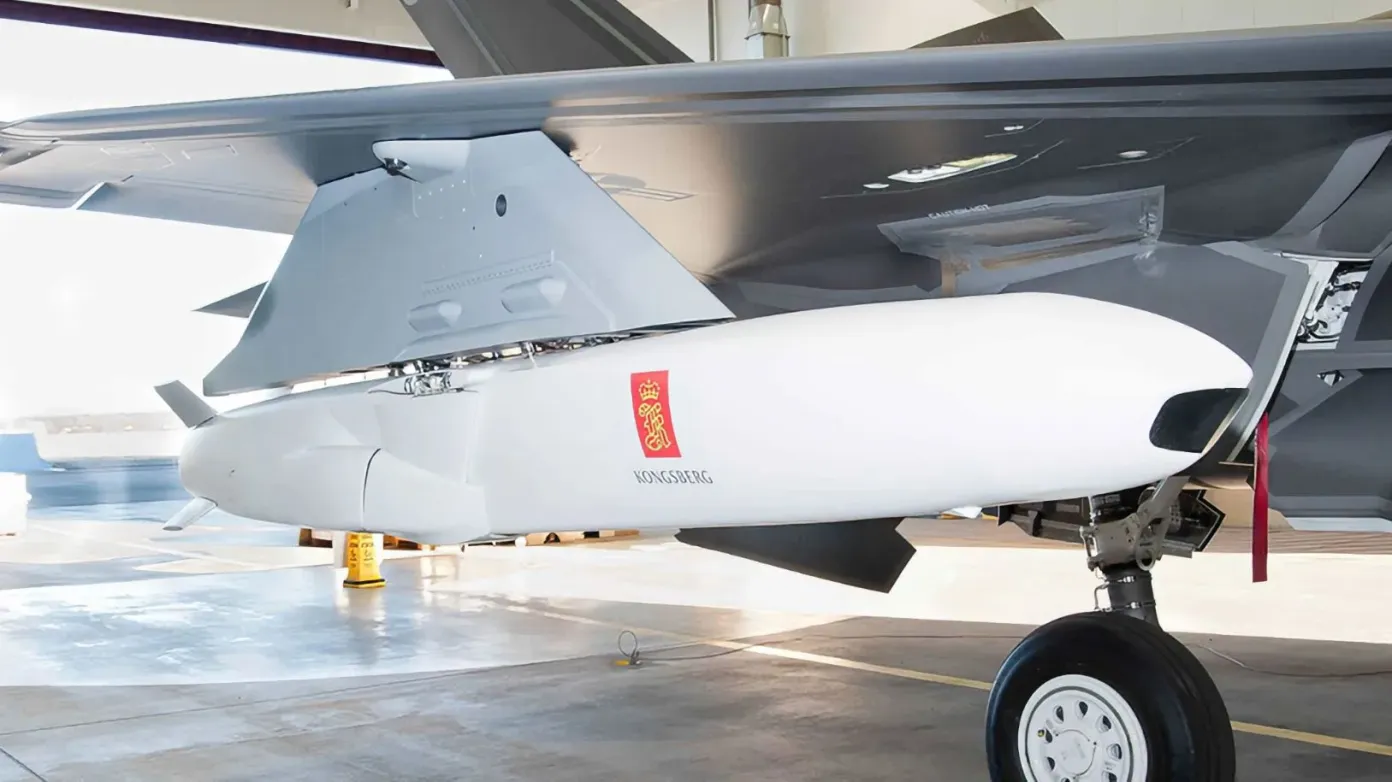
Denmark has announced its intention to acquire Kongsberg’s Joint Strike Missile (JSM) for its F-35A Lightning II fleet, becoming the seventh nation to select the stealthy air-launched cruise missile. In an October 22, 2026, statement, the Norwegian manufacturer said contract scope and value will be set in negotiations and disclosed once signed.
The selection came as the Danish Ministry of Defence confirmed two long-range precision weapon purchases: the air-launched JSM and the ground-launched Anthem cruise missile from U.S. company Covenant. The ministry said both buys follow a recommendation from the Chief of Defence and will strengthen Danish and NATO deterrence, but it released no quantities, costs, or delivery dates. Defense Minister Jeppe Bruus called the acquisitions a significant step in making Denmark better able to defend itself and said the weapons would allow strikes behind enemy lines if the country is attacked. The government committed to buying long-range offensive weapons in September 2025, citing Russia’s military threat to Europe.
Joint Strike Missile Design, Guidance, and Internal F-35A Carriage
Designated AGM-184 in U.S. service, the JSM is an air-launched derivative of Kongsberg’s Naval Strike Missile (NSM), teamed with RTX’s Raytheon and optimized for strikes against defended maritime and land targets. Its defining attribute is fit. Publicly available specifications put the missile at about 4 meters long and 416 kilograms, making it the only weapon in its class shaped for the F-35A’s internal bays, which hold two rounds. Internal carriage keeps the jet’s radar signature intact up to the release point; the F-35 can also carry the JSM externally, at the cost of that advantage.
The missile carries a 120-kilogram blast-fragmentation warhead with an intelligent fuze that selects the impact point. Published figures put its range at more than 350 kilometers. Open-source estimates reach 555 kilometers on a high-altitude profile and fall to roughly 185 kilometers on a fully sea-skimming flight. The missile cruises at high subsonic speed and is built to maneuver hard in the terminal phase.
Mid-course navigation combines an inertial system with GPS and terrain-reference navigation, letting the JSM hold its track when satellite signals are jammed. Terminal guidance relies on a passive imaging infrared seeker with automatic target recognition. Because the seeker emits nothing, a target’s electronic support measures have no signal to detect and radio-frequency jamming has nothing to defeat. A two-way datalink allows the launching F-35, or a third-party controller, to update targeting after release.
For Denmark, those parameters translate into geography. From launch points over the Baltic Sea, a weapon in this range class can hold naval and air defense targets around Kaliningrad at risk without the F-35A penetrating the densest layers of an integrated air defense network.
How the JSM Fits Denmark’s Expanding F-35A and Missile Inventory
Denmark retired its F-16 fleet in January 2026, leaving the F-35A as its sole fighter. Copenhagen committed to 27 aircraft in 2016 and announced 16 more in October 2025, for a planned force of 43 jets. The JSM runs alongside a parallel U.S. track: in June 2026, the State Department approved a potential $842 million Foreign Military Sale of 200 Lockheed Martin JASSM-ER missiles for Danish F-35s, for which no contract has been announced. Either weapon would give the Royal Danish Air Force its first air-launched long-range strike capability.
The decision also extends a procurement pattern built on Kongsberg’s missile family. In March 2025, Denmark signed a NOK 2.1 billion contract for NSMs to replace Harpoon on its Iver Huitfeldt-class frigates, followed in December 2025 by an NSM Coastal Defence System valued at more than €100 million. On October 19, 2026, Kongsberg announced a further NOK 400 million order for additional NSMs, negotiated by the Norwegian Defence Materiel Agency on Denmark’s behalf. Germany used the same government-to-government route for its NOK 6.5 billion JSM contract in June 2025 and a NOK 3.5 billion follow-on in May 2026. Danish officials have not said whether the JSM purchase will follow that path.
Commonality with Norway carries operational weight. Norway received its first JSMs in April 2025 and has been developing tactics for the weapon on its own F-35As, experience Danish crews can draw on for combined training and shared defense planning. Industrial ties are tightening in parallel: Danish firm Terma and Kongsberg Aviation Maintenance Services launched Defence Aviation Services, a joint military aviation maintenance venture, on October 21, 2026.
Norway, Japan, Australia, the U.S. Air Force, Germany, and Canada have all selected the JSM, with Canada’s NOK 4.7 billion order confirmed in July 2026. Belgium, absent from Kongsberg’s count, received U.S. approval in May 2026 for a Foreign Military Sale of AGM-184 missiles valued at up to $236 million.
Analysis: The JSM lets Danish F-35As deliver conventional deep strike without surrendering the low observability that underpins their survivability, while the ground-launched Anthem spreads long-range fires across a second launch domain an adversary must track separately. Collectively, with Norway, Germany, Belgium, and Denmark converging on the same internally carried missile for the same aircraft, northern Europe’s F-35 operators are assembling a common stand-off arsenal that simplifies stockpiling, sustainment, and allied targeting in a Baltic contingency. The binding constraint is software: operational use depends on the F-35’s Block 4 modernization, which Pentagon testers report has been slowed by Technology Refresh 3 software instability.
The next milestone is a signed contract, which Kongsberg has committed to announce and which should reveal the order’s size and value. Open questions include the delivery schedule, whether Norway’s procurement agency will negotiate on Denmark’s behalf, and whether Kongsberg’s new plants in Australia and the United States, due at full capacity by 2028, can absorb the growing European order book.