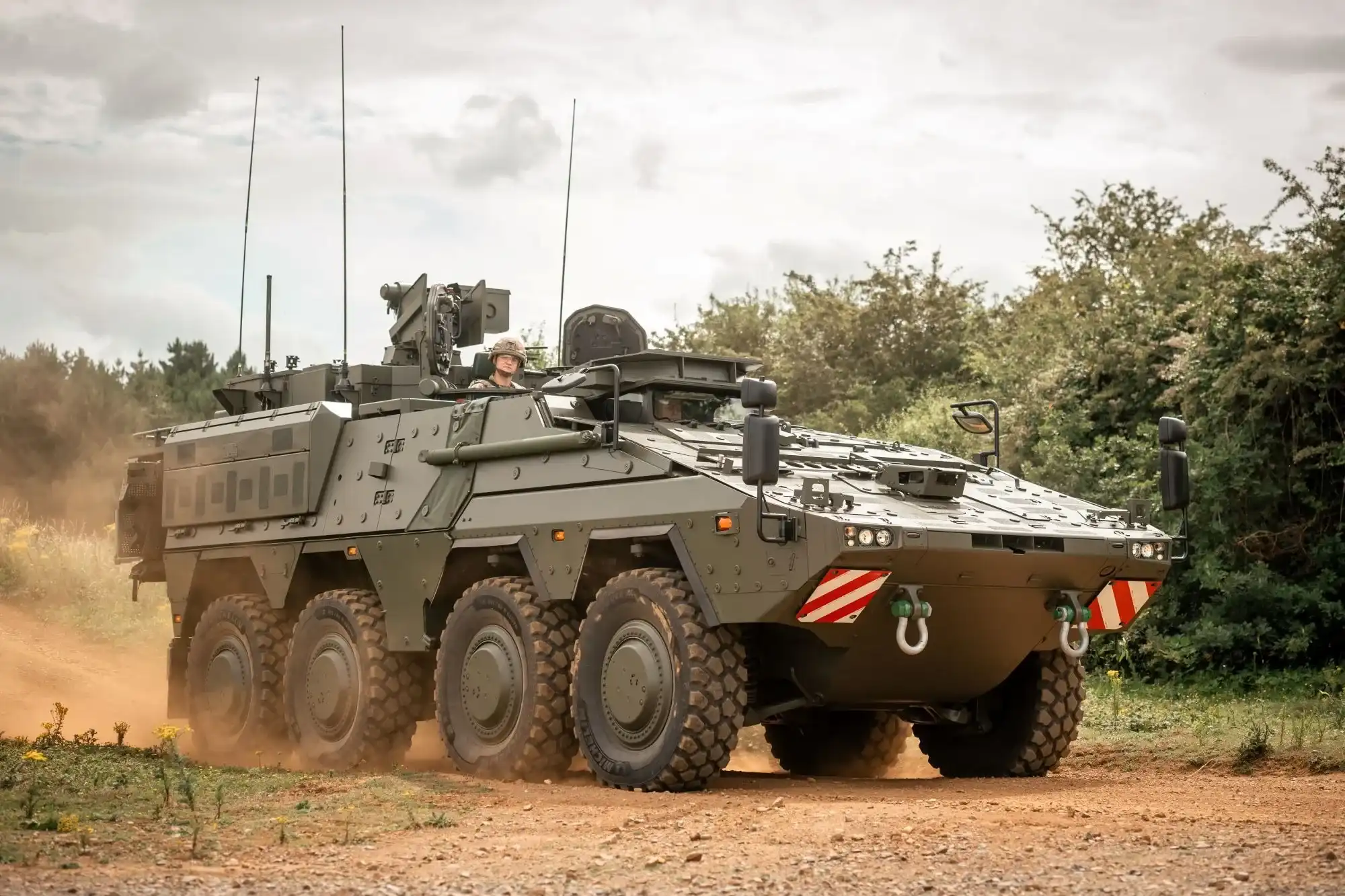
The British Army will procure a Heavy Wheeled Recovery Vehicle to recover Boxer armored vehicles on the battlefield, after the Ministry of Defence (MoD) dropped plans for a dedicated Boxer repair and recovery variant, Minister for Defence Readiness and Industry Luke Pollard told Parliament in a written answer this week. Pollard also confirmed that the UK order for 623 Boxer Mechanised Infantry Vehicles (MIV) is unchanged, alongside 72 Remote Controlled Howitzer 155 (RCH 155) artillery vehicles.
The answer responded to Conservative MP Ben Obese-Jecty, member for Huntingdon, who asked how Boxers would be repaired in the field with no repair and recovery version on order. Earlier in October, Pollard confirmed that the Armoured Mortar, Repair and Recovery, and Mounted Close Combat Overwatch capabilities of the MIV program were no longer being pursued, citing reprioritization within the Military Strategic Headquarters during work on the Defence Investment Plan. Ministers have also confirmed that a planned third Boxer batch will not proceed through the program. The cuts reverse part of a draft Boxer pipeline the Army presented in January 2024, in which the Repair and Recovery variant was the first follow-on priority, with initial operating capability possible by 2029.
Why the MoD Rejected a Dedicated Boxer Recovery Variant
“The Army will absolutely have the ability to recover and support Boxer vehicles on the battlefield, such as through the Boxer support variants and the wider force, including the Heavy Wheeled Recovery Vehicle which we will procure,” Pollard said. He did not identify the platform, the quantity required or a timeline, nor define which Boxer support variants he meant.
In an answer the previous day, Pollard said the MoD had assessed the Armoured Recovery Module developed by Germany’s Flensburger Fahrzeugbau Gesellschaft (FFG) and rejected it, concluding that a generic heavy wheeled recovery vehicle would offer greater utility and affordability across the force. Publicly available specifications indicate the FFG module, a private venture launched in 2017 and unveiled at DSEI 2019, weighs about 13 tonnes, is built from welded armored steel and attaches to the Boxer drive module through standard interfaces. It carries a capstan winch with a 60-meter Kevlar cable rated at 200 kN, a crane capable of powerpack and mission module changes, hydraulic side outriggers and a 2.95-meter rear spade. A lithium-ion battery pack allows three to four hours of operation with the Boxer engine off.
The case for an armored recovery variant rests on protection and pace: a vehicle on the Boxer hull moves with the formation, shares its spare parts and keeps the crew under the same armor as the vehicle being recovered. A wheeled recovery truck can serve every vehicle type in the Army but generally carries far less protection. Until the new vehicle arrives, Boxers recover one another peer to peer, backed by the Army’s MAN Support Vehicle (Recovery) 8×8 trucks, fitted with an EKA recovery system, and the tracked Challenger Armoured Repair and Recovery Vehicle.
Boxer Order Holds at 623 as RCH 155 Artillery Moves Forward
“There has been no change to our order of 623 Boxer vehicles, of which over 500 are being built here in the UK, and we are buying 72 Boxer RCH Artillery vehicles,” Pollard said, adding that the work backs more than 1,000 British jobs.
The UK placed its initial £2.8 billion contract for 523 Boxers in November 2019 and exercised an option for 100 more in April 2022. All 623 MIV vehicles are being delivered to a common build standard at Rheinmetall BAE Systems Land in Telford and KNDS UK in Stockport, and Team Boxer UK delivered the 100th MIV on June 25, 2026.
The 72 RCH 155s sit outside that total. The Organisation for Joint Armament Co-operation (OCCAR) signed the contract with ARTEC, the KNDS and Rheinmetall joint venture, on April 30, 2026, and the MoD valued it at nearly £1 billion with initial training and support. The system pairs an uncrewed Artillery Gun Module derived from the PzH 2000, operated by a crew of two, with the new Boxer B0 drive module built in Stockport, while Rheinmetall produces the 155 mm L/52 weapon in Telford. The MoD cites eight rounds per minute and ranges up to 70 km depending on ammunition. First deliveries are expected in 2028, taking over the close support role from the interim Swedish-built Archer guns acquired after the AS90 fleet was donated to Ukraine in 2023.
Analysis: The recovery decision fits a broader pattern: the UK is protecting Boxer hull numbers while stripping out the specialist mission modules that justified the platform’s modular premium. A generic wheeled recovery vehicle is cheaper and can serve trucks and Boxers alike, but it moves recovery crews out from under armor just as drones have turned the rear area into contested ground. The trade is defensible if doctrine favors dragging disabled vehicles rearward rather than repairing them forward, yet Australia selected a dedicated Boxer recovery variant on the same hull, and the British Army has published no requirement explaining how a truck-based solution closes the protection gap.
The next markers are a published Heavy Wheeled Recovery Vehicle requirement, its funding line within the Defence Investment Plan, and whether the Army turns to an existing commercial design. On artillery, Rheinmetall has scheduled L/52 gun deliveries between May 2028 and June 2031, setting the pace for an initial deployable RCH 155 capability before the end of the decade.