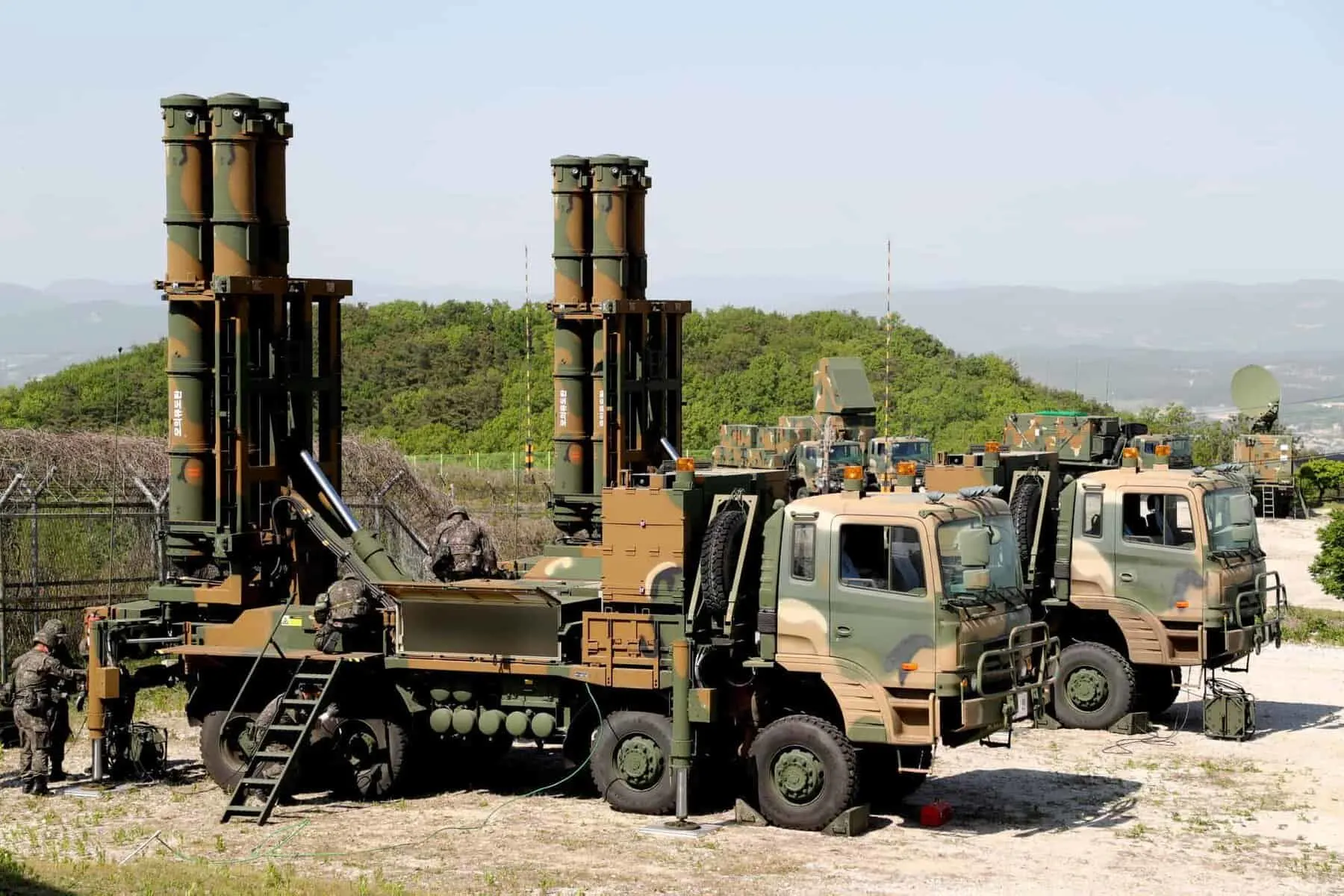
South Korea will not send forces into the U.S.-led war against Iran, but South Korean weapons are already part of it. The Cheongung-II medium-range air defense system fielded by the United Arab Emirates (UAE) recorded a 96 percent interception rate against Iranian attacks in the war’s first days, according to a South Korean lawmaker, as South Korea arms exports push deeper into Gulf and Iraqi markets.
Washington has noticed the gap. In mid-August 2026, President Donald Trump said President Lee Jae Myung had refused his request to “give us a little hand” against Tehran, citing 39,000 U.S. soldiers on the peninsula, above the roughly 28,500 that U.S. Forces Korea has long maintained. On September 18, 2026, Lee ruled out deploying troops or military assets in any way that involves Seoul in the war, while his government reviews a wider role for the Cheonghae Unit, the Navy’s anti-piracy destroyer contingent, reportedly including an extension of its operating area to the Gulf of Oman, before its authorization expires on December 31.
How Cheongung-II Combat Use Is Driving South Korea Arms Exports
The Cheongung-II, also designated KM-SAM Block II or M-SAM II, gave South Korean industry its first foreign combat record. Only two Emirati batteries were operational when Iranian salvos began, layered with U.S.-built Patriot and Terminal High Altitude Area Defense (THAAD) systems. Rep. Yu Yong-weon of the National Assembly’s National Defense Committee, citing unnamed sources familiar with UAE operations, said on March 5, 2026, that about 60 interceptors had been launched; at two rounds per target, that implies roughly 30 targets engaged. The Ministry of National Defense declined to corroborate the figures. In early March 2026, a UAE Air Force C-17 airlifted more than 30 interceptors from Daegu Air Base after Seoul approved an emergency request to accelerate deliveries.
Publicly available specifications indicate an intercept range of about 40 km and a ceiling of about 15 km, using a hit-to-kill interceptor rated against aircraft and ballistic missiles. A typical battery pairs a Hanwha Systems multifunction active electronically scanned array (AESA) radar and an engagement control post with four Hanwha Aerospace launchers, each holding eight vertically launched canisters supplied by prime contractor LIG Nex1. At home, the system forms the middle layer of Korea Air and Missile Defense (KAMD) alongside Patriot and THAAD. A reported unit cost of about $1 million per interceptor, roughly a quarter of the $4 million price of a Patriot PAC-3, matters operationally: it lets Gulf states absorbing massed Iranian salvos preserve scarce PAC-3 stocks for the hardest targets.
The UAE signed for the system in January 2022 in a $3.5 billion deal, then South Korea’s largest single arms export. Saudi Arabia followed with a $3.2 billion contract for 10 batteries, signed in November 2023 and disclosed in February 2024. Iraq contracted eight batteries in September 2024 for about $2.8 billion, adding an anti-ballistic layer that its existing air defenses lack.
K9, K2, and KF-21: How Technology Transfer Wins Regional Buyers
Seoul’s second lever is industrial participation. Egypt’s $1.7 billion contract for the K9A1EGY self-propelled howitzer, signed in February 2022, includes technology transfer and local assembly; in December 2025, Egypt’s State Information Service said component manufacturing had entered its final phase. The K9 Thunder’s 155mm/52-caliber gun reaches about 40 km with extended-range rounds, according to publicly available specifications, and Türkiye has used its licensed T-155 Fırtına variant in Syria and Iraq.
Armor follows the same model. Türkiye’s Altay main battle tank, developed with Hyundai Rotem technology transfer based on the K2 Black Panther, entered service on October 28, 2025, initially running on a South Korean power pack after German export restrictions blocked the planned engine and transmission. Hyundai Rotem is now offering the K2ME, a desert variant in development since 2024 and rolled out at its Changwon plant on March 26, 2026. Derived from the K2, which pairs an autoloaded 120mm/55-caliber smoothbore gun with a three-person crew, it adds a domestically produced power pack with an upgraded radiator and cooling housing, plus auxiliary turret and hydraulic oil cooling for operations at up to 50°C (122°F). Raising the K2’s localization rate beyond its current level of about 90 percent reduces exposure to third-country export vetoes. Seoul reportedly views Saudi Arabia and Iraq as the likeliest buyers. Iraq has reportedly weighed up to 250 K2 tanks for about $6.5 billion since autumn 2025, an unconfirmed deal that would exceed the 140 M1A1 Abrams and 73 T-90S tanks it bought from Washington and Moscow combined.
Combat aviation is the longer bet. Iraq received 24 T-50IQ jets, derived from the T-50 Golden Eagle supersonic trainer, in the late 2010s, and reports since 2023 have pointed to Emirati interest in a KF-21 Boramae role. The first series-production KF-21 Block I, a 4.5-generation fighter powered by two General Electric F414 engines, reached the Republic of Korea Air Force (ROKAF) on September 22, 2026, with initial operational capability planned for the second half of 2027.
Analysis: Seoul is converting battlefield neutrality into commercial leverage. Staying out of combat limits political exposure at home, where 55 percent of respondents opposed a Hormuz deployment in a September Gallup Korea poll, while a combat-validated interceptor, local production, and fast deliveries keep South Korean systems on U.S. partners’ shortlists. Washington gains indirectly, as each battery thickens partner networks built around Patriot and THAAD. The contrast with North Korea is sharp: Pyongyang’s missile cooperation helped build the Iranian arsenal that South Korean interceptors now engage. The constraint is inventory, because emergency transfers draw on the same KAMD stocks Seoul needs against North Korea.
The government is considering an extension motion for the Cheonghae Unit before its mandate expires on December 31, and any Gulf of Oman expansion will be read closely in Washington and Tehran. Saudi and Iraqi Cheongung-II deliveries, a first K2ME export contract, and any Iraqi decision on the 250-tank requirement will show whether the Gulf order book keeps growing. How Washington treats a non-combatant ally arming its regional partners remains the main political unknown.