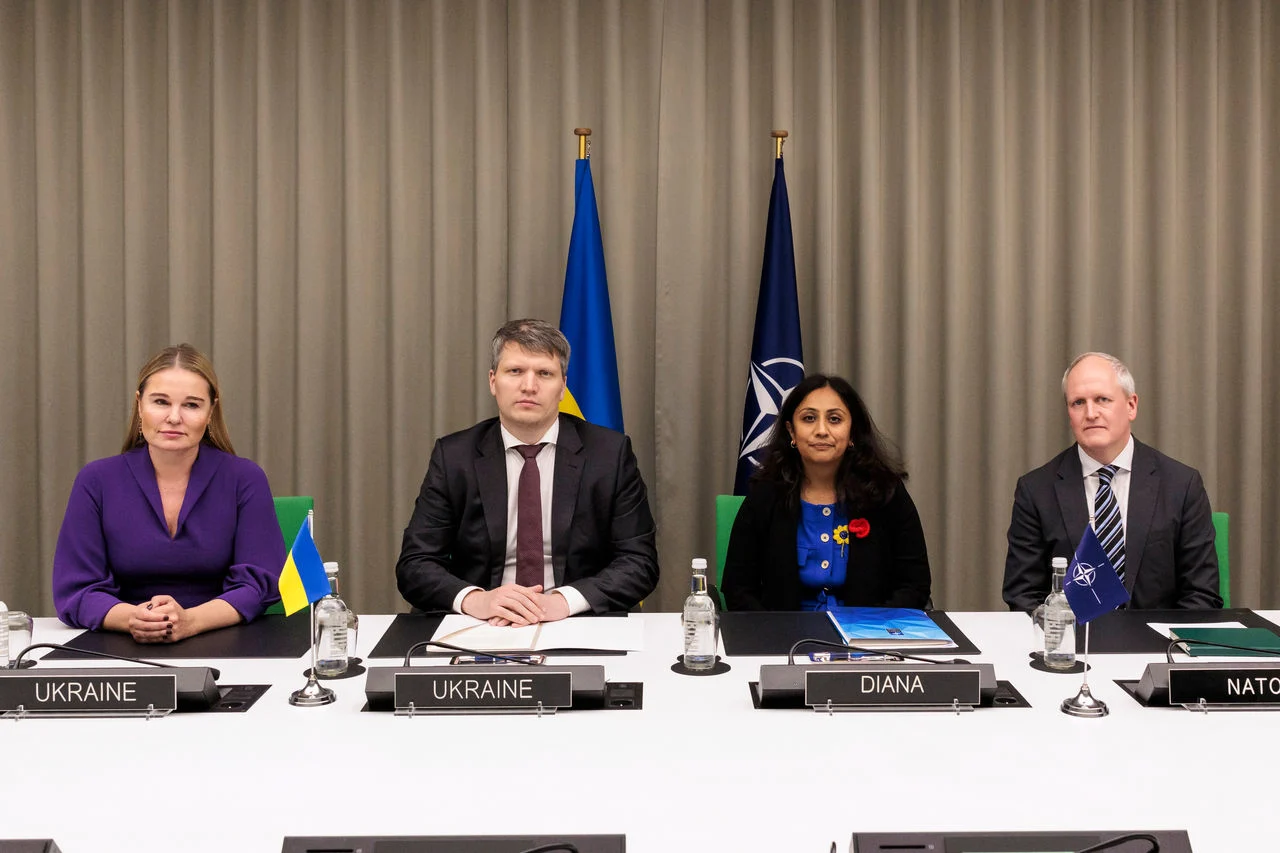
NATO’s Defence Innovation Accelerator for the North Atlantic (DIANA) and Ukraine signed a memorandum of understanding (MoU) at NATO Headquarters in Brussels on October 29, 2026, creating a framework to develop and test defense technologies jointly and to connect Ukraine’s wartime innovation base with the Alliance’s accelerator network. According to NATO, it is the first agreement of its kind between DIANA and a NATO partner nation.
The signing comes as Allies try to replenish depleted stocks of critical capabilities while building an industrial base able to field new technology faster. Allied leaders agreed to create DIANA at the June 2021 Brussels Summit to draw dual-use start-ups and small firms into defense work. Ukraine, meanwhile, has spent more than four and a half years since Russia’s full-scale invasion in February 2022 fielding, testing and adapting systems under combat conditions, building a defense technology sector that has so far remained largely outside DIANA’s membership-based programmes.
NATO DIANA Ukraine MoU Targets Testing Access and Scale-Up Barriers
Per NATO, the agreement is designed to help Ukrainian innovators navigate NATO requirements, explore testing opportunities and tackle the barriers that keep promising technologies from scaling. For the Alliance, the stated objective is to broaden the community of innovative suppliers contributing to Allied security and to strengthen the industrial base on which collective defense depends. NATO described the partnership as reciprocal: Ukraine brings rapid, combat-driven test and adaptation cycles, while DIANA offers an established pathway into NATO’s defense expertise and infrastructure.
As of its December 2025 cohort announcement, DIANA operated 16 accelerator sites and more than 200 affiliated test centres across the Alliance. Its 2026 Challenge Programme selected 150 companies from 24 Allied countries out of 3,680 applicants, spread across 10 challenge areas including autonomy and unmanned systems, contested electromagnetic environments, resilience in space and data-based decision-making. Selected firms receive €100,000 in initial contractual funding, with top performers eligible for up to €300,000 more in a follow-on phase.
Eligibility is the binding constraint. DIANA’s 2027 call, which closed on July 3, 2026, was open only to companies incorporated, headquartered and principally operating in a NATO member nation, and controlled and majority owned by nationals of member states. Ukrainian firms do not meet those criteria. NATO’s announcement did not say whether the MoU changes Ukrainian access to accelerator cohorts, funding or specific test centres, and it disclosed no budget, timeline, technology priorities or the names of the Ukrainian signatories.
Jyoti Hirani-Driver, DIANA’s Acting Managing Director, framed the document as a starting point. “This Memorandum of Understanding is a beginning. A door is opening. Now our job is to walk through it together,” she said, adding: “We have an enormous amount to learn from Ukraine.”
How the DIANA Agreement Builds on UNITE-Brave NATO and JATEC
The MoU extends a cooperation track that has accelerated since 2025. The NATO-Ukraine Joint Analysis, Training and Education Centre (JATEC), launched on February 17, 2025, in Bydgoszcz, Poland, ran the 15th, 16th and 17th NATO Innovation Challenges with Allied Command Transformation during its first year, according to Ukraine’s Ministry of Defense. The ministry also said a JATEC Innovation Hub was being set up to connect Ukrainian stakeholders, including the Ministry of Defense, the Brave1 defense technology cluster and the Armed Forces of Ukraine, with NATO bodies such as DIANA and the NATO Science and Technology Organization.
In November 2025, NATO and Ukraine also announced UNITE-Brave NATO, the first joint programme focused on scaling prototyped and tested technologies to Allied interoperability requirements. Its pilot round offered €10 million in joint grants to teams of Allied and Ukrainian companies, funded equally through NATO’s Comprehensive Assistance Package for Ukraine and Ukraine’s Ministry of Digital Transformation. Brave1 coordinates the programme on the Ukrainian side, while the NATO Communications and Information Agency (NCIA) was selected to run the first competition, which prioritized counter-drone systems, air defense, and frontline communications and navigation. Funding could rise to as much as €50 million in 2026 if the pilot succeeds.
The DIANA agreement adds a third layer to that structure. JATEC captures battlefield lessons, UNITE-Brave NATO funds mixed Allied-Ukrainian teams, and DIANA provides the test infrastructure, mentoring network and challenge-setting process built to carry dual-use technology toward Allied adoption, a sequence that none of the three mechanisms covers on its own.
Analysis: The MoU matters less for its text than for where it places Ukraine inside NATO’s innovation architecture. DIANA was built to move start-ups across the gap between prototype and procurement, but its membership-based eligibility rules have kept one of Europe’s most combat-tested defense technology sectors outside its cohorts. A partner-level agreement gives DIANA a channel to absorb Ukrainian operational feedback without rewriting those rules, and gives Ukrainian developers a route toward the NATO requirements that will shape future Allied procurement. Whether that channel carries real test access, data and co-development, rather than consultation alone, depends on implementing arrangements NATO has not yet published.
The next markers are concrete. DIANA’s 2027 cohort, drawn from six challenge areas, begins its six-month accelerator programme in January 2027, and any Ukrainian involvement in testing, mentoring or co-teaming alongside that cohort would be the first practical sign of the MoU at work. Further UNITE-Brave NATO rounds and the stand-up of the JATEC Innovation Hub will show how the three tracks interlock. NATO has not said whether DIANA intends to sign similar agreements with other partner nations.