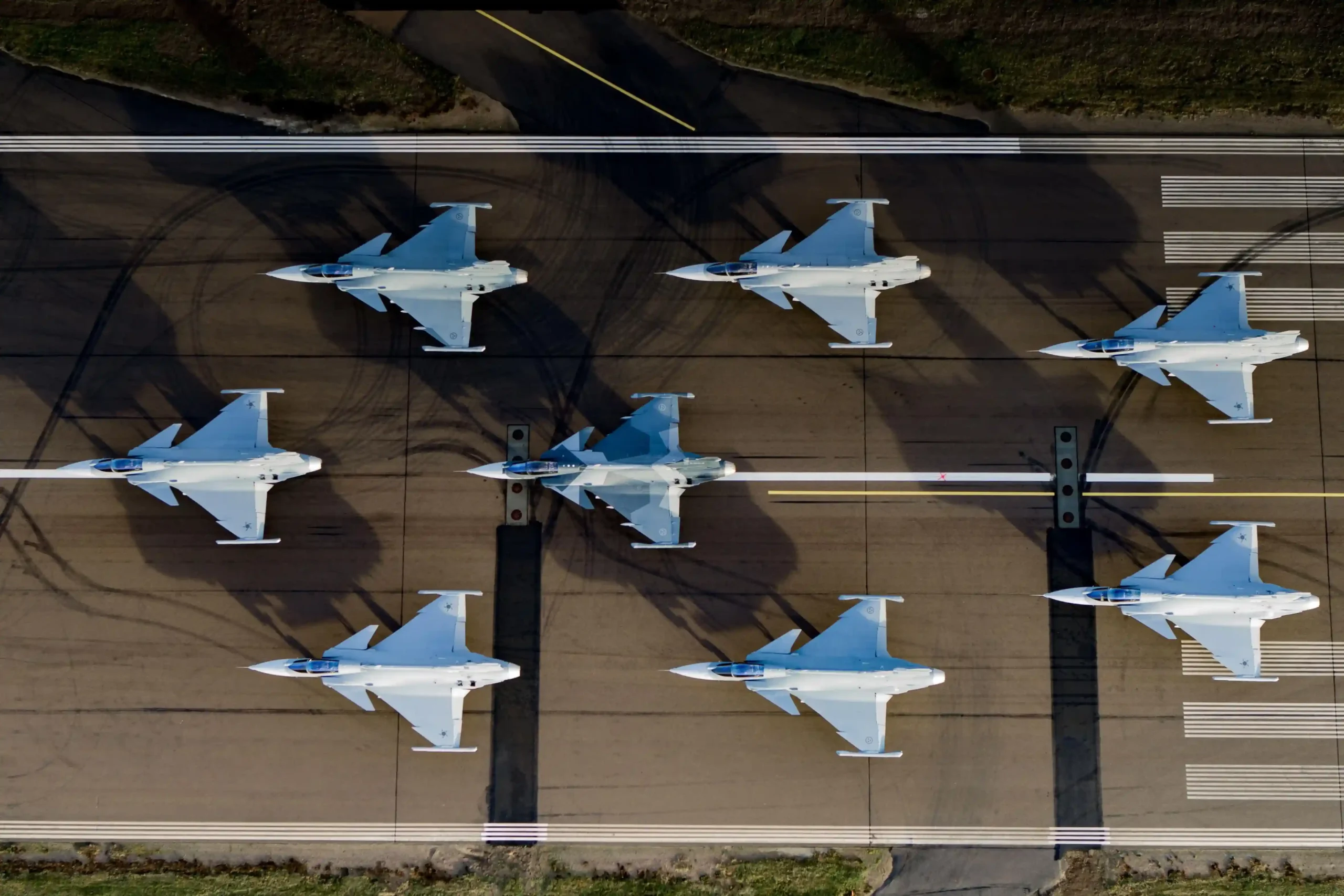
Saab AB booked SEK 65,825 million (approximately $6.6 billion) in new orders in the third quarter of 2026, more than triple the SEK 20,861 million recorded a year earlier, the Swedish defense group reported on October 23, 2026. Three contracts accounted for SEK 43.4 billion of the total: 16 Gripen E fighters for Ukraine worth SEK 24.6 billion, two GlobalEye airborne early warning and control (AEW&C) aircraft for an undisclosed customer worth SEK 10.1 billion, and SEK 8.7 billion in combat systems and sensors for the German Navy’s new frigates.
The quarter extends a run of large allied procurement decisions that has reshaped Saab’s order book since 2025. The backlog reached a record SEK 364 billion at the end of September, according to company presentation material, up from SEK 317.7 billion at the end of June. Results beat market expectations, and Saab shares rose as much as 2.8 percent in Stockholm on publication day. “Demand on our side is very high,” President and CEO Micael Johansson told Bloomberg. “We can’t see any leveling off.”
Saab Q3 Results: Sales, Margins, and Cash Flow Accelerate
Sales rose to SEK 20,553 million from SEK 15,871 million, organic growth of 30.6 percent against 18.3 percent a year earlier. Earnings before interest and taxes (EBIT) climbed 42 percent to SEK 1,945 million, lifting the EBIT margin to 9.5 percent from 8.7 percent, while the EBITDA margin edged up to 13.8 percent from 13.7 percent. Net income reached SEK 1,432 million, or SEK 2.57 per share, compared with SEK 975 million and SEK 1.77.
Operational cash flow reached SEK 6,785 million, against SEK 142 million in the third quarter of 2025, and net liquidity rose to SEK 8,679 million from SEK 3,989 million at year-end 2025. Presentation material shows the backlog spread across business areas: Aeronautics 28 percent, the naval business 26 percent, Dynamics 25 percent and Surveillance 21 percent. Only 8 percent is scheduled for delivery in the fourth quarter of 2026; 75 percent falls between 2027 and 2029.
Group Management changes took effect on October 1, with Marcus Wandt heading Aeronautics, deputy CEO Anders Carp taking over Dynamics and Lars Tossman moving to Group Strategy and Growth.
Gripen E for Ukraine and GlobalEye: Platforms and Delivery Timelines
The Ukrainian contract, signed on June 30, 2026, with the Swedish Defence Materiel Administration (FMV), covers 16 Gripen E fighters plus spare parts and associated equipment, with deliveries to FMV scheduled for 2029 and 2030. It is the first firm order under the October 2025 letter of intent in which Stockholm and Kyiv outlined a potential 100 to 150 Gripen E.
Publicly available specifications indicate the Gripen E is powered by a single General Electric F414G turbofan rated at roughly 98 kN with afterburner, and carries the Leonardo ES-05 Raven active electronically scanned array (AESA) radar, the Skyward-G infrared search and track sensor and the Arexis electronic warfare suite. Paired with the MBDA Meteor beyond-visual-range air-to-air missile, that sensor set gives Ukrainian pilots the reach to threaten Russian strike aircraft releasing glide bombs from standoff range. Saab designs the jet to fly from road bases and short temporary strips with small ground crews, a dispersal model suited to an air force whose fixed airfields face recurring missile and drone attacks.
The GlobalEye order covers two aircraft for a customer reported to be in the Middle East, with deliveries in 2030. The system mounts the Erieye Extended Range AESA radar on a Bombardier Global 6500 business jet alongside maritime, ground and electronic surveillance sensors, with a published endurance of more than 12 hours. The United Arab Emirates operates five, France ordered two in December 2025, Canada named Saab its preferred supplier in May 2026, and NATO announced on July 7, 2026, that it would negotiate for up to 10 aircraft to replace its E-3A fleet. Saab rolled out the first GlobalEye for the Swedish Air Force on October 15.
MEKO A-200 DEU Frigates and Uncrewed Systems Broaden Saab’s Order Base
The naval order comes from German shipbuilder TKMS, prime contractor for four MEKO A-200 DEU frigates. Saab will supply the 9LV combat management and fire control systems, the Sea Giraffe 4A Fixed Face long-range surveillance radar, the lightweight Sea Giraffe 1X multi-mission radar, passive sensors and composite superstructures. Deliveries run from 2029 to 2032, with an option to equip additional hulls. The class emerged as Berlin’s faster path to new surface combatants after setbacks in the F126 program, placing a Swedish combat system at the core of a German-built frigate designed for anti-air, anti-submarine and anti-surface warfare.
Johansson also said demand is broadening beyond Saab’s flagship platforms, with customers increasingly seeking autonomous systems to complement crewed ones. On October 16, Saab, FMV and the Swedish Armed Forces announced the launch of a Large Uncrewed Underwater Vehicle (LUUV) demonstrator, completed less than a year after contract award, and on October 20 the company introduced the Allied Mission System, a cloud-based platform for space domain awareness and command and control.
Analysis: Saab’s constraint is shifting from winning orders to delivering them. Three quarters of the backlog falls due between 2027 and 2029, and all three headline contracts deliver from 2029 onward, stacking Gripen E, GlobalEye and naval work on top of commitments to Sweden, Brazil, Colombia and Thailand. The cash flow surge gives Saab the liquidity to fund capacity expansion, but production throughput and supplier depth now set the ceiling on growth. The quarter also confirms allied buyers sourcing airborne surveillance and naval combat systems from a European prime, a trend NATO’s GlobalEye selection reinforced.
Saab must convert NATO’s selection into a contract with the NATO Support and Procurement Agency (NSPA), which has published no timeline, and Canada has yet to place a firm GlobalEye order. In Ottawa, Saab is also pressing for a dual fighter fleet adding Gripen to the F-35s Canada has ordered. “It’s rational, it’s logic. But it’s a political decision,” Johansson told Bloomberg. Further Ukrainian tranches under the 2025 letter of intent, and the identity of the GlobalEye customer, remain open questions.