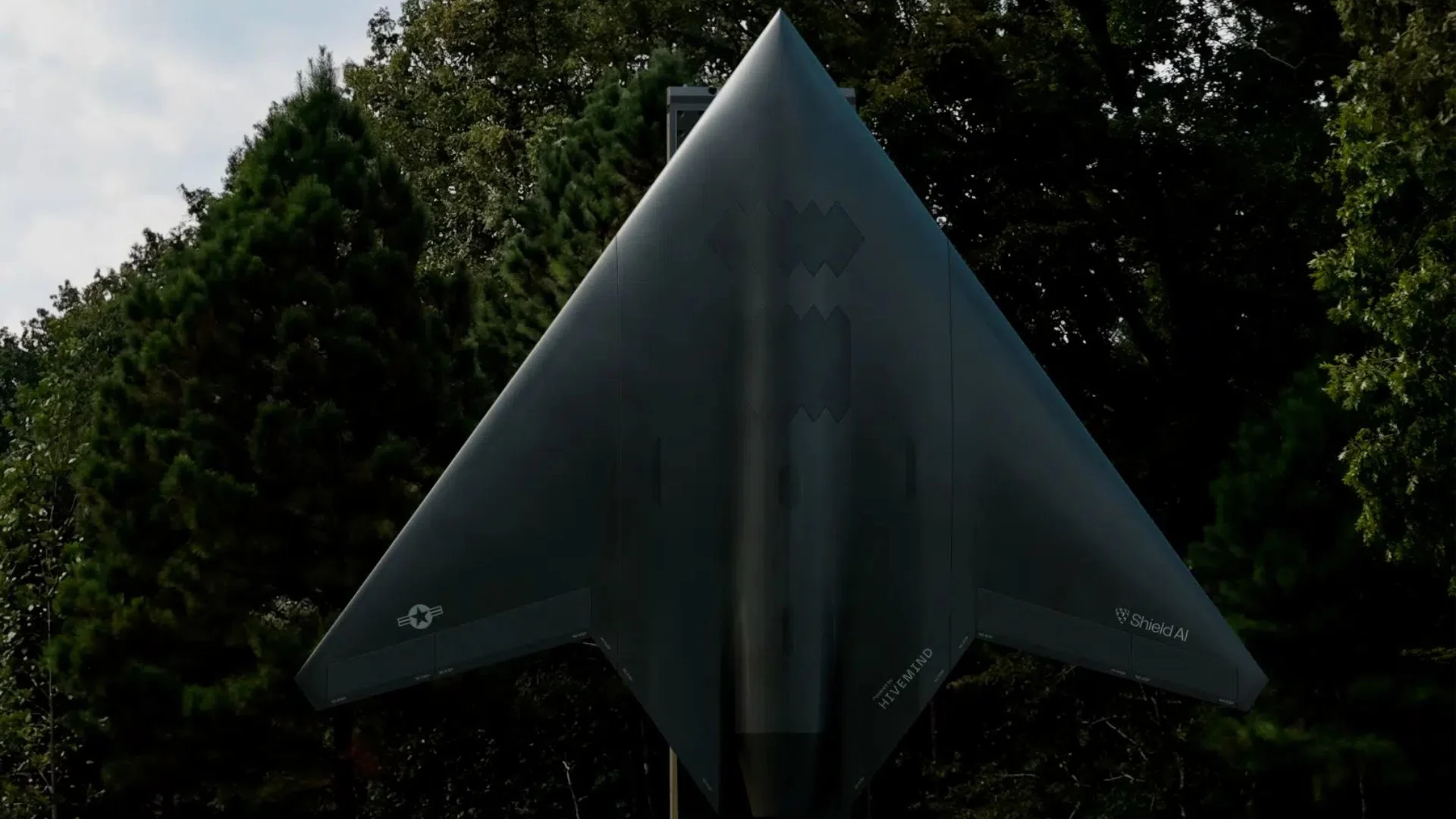
Shield AI will take its X-BAT autonomous vertical takeoff and landing (VTOL) strike fighter to European air chiefs at the International Fighter Conference (IFC) in Munich, scheduled for November 3 to 5, 2026. The company’s European campaign is led by Andrew “Geeky” Hawkes, a former Royal Air Force (RAF) Eurofighter Typhoon pilot, who argued in a company interview published October 29, 2026, that X-BAT’s range would free European operators from their dependence on scarce tanker aircraft.
Shield AI unveiled X-BAT in October 2025 as an AI-piloted, runway-independent combat aircraft. The program now counts $400 million in announced public and private commitments, including a $150 million U.S. Navy modification to the company’s Other Transaction (OT) agreement, announced on October 8, 2026, and matched by $150 million of Shield AI capital. That modification funds Defense Exportability Features, meaning export configuration work is being paid for before the aircraft has flown. For European buyers, that signals foreign sales are designed into the program rather than bolted on later.
Shield AI X-BAT Design, Propulsion, and Range Figures
According to company figures, X-BAT measures 26 feet (7.92 m) long with a 39-foot (11.9 m) cranked-delta wingspan, roughly half the size of an F-35. The airframe uses low-observable shaping and internal weapons bays, each able to carry up to 2,000 pounds of ordnance, which the company describes as comparable in size to the F-35’s.
Propulsion comes from a single afterburning General Electric F110, under a memorandum of understanding that pairs the F110-GE-129 with the Axisymmetric Vectoring Engine Nozzle (AVEN), a nozzle first flown in the 1990s on the experimental F-16 Multi-Axis Thrust Vectoring (MATV) aircraft. On X-BAT, it provides attitude control in vertical flight. The aircraft launches vertically from a trailer or ship deck, transitions to wingborne flight, and recovers vertically.
Shield AI claims a range exceeding 2,000 nautical miles with a mission payload and a service ceiling above 50,000 feet. Supersonic capability is expected but has not been demonstrated. The aircraft flies on Hivemind, the company’s AI pilot, designed to operate without GPS and with degraded communications. Shield AI prices the jet at about $27 million, roughly the U.S. Air Force’s target price for Collaborative Combat Aircraft (CCA).
Hawkes ties the range figure directly to European force structure. “Nobody has enough tankers,” he said, arguing that X-BAT lets operators stay “operationally relevant everywhere” without tying sorties to refuelling assets. His second argument draws on the Typhoon’s early combat use, when the jet flew in an air-to-air only role and crews concluded within a month that it needed to carry bombs. “You must have strike assets,” he said. Key unknowns remain: the company has not disclosed the weapons load X-BAT can lift in a vertical takeoff, nor how much range survives a full internal load.
London, Oslo, and Poland: Building X-BAT’s European Industrial Footprint
Shield AI is pairing the pitch with a physical presence. Hawkes said the company believes it is “strong by being local,” citing a London office building out corporate and engineering staff, a permanent office in Oslo, opened in September 2025, and a Polish office now being established, with more planned.
Poland is the most advanced European track. On June 16, 2026, Prime Minister Donald Tusk said Shield AI intended to produce parts of X-BAT in Poland. On September 8, 2026, at the MSPO defense exhibition in Kielce, Shield AI signed a letter of intent with Polska Grupa Zbrojeniowa (PGZ) and Wojskowe Zaklady Lotnicze No. 2 (WZL-2) covering the design, production, delivery, and sustainment of X-BAT in Poland, for Polish and export customers. Workshare and production sites remain subject to definitive agreements that have not yet been announced.
In the United States, X-BAT development runs out of Frisco, Texas, with flight testing and sustainment at Newton, Kansas, and a production facility, designated X3, in Des Moines, Washington, south of Seattle. Around 500 engineers at Shield AI and its suppliers, including GE Aerospace, are building flight-test aircraft. Hawkes framed the scale-up as a credibility test for export customers: an autonomous VTOL fighter, he said, “isn’t going to help anybody” if only one can be built every six months.
Analysis: X-BAT’s European case rests on two shortfalls European air forces know well. The 2011 Libya campaign, in which Hawkes flew, exposed Europe’s reliance on U.S. tanker support, and Russian long-range missiles now hold eastern-flank main operating bases at risk. A runway-independent striker with 2,000-nautical-mile reach answers both on paper. The obstacles are equally concrete: the aircraft has not flown, the U.S. Air Force has so far held off investing, and European budgets are committed to the Future Combat Air System (FCAS) and the Global Combat Air Programme (GCAP), each with its own uncrewed adjuncts. A U.S.-controlled design also faces European preference rules on content, which makes Polish workshare less a courtesy than a commercial necessity.
Shield AI expects its first full-scale prototype to be completed by the end of October 2026, with first flight at Newton before year-end. Shield AI targets an early operational capability around 2029. In Munich, the questions for European delegations will be whether a second national partner follows Poland and when the PGZ letter of intent becomes a binding contract.