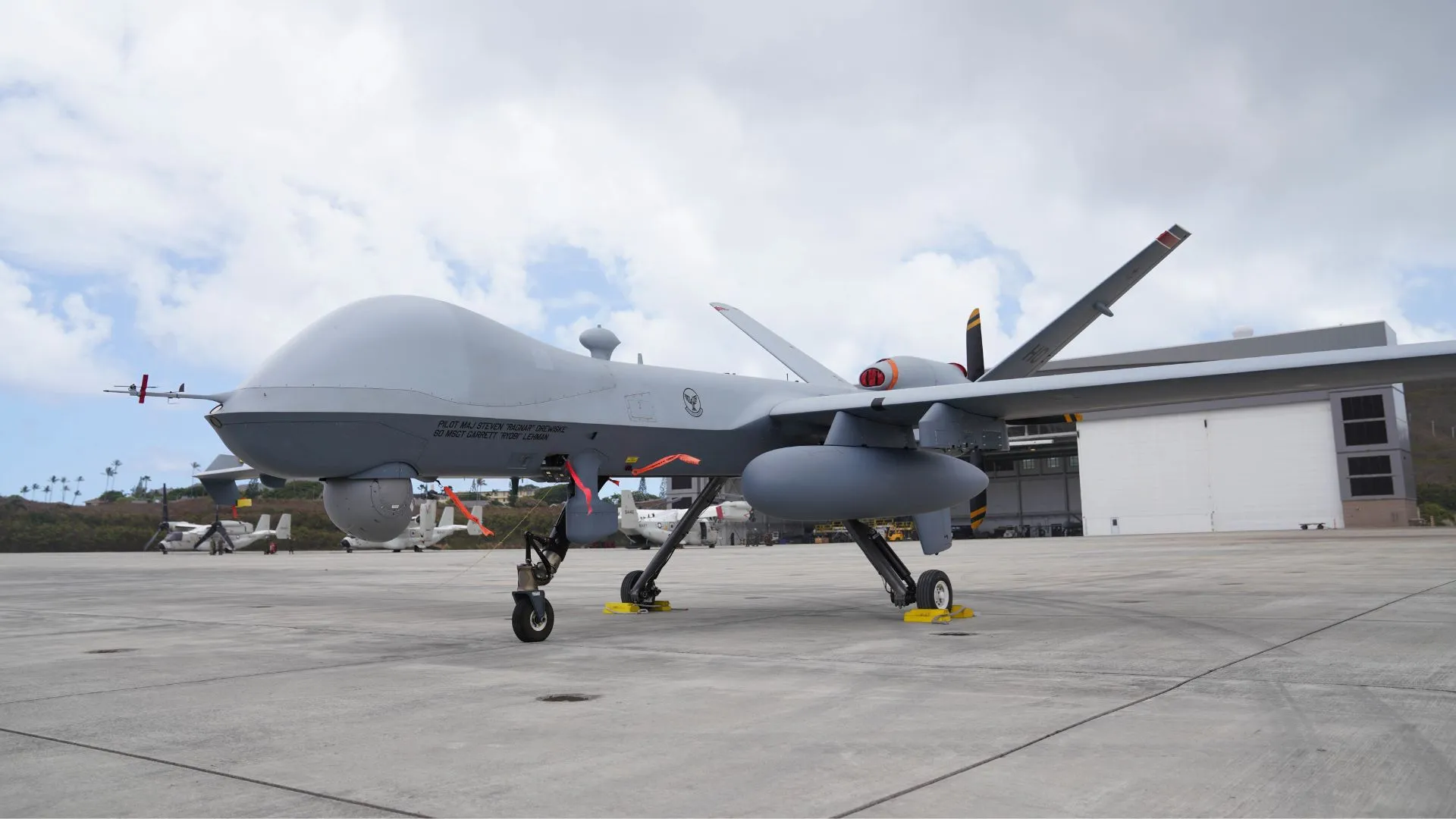
General Atomics Aeronautical Systems, Inc. (GA-ASI) opened a Remote Split Operation (RSO) facility at its Flight Test and Training Center (FTTC) near Grand Forks, North Dakota, on October 30, 2026, moving the pilots who fly its leased MQ-9A Reaper aircraft for U.S. Africa Command (AFRICOM) from the African continent to the continental United States. The company will use the site to continue executing its Contractor-Owned, Contractor-Operated (COCO) MQ-9A lease in support of AFRICOM and the Department of War.
The decision relocates the flying crews of a contractor-run intelligence, surveillance and reconnaissance (ISR) service into an established GA-ASI hub. The FTTC began operations at the GrandSKY Unmanned Aircraft System (UAS) business park on July 18, 2016; the park sits on Grand Forks Air Force Base property with access to the base’s 12,351-foot runway. AFRICOM has long relied on contracted ISR to cover a vast theater with a light footprint, and U.S. basing options on the continent narrowed further after American forces withdrew from Niger in 2024.
How the Remote Split Operation Model Moves MQ-9A Crews Stateside
An RSO divides each sortie between two teams. In standard MQ-9 practice, a launch and recovery element (LRE) based near the runway handles takeoff and landing over a line-of-sight datalink, then hands the aircraft to a mission control element (MCE) that flies the ISR portion of the sortie over a satellite link from thousands of miles away. The U.S. Air Force has operated its own Reaper fleet this way for years from stateside bases such as Creech Air Force Base, Nevada.
Publicly available specifications indicate the MQ-9A is powered by a Honeywell TPE331-10 turboprop rated at roughly 900 shaft horsepower, spans 66 feet, and has a maximum takeoff weight of 10,500 pounds, with endurance above 27 hours in its baseline configuration. That endurance is what makes the split model efficient: a single forward launch feeds a long orbit flown by crews rotating through shifts at a ground control station in North Dakota.
GA-ASI did not disclose how many personnel will remain in theater for launch, recovery and maintenance, which African locations host the leased aircraft, or the sensor and weapons configuration of the lease fleet.
AFRICOM Contractor ISR Lease and the $10 Million Savings Claim
Senator John Hoeven (R-ND), whose office GA-ASI credits with establishing the center, said he worked the move through the Senate Defense Appropriations Committee and that AFRICOM “will save more than $10 million per year” as pilots operate from Grand Forks rather than overseas. Neither the senator nor the company published the basis for that estimate.
GA-ASI Chief Executive Officer Linden Blue said the relocation will reduce the number of personnel required overseas, lower the cost of the COCO arrangement to the government and “significantly increase the safety for our personnel.” He put new local employment at approximately 50 jobs.
GA-ASI disclosed in November 2022 that it supports AFRICOM ISR as a major subcontractor to SMX under the AFRICOM Reconnaissance Intelligence Exploitation Services (ARIES) task order, estimated at $2.3 billion including options and covering six MQ-9As organized in three lines of two aircraft. An SMX senior vice president attended the October 30 ribbon cutting, although the company’s announcement did not name the task order or state whether its scope has changed.
Analysis: The relocation imports the Air Force’s own RSO logic into a contractor-delivered service. Under a COCO lease, the government buys ISR coverage rather than airframes, so every crew member moved out of theater reduces the contractor’s cost base and the government’s force-protection burden in a region where U.S. access has contracted. The trade-off is heavier reliance on resilient satellite communications and on whatever forward footprint remains for launch, recovery and maintenance. If the savings claim holds, the model offers a template for sustaining persistent ISR in economy-of-force theaters without adding uniformed manpower.
Open questions include the size of the residual in-theater team, the cost methodology behind the $10 million figure, and whether Grand Forks will host additional COCO or foreign customer lines. ARIES was structured as a seven-year effort when awarded in 2022, which places a follow-on AFRICOM ISR decision within the next few years.