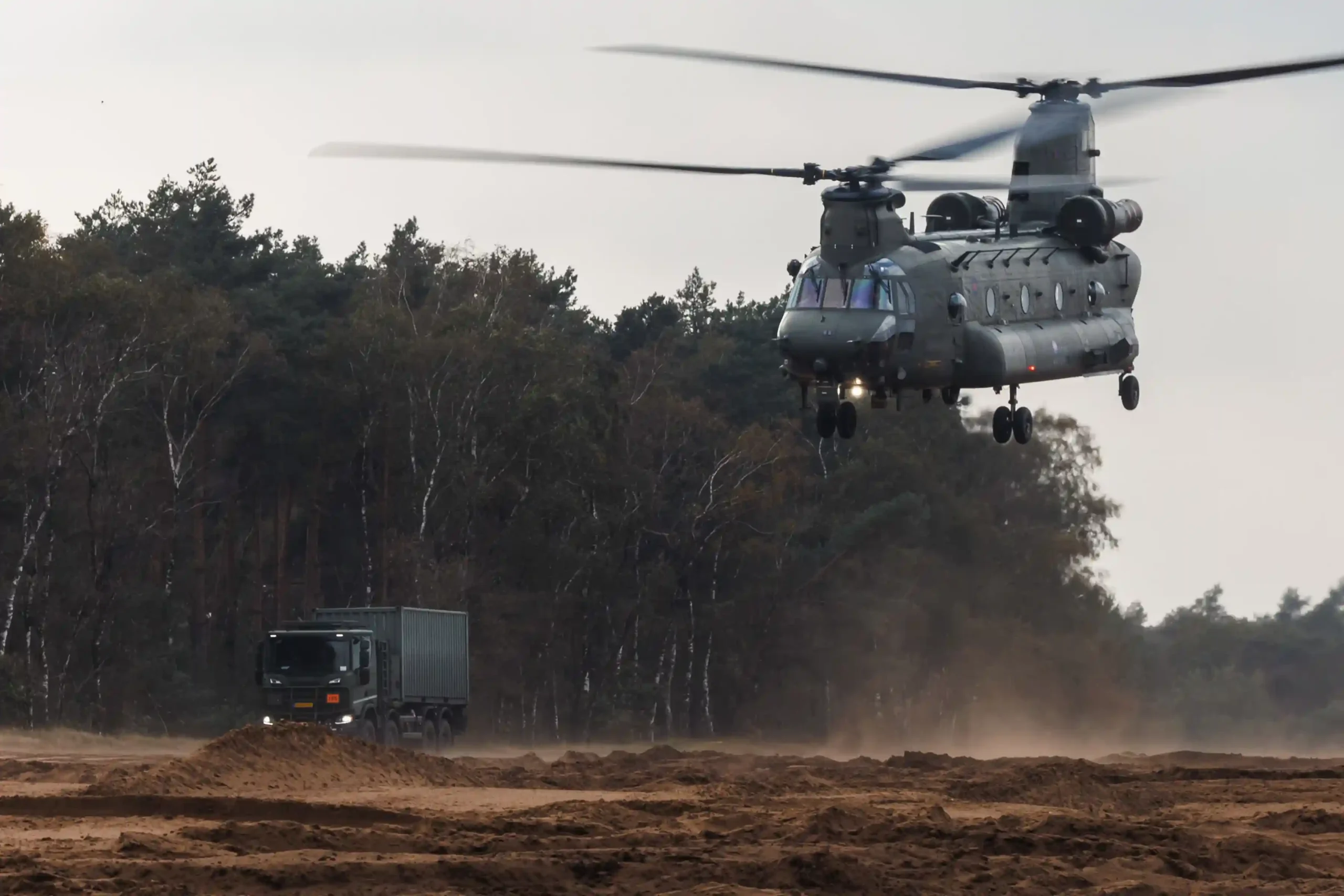
The Royal Air Force deployed CH-47 Chinook crews and support personnel from 18 (Bomber) Squadron to Gilze-Rijen Air Base in the Netherlands for Exercise Greyhound Titan 26, flying daily missions into Germany in support of 16 Air Assault Brigade Combat Team (16X) during Exercise Rhino Titan 26 at the Sennelager training area, the RAF said on October 31, 2026.
The deployment paired the RAF’s heavy-lift helicopter force with the British Army’s rapid-reaction air assault brigade. Rhino Titan, a seven-week exercise involving roughly 2,500 British and French troops, included one of the UK’s largest airborne operations in two decades, with around 600 British and 100 French paratroopers jumping from four A400M Atlas transports on October 20, 2026, against an opposing force equipped with drones and electronic warfare. Greyhound Titan formed the rotary-wing layer of that effort, aimed at keeping aviation fully embedded in the planning and execution of air manoeuvre operations.
How RAF Chinooks Supported 16X Air Manoeuvre From Gilze-Rijen
Personnel from 18 (B) Squadron and supporting elements deployed from RAF Odiham, the home of the UK’s Chinook force, and staged out of the Dutch base for daily sorties across the border to Sennelager. Mission sets included personnel recovery, medical evacuation, uncrewed aircraft systems (UAS) integration, air assault and general aviation support to ground forces. The RAF did not disclose how many aircraft deployed, which Chinook marks were involved, or the exercise dates for the helicopter detachment.
“This exercise put into practice everything 18 (B) Sqn had been building up to this year,” said Flight Lieutenant Sam, a Chinook pilot with the squadron. “Deploying forward from The Netherlands to Germany daily, integrated and realistic training with 16 Air Assault Brigade Combat Team saw us conducting personnel recovery, UAS, medevac and air assault missions.”
The tandem-rotor Chinook remains the backbone of British battlefield mobility. Publicly available specifications indicate the RAF variants are powered by two Honeywell T55 turboshaft engines and can lift up to 55 troops or approximately 10 tonnes of mixed cargo, internally or on underslung hooks. That capacity lets a single airframe insert a platoon-sized element or reposition artillery and supplies in one lift.
Basing at Gilze-Rijen also put the British crews alongside 298 Squadron of the Royal Netherlands Air and Space Force (RNLASF), which operates the CH-47F from the same airfield. Flight Lieutenant Sam said the detachment tested its skills “alongside the Dutch Chinook Squadron, 298 Squadron,” adding that it helped “enhance relationships and trust with a fellow Chinook squadron and coalition partner.” Operating from a partner’s main base gave RAF personnel direct experience of the host-nation support arrangements a real reinforcement would require.
Embedded Aviation Planning and Dust Bowl Desert Readiness Trials
Beyond flying, the exercise focused on staff integration. Aviation planning and liaison functions were placed inside the 16X headquarters, and Brigade, Battlegroup and Aviation staffs worked together on planning, synchronisation and targeting.
“Embedding aviation representation within the supported headquarters significantly enhanced situational awareness, understanding of commander’s intent and the ability to align rotary-wing capabilities with emerging operational requirements,” said Group Captain Harris, Chief Force Coordinator.
According to the RAF, the exercise validated liaison arrangements but also identified areas for further development, particularly communications, subject matter expert (SME) reach-back and aviation support planning. It also flagged a need to deepen squadron-level understanding of land planning processes, without detailing the specific shortfalls.
The detachment also assessed specially prepared dust bowls as a method of supporting environmental qualification and desert operations training. Landing in loose sand and dust, where rotor downwash can generate brownout, is a perishable skill usually maintained through overseas deployments. The RAF said the evaluation will inform future methods of maintaining readiness for austere environments, without publishing results. The 3rd Battalion, The Parachute Regiment (3 PARA) also trained alongside the squadron during the exercise.
Analysis: The most consequential output of Greyhound Titan is procedural rather than tactical. Air assault depends on aviation being present when the brigade plan is built, not tasked after it is finished, and the RAF’s own findings on communications and reach-back suggest that integration is still maturing. The timing matters because the UK Chinook force is entering a fleet transition: London has ordered 14 extended-range H-47ER aircraft, a program announced in 2021 at about £1.4 billion, and the Ministry of Defence expects the first to enter service from late 2027 as the oldest airframes approach retirement. During that transition, routine co-location with 298 Squadron offers allied depth on a closely related type, and dust bowl training closer to home could reduce dependence on overseas deployments for environmental qualification.
The next markers are whether the RAF formalizes embedded aviation liaison as standard practice within 16X, whether the dust bowl concept is adopted for routine environmental qualification, and how quickly the H-47ER enters service at Odiham. The RAF has not published a timeline for closing the communications and planning gaps identified during the exercise.