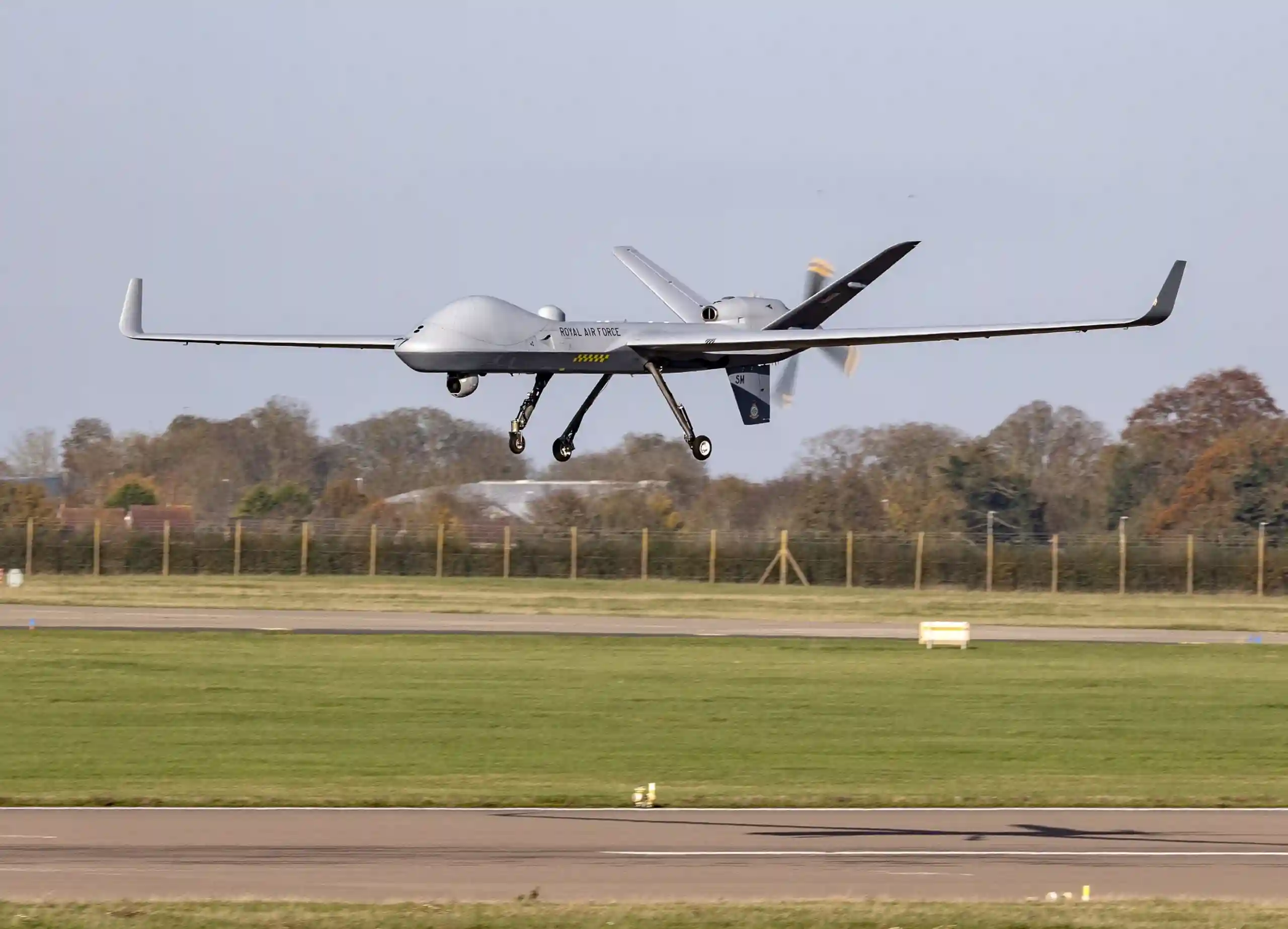
The Royal Air Force has flown its Protector RG1 remotely piloted aircraft against Russian naval activity in the English Channel for the first time, the UK Ministry of Defence (MoD) disclosed on October 31, 2026. The unarmed aircraft logged more than 10 hours surveying foreign vessels between late September and mid-October, working alongside Royal Navy warships and helicopters during its first operational sorties in UK airspace.
The sorties come as Russian naval traffic around the British Isles intensifies. According to the MoD, Royal Navy activations to monitor Russian activity rose 25 percent in the first seven months of 2026 compared with the same period in 2025. Between October 1 and October 14, the Type 45 destroyer HMS Dauntless and the offshore patrol vessel HMS Tyne monitored the Baltic Fleet frigate Neustrashimy, which conducted a live-fire gunnery exercise in the Channel on July 20. Over the same period, helicopters tracked a Russian intelligence-gathering ship operating near NATO units on a training exercise, as well as the landing ship Aleksandr Shabalin during a Channel transit.
Protector RG1 Drone Brings Persistent ISR to Channel Patrols
Protector RG1 is the British designation for General Atomics Aeronautical Systems’ MQ-9B SkyGuardian, a medium-altitude, long-endurance (MALE) aircraft operated by XIII Squadron from RAF Waddington in Lincolnshire. The UK has procured 16 airframes, of which 11 have been delivered into service. Published RAF specifications list a 24.07-meter wingspan, a Honeywell TPE331-10T turboprop rated at 900 shaft horsepower, and endurance exceeding 40 hours depending on mission configuration. Each aircraft is flown by a three-person team: a remote pilot, a sensor operator, and a mission intelligence coordinator.
The sensor suite combines a synthetic aperture radar with the AN/DAS-4 multispectral targeting system, providing radar imaging alongside electro-optical and infrared observation. The MoD has not disclosed which sensor configuration flew on the Channel missions, nor whether the aircraft carried a 360-degree maritime search radar of the type fitted to the SeaGuardian variant. Protector can also carry Brimstone 3A missiles and Paveway IV precision-guided bombs, but the aircraft used for these sorties flew unarmed.
Endurance is the operational point. A shipborne helicopter can hold a surface contact for a few hours before returning to its host; a MALE aircraft with a 40-hour envelope can keep track on a transiting warship across an entire Channel passage, cueing surface units instead of depending on them for continuous observation. Wing Commander Sam Haley, officer commanding XIII Squadron, said the aircraft delivered “persistent intelligence, surveillance and reconnaissance coverage” while operating across both military and civilian airspace.
Civil Airspace Access Puts Protector Over Britain’s Busiest Waters
What separates Protector from the MQ-9A Reaper it succeeds in RAF service is its design for operation in non-segregated airspace. That allows the aircraft to fly under standard air traffic procedures above the Channel, one of the world’s busiest maritime corridors and a crowded block of civil airspace. The RAF validated the capability on June 11, 2026, when a Protector flew more than 2,000 nautical miles from RAF Waddington to RAF Akrotiri in Cyprus in roughly 13.5 hours, transiting French, Italian, Maltese and Greek airspace. The Channel sorties are the first documented operational use of that access over home waters.
The timing aligns with a broader UK focus on grey-zone activity at sea. The Telegraph reported on October 21 that Russian fishing trawlers had repeatedly loitered over or followed the routes of undersea cables linking Britain to Europe and the US, and ministers have confirmed that Moscow uses commercial proxies to threaten undersea infrastructure. The government has since proposed lengthy prison terms for cable saboteurs. In June, Royal Marines seized the shadow fleet tanker Smyrtos in a six-hour operation. Defence Secretary Wes Streeting said the Channel sorties show how the armed forces are adapting to monitor and deter threats and irresponsible provocation.
Analysis: The 10-hour figure matters less than what it signals about force allocation. The Royal Navy’s surface fleet is too thin to shadow every Russian transit with a high-end escort, and a Type 45 committed to a frigate in the Channel is unavailable for carrier escort or North Atlantic tasking. A long-endurance aircraft that holds contact and cues ships only when needed offers a cheaper way to sustain the watch as Russian traffic grows. The open question is scale: 11 aircraft must also cover overseas ISR and strike commitments, and the MoD has not said how many Channel hours it can sustain routinely.
Five Protector airframes remain to be delivered, and the MoD has not published a date for full operating capability or said whether Channel surveillance will become a standing task. Funding will hinge on the path to defence spending of 3 percent of GDP by 2030 and 3.5 percent by 2035, set out in Chancellor John Healey’s October 28 Budget and due for detail in the next Spending Review. Further Russian transits through the Channel will show whether Protector’s debut becomes routine.