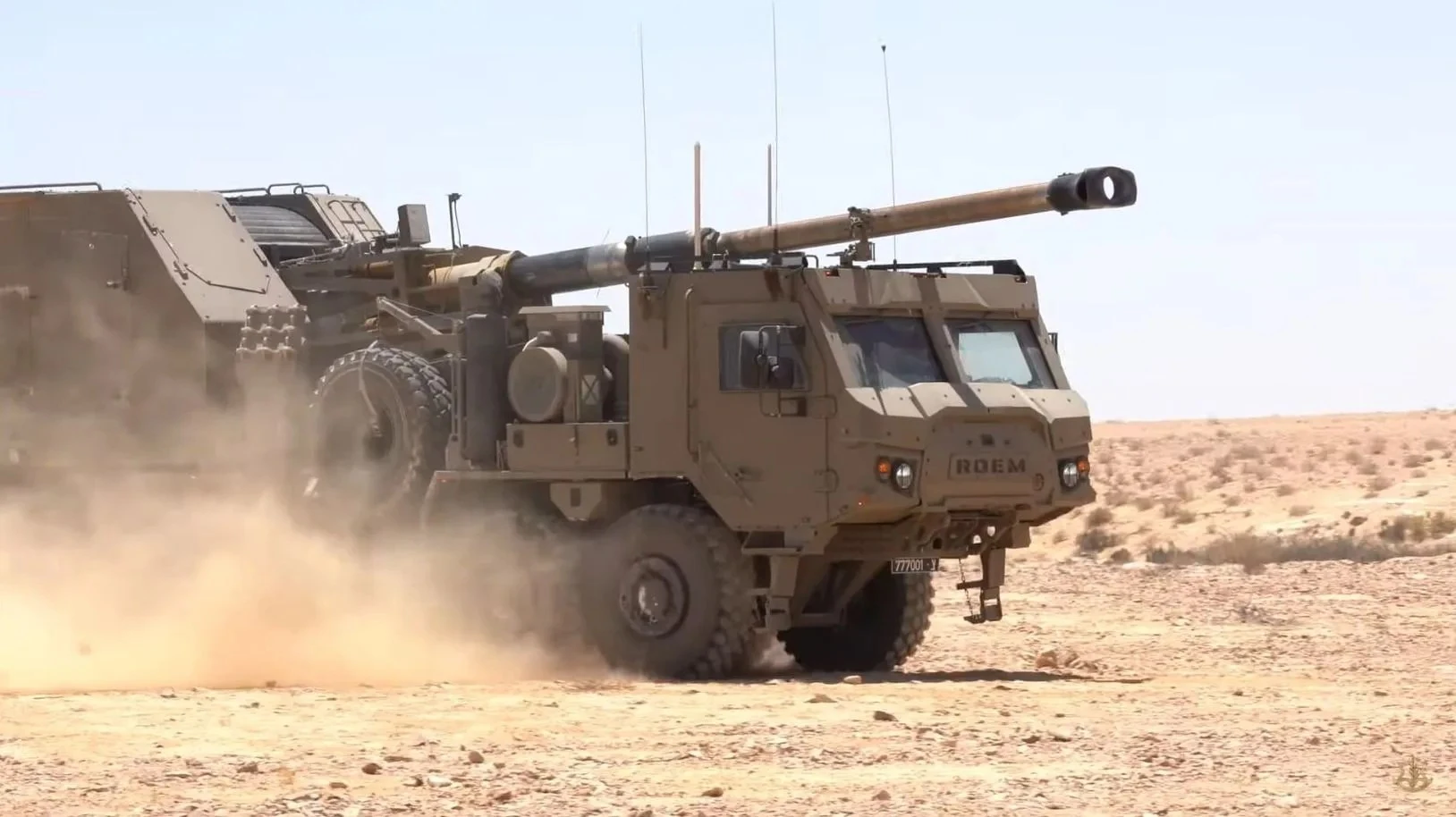
Israel’s Ministry of Defense has signed a 15-year agreement with Elbit Systems worth approximately 600 million shekels, or about $192 million, to build and operate an advanced training and simulation center for the Israel Defense Forces (IDF) Artillery Corps, the ministry announced on November 2, 2026. The facility will prepare crews for the corps’ two new principal fire platforms: the Roem self-propelled howitzer and the Lahav rocket launcher.
The contract lands as the Artillery Corps re-equips around two new systems. The Roem, the IDF designation for Elbit’s SIGMA 155 mm wheeled howitzer, is replacing the US-built M109 tracked howitzers known in Israeli service as Doher, while the Lahav, the Israeli version of Elbit’s Precise and Universal Launching System (PULS), gives the corps a multi-caliber precision rocket capability. The IDF must now requalify gunners, commanders, and drivers trained for decades on legacy systems while both platforms are already committed to operations.
Inside the 15-Year Artillery Training Center Contract
The Directorate of Defense Procurement (DDP) signed the agreement in cooperation with the IDF Ground Arm, with the directorate’s land procurement division leading the deal. Under its terms, Elbit will develop and deliver the facility’s physical infrastructure and advanced classrooms, along with driving simulators and mission simulators for both platforms. The company will then provide a long-term support package covering instruction, maintenance, and logistics across the 15-year life of the contract.
The ministry framed the move as a shift to an integrated training concept designed to let artillery crews exploit the full operational potential of the new systems. It cited three expected effects: a shorter qualification cycle for crews, a higher standard of individual and collective proficiency, and lower costs through reduced wear on operational vehicles diverted to training.
Ze’ev Landau, head of the Directorate of Defense Procurement, said pairing advanced simulation technology with a long-term support package would help the Artillery Corps realize the full firepower of the Roem and the other new systems while making optimal use of resources. Boaz Cohen, general manager of Elbit Systems Land and Armaments, said the artillery school and its associated training system would give the corps high-quality, efficient training to keep its fire system at peak readiness.
Several key parameters remain undisclosed. The ministry has not identified where the center will be built, how many simulators it will house, or when it will open. The split between construction costs and the long-term service component of the 600 million shekel value has also not been published.
Roem and Lahav: The Platforms Driving the Training Requirement
The Roem mounts a fully automated 155 mm/52-caliber gun on a 10×10 wheeled chassis. Automated loading and laying cut the crew to three, against seven on the M109, and the Artillery Corps credits the system with a rate of fire of up to eight rounds per minute. Publicly available specifications indicate a range of about 40 km with standard ammunition, roughly double that of the Doher. The system can switch from travel to firing mode in under a minute. A three-person crew running an automated gun needs a different skill set than a seven-person M109 detachment: fewer manual loading drills, more fire control software, fault management, and road-march driving of a heavy wheeled vehicle. Those are the skills the planned driving and mission simulators target.
Elbit handed over the first Roem in late December 2025, and the system entered training at the Tze’elim base in southern Israel. The 282nd Artillery Brigade took it into combat for the first time in April 2026, striking rocket and anti-tank launch positions in southern Lebanon. The IDF expects to field it in both regular and reserve artillery units.
The Lahav has been in IDF service since 2020. Built around Elbit’s PULS launcher, it fires munitions of several calibers from the same truck. Publicly available specifications indicate pods carrying eighteen 122 mm Accular rockets to 35 km or ten 160 mm Accular rockets to 40 km, with the EXTRA rocket reaching about 150 km and the Predator Hawk roughly 300 km. PULS has also become a leading Elbit export: Denmark, the Netherlands, and Germany have ordered it, and Greece signed an approximately $750 million deal in April 2026.
Analysis: The deal extends a model the Israeli Ministry of Defense now applies across the Ground Arm: contractor-built, contractor-sustained training centers tied to new platforms, following a 2023 Elbit agreement for an Armored Corps training facility. With Roem and Lahav both already used in combat, every hour a vehicle spends on a training range is an hour lost to the firing line and a step closer to depot maintenance. Shifting qualification into simulators protects scarce operational vehicles and speeds the conversion of both regular and reserve units. For Elbit, designing the gun, the launcher, and the schoolhouse consolidates its position as the IDF’s dominant land fires supplier and secures sustainment revenue into the 2040s.
Key milestones remain unannounced. The ministry has not disclosed a construction start, a target opening date, or a deadline for the Artillery Corps to complete its transition to Roem and Lahav. The next indicators to watch are site selection, the first simulator deliveries, and whether follow-on Roem production orders accelerate the retirement of the M109 fleet.