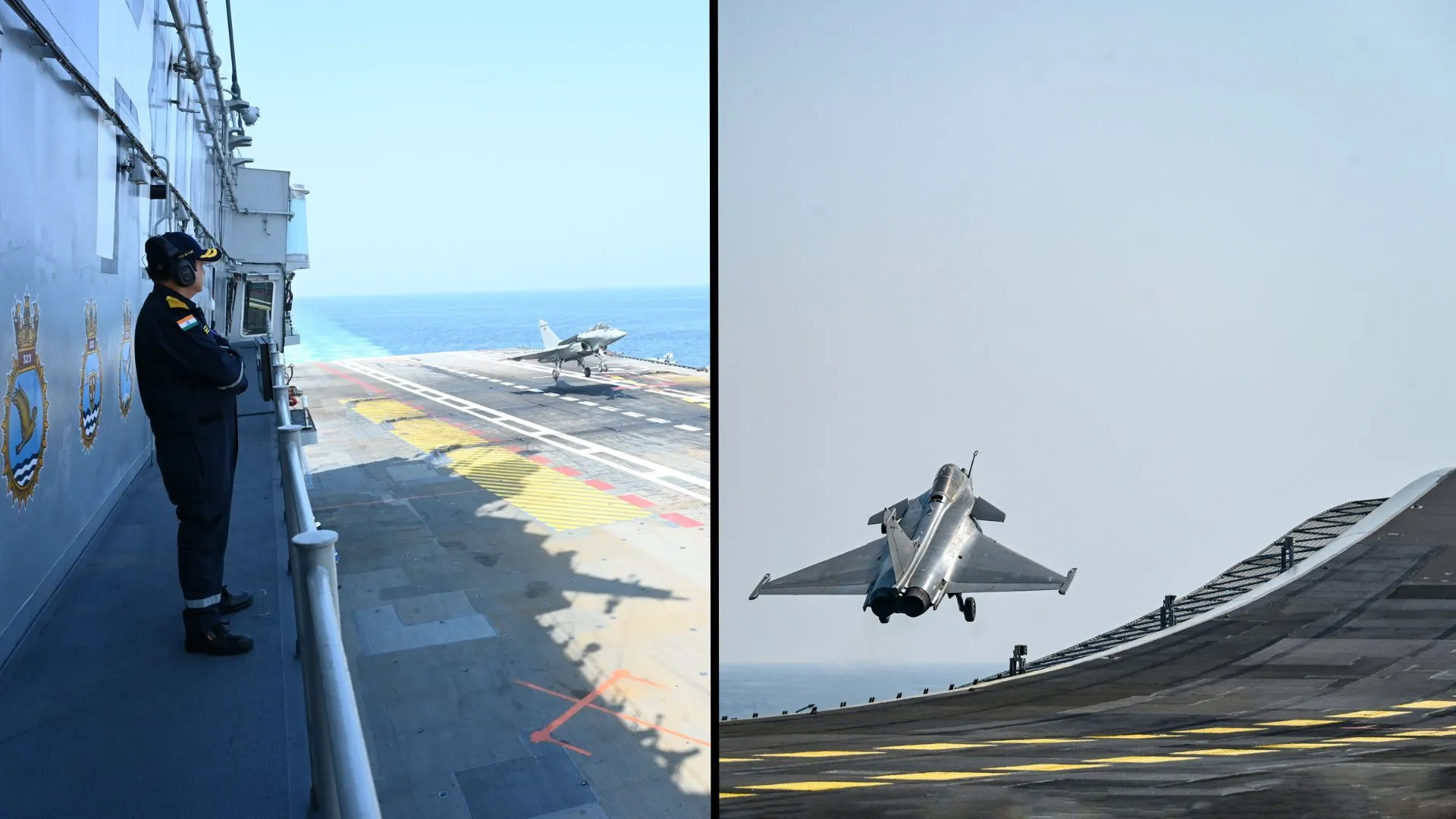
A French Navy Rafale Marine fighter made its first arrested landing aboard India’s indigenous aircraft carrier INS Vikrant on October 29, 2026, succeeding on its maiden attempt and moving the Indian Navy’s Rafale M carrier trials from shore-based testing to the flight deck ahead of the induction of 26 jets ordered from Dassault Aviation.
The Indian Navy confirmed the landing on October 30, stating that the ongoing trials “mark the first steps towards operationalisation of the aircraft” in the service. Naval News reported that the jet is understood to come from France’s Marine Nationale fleet, and Defence Security Asia said it was flown by a French pilot. The deck campaign follows testing earlier in October at the Shore Based Test Facility (SBTF) at INS Hansa, Goa, and comes 18 months after New Delhi signed for the fighters, as the Navy’s Russian-built MiG-29K/KUB fleet continues to struggle with serviceability.
Rafale M Carrier Trials Move From Goa to INS Vikrant
The trials close a basic compatibility gap. The Rafale M was designed for Catapult Assisted Take-Off But Arrested Recovery (CATOBAR) operations aboard the French carrier Charles de Gaulle. INS Vikrant, commissioned on September 2, 2022, and the older INS Vikramaditya use Short Take-Off But Arrested Recovery (STOBAR): fighters accelerate under their own thrust, leave the deck over a bow ski-jump, and recover by catching an arresting wire with a tailhook.
Preliminary tests at the SBTF, which replicates the ski-jump and arresting gear of Indian carriers, demonstrated the feasibility of ski-jump take-offs before the jet went to sea. The October 29 landing, conducted under the command of Captain Ashok Rao, Commanding Officer of INS Vikrant, was followed by a take-off from the carrier. The Rafale M is the third fixed-wing type to operate from Vikrant, after the MiG-29K and the naval Light Combat Aircraft (LCA) demonstrator, which both first landed aboard in February 2023.
A single recovery proves that the hook, wires and approach procedures work under the conditions of the day. It does not define launch weights, recovery weights or wind-over-deck limits. Without a catapult, a ski-jump launch depends entirely on aircraft weight, available thrust, deck run and ambient conditions. Publicly available specifications indicate the Rafale M is powered by two Safran M88-2 turbofans rated at about 75 kN each with afterburner. How much fuel and ordnance that thrust can lift off Vikrant’s bow is the central output of the campaign, and it will set the jet’s practical strike radius from Indian decks.
Deck handling is the second constraint. The Rafale M’s delta wing does not fold, and publicly available data put its span at roughly 10.9 meters, beyond the dimensions of Vikrant’s aircraft elevators. Naval News reported that the Indian jets will feature detachable wingtip missile rails and that minor elevator modifications and specialized systems are being installed aboard the carrier. Comparable work will be needed on Vikramaditya.
From 57 to 26 Jets: How India’s Rafale M Contract Took Shape
The Navy’s original requirement called for 57 carrier fighters to complement and eventually replace the MiG-29K/KUB across both carriers, a figure later cut to 26. The Rafale M and Boeing’s F/A-18E/F Super Hornet both flew evaluation trials from the SBTF in 2022, and India selected the French jet in July 2023.
On April 28, 2025, India and France signed an intergovernmental agreement valued at about INR 63,000 crore, roughly $7.5 billion, for 22 single-seat Rafale M and four twin-seat trainers. Because no two-seat Marine variant exists, the trainers are not carrier capable and will operate from shore bases. The package covers weapons, simulators, pilot training and long-term support, along with additional equipment for the Indian Air Force (IAF) Rafale fleet and transfer of technology to integrate Indian weapons. Deliveries are expected to begin in late 2028 or early 2029, making India the first export operator of the Rafale M.
The deal also places Indian industry in the Rafale supply chain. Tata Advanced Systems is developing a fuselage production facility with Dassault, sized for two fuselages per month from fiscal year 2028, while Dassault and Safran are establishing maintenance, repair and overhaul (MRO) capacity in India for the airframe and the M88 engine.
Operationally, the Rafale M brings the Thales RBE2 active electronically scanned array (AESA) radar and the SPECTRA electronic warfare suite, with Meteor and MICA air-to-air missiles, the SCALP-EG cruise missile and the Exocet AM39 anti-ship missile. It also offers training and logistics commonality with the IAF’s 36 land-based Rafales, acquired under a 2016 agreement.
Analysis: The Vikrant landing de-risks the platform, not yet the capability. The Navy now knows the carrier can recover a Rafale M; it does not yet know how much payload the jet can carry off a ski-jump in Indian Ocean heat, which erodes engine thrust. That launch envelope will decide whether Meteor-armed fleet air defense and SCALP-EG or Exocet strike missions can be flown at useful radius from Vikrant. With the indigenous Twin Engine Deck Based Fighter (TEDBF) now projected to fly only around 2029 to 2030, the Rafale M will carry Indian carrier aviation through the next decade, and a follow-on order toward the original 57-aircraft requirement remains a credible option.
Next milestones include further deck sorties to clear launch and recovery envelopes, completion of elevator modifications aboard Vikrant and equivalent work on Vikramaditya. The first India-standard aircraft are due from late 2028. The Navy has not disclosed the duration of the current trials, the weights tested or the timeline for Indian weapons integration.