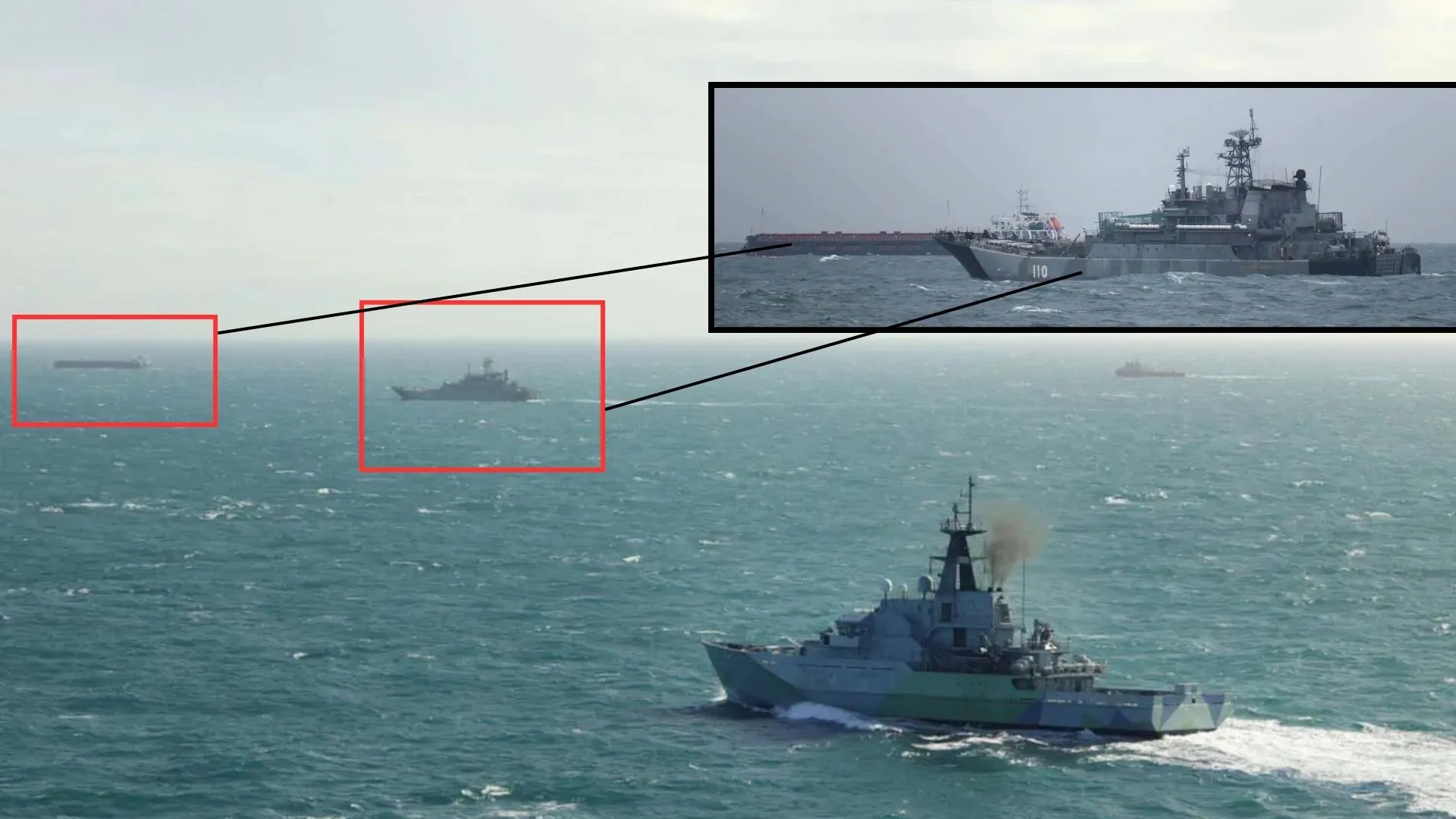
Royal Navy warships and helicopters tracked three Russian naval vessels through UK waters in three separate operations spanning 17 days in late September and the first half of October 2026, the Royal Navy said on November 2, 2026. Type 45 destroyer HMS Dauntless, offshore patrol vessel HMS Tyne, and Merlin and Wildcat helicopters shadowed the frigate RFN Neustrashimy, the intelligence-gathering ship Viktor Leonov and the landing ship RFN Aleksandr Shabalin.
The taskings come as Moscow uses frontline warships to escort sanctioned cargo through the English Channel, a pattern the Royal Navy says has run for the past three months. Neustrashimy has repeatedly crossed the UK area of responsibility while escorting shadow fleet tankers, and on July 20 it carried out gunnery firings outside UK and French territorial waters while HMS Tyne monitored it, according to the UK Ministry of Defence. The UK has sanctioned more than 500 vessels linked to Russia’s shadow fleet and seized the tanker Smyrtos in June. The Royal Navy has also reported that activations to monitor Russian activity rose 25 percent in the first eight months of 2026 compared with 2025.
Tracking Russian Warships Through the English Channel
HMS Dauntless and HMS Tyne were tasked from October 1 to October 14 to report on Neustrashimy as the frigate escorted sanctioned cargo ships through the Channel. Publicly available specifications indicate the Baltic Fleet vessel is the lead ship of Project 11540, launched in 1988 and designed primarily for anti-submarine and escort missions. Open-source data put its full-load displacement at roughly 4,400 tonnes and list a 100mm AK-100 gun, 3K95 Kinzhal vertically launched short-range air defense missiles, close-in weapon systems, and anti-submarine rockets and torpedoes. Open-source imagery shows the frigate has carried a Ka-27 helicopter in its hangar during the current deployment.
That loadout shapes the Royal Navy’s response. Publicly available data put the Type 45 at about 8,500 tonnes, with the SAMPSON multifunction radar and the Sea Viper air defense system firing Aster 15 and Aster 30 missiles. A lightly armed River-class patrol ship of roughly 1,700 tonnes can report on a Russian frigate but cannot match it. Pairing Tyne with Dauntless gave the Royal Navy a persistent tracker and a combatant whose sensors and weapons outclass the vessel under watch.
After handing Neustrashimy over to Dauntless, Tyne intercepted Aleksandr Shabalin between October 11 and October 14. The Project 775 Ropucha-class landing ship was escorting cargo ship MV Energy-2, accompanied by the tugboat Proton, through the Channel toward the Baltic region. Tyne was activated from North Shields and operated with a Wildcat helicopter from 815 Naval Air Squadron. Lieutenant Commander Sam Fields, Tyne’s commanding officer, said the back-to-back taskings “demonstrate the flexibility and enduring utility of our patrol ships.” Commander Neil Skinner, commanding Dauntless, said the destroyer maintained “close and proficient monitoring” of Neustrashimy throughout its Channel operations.
Operation Iceblast: Merlin Helicopters Shadow Viktor Leonov off Scotland
A third operation ran in parallel off Scotland. Under Operation Iceblast, Merlin helicopters deployed at short notice from Royal Naval Air Station (RNAS) Culdrose in Cornwall to Glasgow Prestwick Airport. From September 29 to October 8, the aircraft tracked the Vishnya-class intelligence ship Viktor Leonov in the Outer Hebrides as it monitored NATO warships taking part in Exercise Strike Warrior, an allied training event involving more than 2,000 personnel from six nations.
Publicly available specifications indicate Viktor Leonov is a Project 864 signals intelligence ship of Russia’s Northern Fleet, displacing about 3,400 tonnes and fitted with antenna arrays for intercepting radar and communications emissions. Positioning such a ship near a multinational exercise lets Moscow catalogue NATO emitter signatures, datalink behavior and tactics. The Merlin HM2, equipped according to open sources with a search radar, dipping sonar and sonobuoy processing, gave the Royal Navy persistent surface tracking with an anti-submarine capability in the same airframe.
Captain James Hall, commanding officer of RNAS Culdrose, said Iceblast was designed to test whether the Merlin Helicopter Force could deploy away from its home base “in force and at short notice.” The Royal Navy has not disclosed how many Merlins deployed, the flight hours logged or whether surface units supported the Hebrides tasking.
Analysis: The three taskings show a small surface fleet stretched across simultaneous demands. Russia’s use of frontline combatants to escort sanctioned cargo raises the level of force needed to monitor each transit, and it draws high-value assets such as a Type 45 into Channel escort work when the same ships are needed for carrier strike and the North Atlantic. Dispersing Merlins from Culdrose to Prestwick also shows the UK rehearsing distributed basing for the High North, where Russian intelligence ships can shadow NATO exercises with little warning. The question is sustainability: an escort pattern that persists for months imposes a recurring cost on a fleet already committed to NATO’s northern flank.
Dauntless now moves to the next phase. A helicopter from 815 Naval Air Squadron will embark on the destroyer as it joins carrier HMS Prince of Wales for Operation Firecrest 2, the continuing mission to the Arctic and North Atlantic protecting NATO’s northern flank. London has paired these operations with a new sanctions package targeting the revenues that fund Russia’s war in Ukraine, alongside 4.5 billion pounds in military support to Kyiv this year, the largest amount provided to date. Whether Moscow sustains warship escorts for sanctioned shipping through the winter will determine how often UK patrol ships and helicopters are called out again.