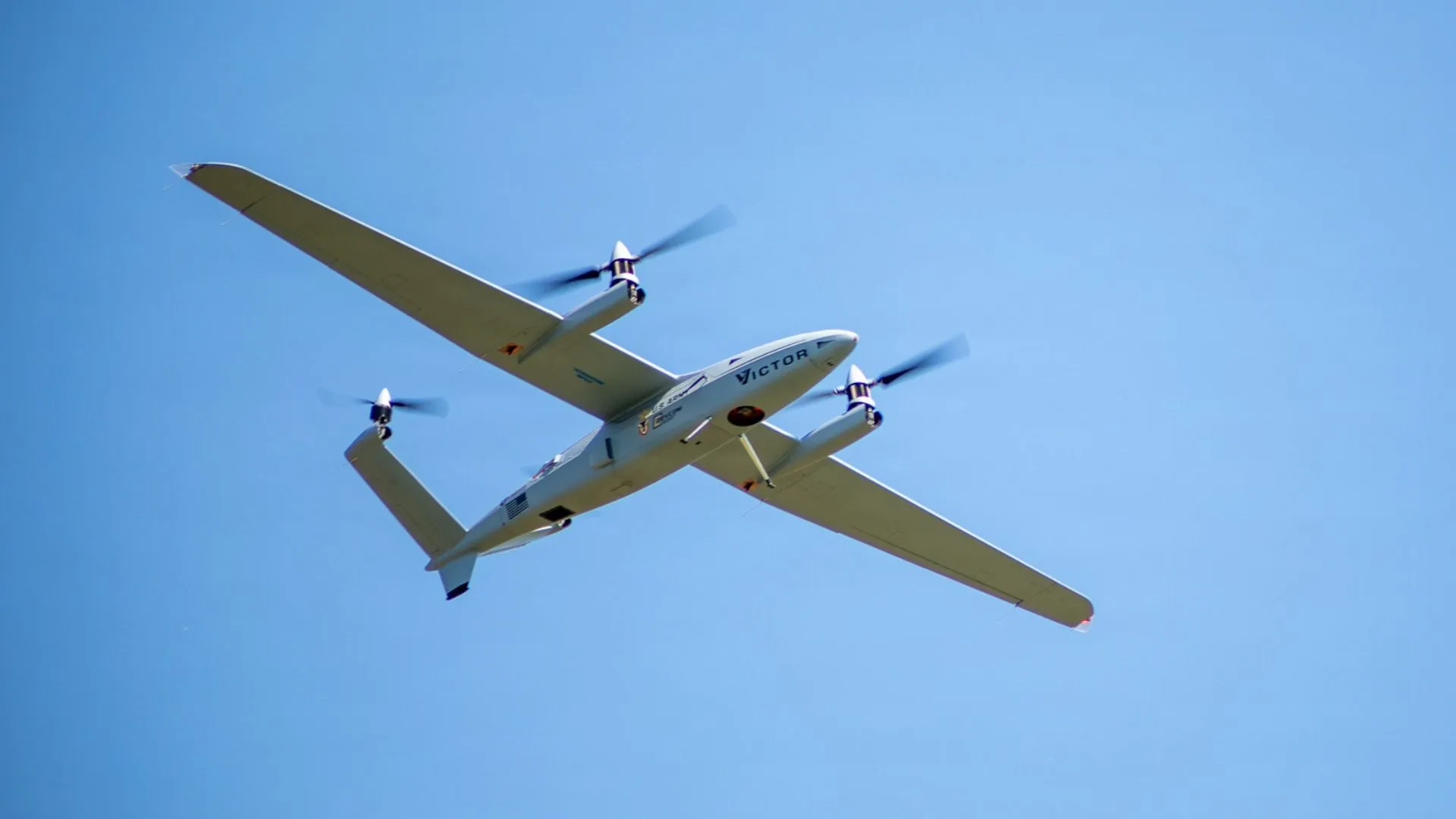
The U.S. Army Combat Capabilities Development Command Army Research Laboratory (DEVCOM ARL) has flight-demonstrated a 3D-printed, heavy-fuel rotary-engine series-hybrid propulsion system aboard a Group 3 unmanned aircraft, the laboratory announced on November 2, 2026. The air-cooled engine, designed in-house, powers the Versatile Intelligence Controlled Tactical Operational Reconnaissance and Attack unmanned aircraft system, or VICTOR UAS, an airframe developed with industry partners including Griffon Aerospace.
The flight caps years of work under ARL’s Versatile Tactical Power and Propulsion Essential Research Program, which shares the VICTOR acronym with the aircraft. The program targets a persistent logistics mismatch: Department of Defense policy favors a single kerosene-based battlefield fuel, JP-8 or its NATO equivalent F-24, yet most engines in the small and mid-sized drone class are built for gasoline. ARL program manager Dr. Chol-Bum “Mike” Kweon has previously said that commercial small-engine makers do not offer heavy-fuel engines in the power class these aircraft require, which leaves units managing a separate fuel stream at the tactical edge.
Inside the 3D-Printed Heavy Fuel Rotary Engine Design
Rotary engines offer a high power-to-weight ratio and low vibration, which explains their long use in tactical drones, but they have resisted heavy fuel. The elongated combustion chamber and limited compression ratio of the Wankel layout struggle to ignite and fully burn low-volatility kerosene, while apex and side seals leak compressed charge between chambers. Kweon authored an ARL technical review of heavy-fueled rotary combustion technologies as early as 2011, a measure of how long the laboratory has worked the problem.
ARL attacked it with advanced computational fluid dynamics modeling and a clean-sheet design. According to the laboratory, the work improved fuel atomization and vaporization while minimizing compressed-air and fuel-vapor leaks, the two failure modes that have long capped heavy-fuel rotary performance.
Additive manufacturing set the pace of iteration. “The use of advanced manufacturing, including 3D metal printing, allowed us to rapidly redesign engine components based on lessons learned through experimentation,” Kweon said. “It enabled us to design an air-cooled engine that reduces propulsion-system size and eliminates the need for liquid coolant.”
Dropping liquid cooling removes a radiator, pump and coolant lines, saving mass and volume while eliminating components that are both maintenance items and points of vulnerability to battle damage. ARL has not released displacement, rated power, dry weight, specific fuel consumption or ignition method for the engine. Those figures will determine how it compares with other heavy-fuel rotary designs funded under the same program.
How the 400-Volt Series Hybrid Powers VICTOR UAS VTOL Flight
The engine does not drive rotors or propellers directly. It turns a novel 400-volt motor-generator, forming a series-hybrid system in which the engine produces electricity and electric motors provide thrust. ARL says the architecture is designed to support vertical takeoff and landing (VTOL) operations in contested environments.
The series layout suits VTOL flight. Hover and transition demand short power peaks well above cruise requirements; decoupling the engine from the thrust units lets it run near its most efficient operating point while the electrical system distributes power to multiple motors. The 400-volt bus also cuts current for a given power level, which reduces cable mass and resistive losses across the airframe.
VICTOR UAS falls into Group 3 of the Department of Defense unmanned aircraft classification, which publicly available definitions place at 55 to 1,320 pounds maximum gross takeoff weight, operating below 18,000 feet mean sea level at speeds under 250 knots. ARL has not disclosed the aircraft’s wingspan, takeoff weight, payload, endurance, range or rotor configuration, nor the date of the demonstration flight. A U.S. Army photo shows VICTOR in flight near Huntsville, Alabama.
Griffon Aerospace’s own Valiant, designated YRQ-30A and a finalist in the Army’s Future Tactical Uncrewed Aircraft System (FTUAS) competition before the service cancelled the program in May 2025, pairs an internal heavy-fuel engine with electrically driven tilt-rotors. ARL has not stated whether VICTOR UAS shares any design lineage with Valiant.
From VICTOR to PULSAR: ARL’s Drone Swarm Concept and Transition Path
ARL says the essential research program worked with more than 30 universities, more than 13 federal laboratories and more than 20 industry partners, producing hundreds of journal publications in combustion chemistry, sensing and controls, materials, batteries and hybrid-electric technology, along with tens of patents and patent applications. It also generated technical data packages, design methods and reliability lessons for future propulsion and drone integration.
Related ARL-funded propulsion efforts include a $9 million award to LiquidPiston in 2022 for its compact X-Engine, a December 2024 demonstration of Advanced Innovative Engineering’s 225ACS Gen 5 heavy-fuel Wankel engine, and a $5.1 million contract under which GE Aerospace demonstrated a one-megawatt hybrid-electric turboshaft system in 2024.
Lessons from VICTOR will feed the Persistent Unmanned Aircraft System for Logistics, Strike, Autonomy, and Reconnaissance, or PULSAR, an advanced drone-operation concept that uses a swarm of VICTOR aircraft for multi-mission tasks. ARL will make both VICTOR UAS and PULSAR available to military partners for further experimentation and development, while industry partners continue refining the aircraft for other applications.
Analysis: The airframe matters less than the fuel. A Group 3 VTOL drone that burns heavy fuel such as JP-8, the fuel family that already powers a brigade’s trucks and generators, removes a dedicated gasoline supply chain and needs no runway, two constraints that weighed on the RQ-7B Shadow the Army moved to retire in 2024. Kweon says research findings have already moved to industry partners for maturation, but the release names no program of record, funding line or production partner. Without a receiving program, the technical data packages risk joining a long list of Army propulsion advances that never reached a fielded aircraft, at a time when the domestic base for small heavy-fuel engines remains thin.
The next markers are the experimentation campaigns with military partners and the first PULSAR swarm trials, for which ARL has given no dates. Publication of engine performance data and flight endurance figures, along with any interest from Program Executive Office Aviation, would show whether the heavy-fuel rotary hybrid moves beyond the laboratory. Until then, the flight stands as a proof of concept for single-fuel propulsion in the Group 3 class.