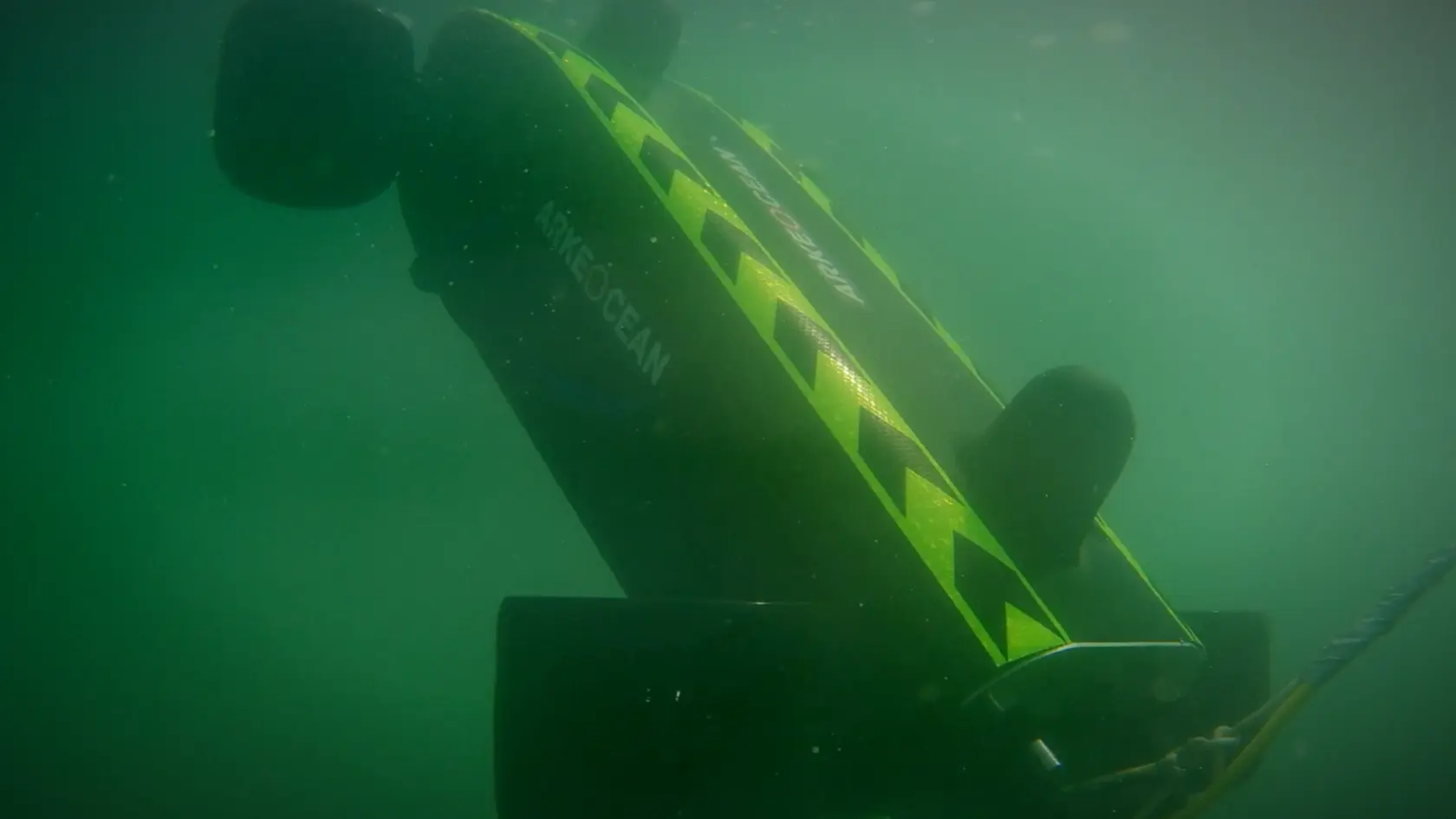
Thales and French underwater robotics company Arkeocean have launched a joint effort to develop a robotic mine countermeasure solution that pairs Arkeocean’s M Platform underwater vehicle with a Thales S-HEB warhead, the companies announced on November 3, 2026. The system is designed to be launched from small tactical boats and to operate in varied environments, including inland waterways.
The announcement, made on the opening day of the Euronaval exhibition near Paris, comes as navies look for lighter and cheaper ways to clear seabed mines without placing ships and crews inside the danger area. Thales has spent 2026 widening its uncrewed mine warfare offer. In March, it launched Expeditionary PathMaster, a portable mine countermeasures system built around an expeditionary portable operations centre (e-POC) and derived from technology developed for the French Navy under the Franco-British Maritime Mine Counter Measures (MMCM) program. The Arkeocean partnership adds a new mission effector to that open architecture.
Robotic Mine Countermeasure Architecture Pairs M Platform With S-HEB Warhead
Arkeocean describes the M Platform as a multi-mission underwater vehicle built on a modular architecture that accepts interchangeable mission payloads. It can operate remotely or autonomously depending on the environment. That flexibility matters in mine warfare, where operators may want autonomy during transit and search but direct control during the final approach to a confirmed contact. Arkeocean has not released dimensions, weight, depth rating, endurance, speed, or sensor fit, and none appear in the announcement.
Founded in 2009, Arkeocean is best known for swarms of micro autonomous underwater vehicles (AUVs), including the 70-centimeter Lelantos, which it trialed with the French Navy in 2023. The M Platform marks a move toward a larger, payload-driven vehicle.
Thales supplies the terminal effect. The S-HEB warhead belongs to the BlueSliver family and was developed at the group’s La Ferté-Saint-Aubin site in central France, which also produces 120 mm mortar munitions. Thales says BlueSliver warheads are designed from the outset to integrate on different compatible platforms and to deliver effects tailored to the target, and that S-HEB neutralizes mines while ensuring a high level of user safety. The company has not disclosed charge mass, explosive fill, effect type, or whether the vehicle is expendable or recoverable after the shot, a detail that will drive cost per neutralized mine.
Expeditionary PathMaster Gains a Small-Boat Mine Neutralization Effector
Thales plans to extend the operational chain through a dedicated payload integrated into the full sequence of detecting, classifying, identifying, and neutralizing mine threats, known as DCLIN. Expeditionary PathMaster combines the M-Cube mission management system and MiMap sonar analysis software in a portable operations centre that can run from shore, a rigid inflatable boat, a minehunter, or another vessel. It is designed to absorb third-party assets, including AUVs, remotely operated vehicles (ROVs), and conventional minehunters. Thales has demonstrated the system with the Lithuanian Navy and claims its AI-assisted processing reaches 99 percent correct classification of sonar contacts.
Within that architecture, the M Platform and S-HEB combination would cover the final step. The neutralization segment is currently dominated by dedicated expendable mine disposal vehicles such as Atlas Elektronik’s SeaFox and Exail’s K-STER, usually operated from minehunters or larger uncrewed surface vessels. A modular vehicle that can swap its warhead for other payloads and fits on a small tactical boat targets navies that cannot assign a minehunter to every harbor, chokepoint, or river crossing. The inland waterway requirement points to riverine and port clearance missions where large hulls cannot operate.
Analysis: The partnership is less about a new vehicle than about who controls the effect. Thales already supplies sensors, software, and command and control across the PathMaster family; integrating its own warhead on third-party vehicles lets it offer the complete DCLIN chain under one open architecture while smaller firms such as Arkeocean carry platform risk. For medium and smaller navies, including Baltic NATO members facing dense legacy and modern mine threats, that model could deliver a neutralization capability at small-boat scale without new mine countermeasure vessels. The decisive variable is unit cost. If the M Platform is expended with each S-HEB shot, its price per kill must undercut existing one-shot vehicles to justify the cost-effective label.
Neither company has announced a launch customer, contract value, test schedule, or in-service date. The next milestones are live neutralization trials against representative mine targets, safety qualification of the warhead and vehicle combination, and formal integration into Expeditionary PathMaster. Interest from the French Navy, already the reference customer for MMCM, would be the first indicator of the program’s prospects.