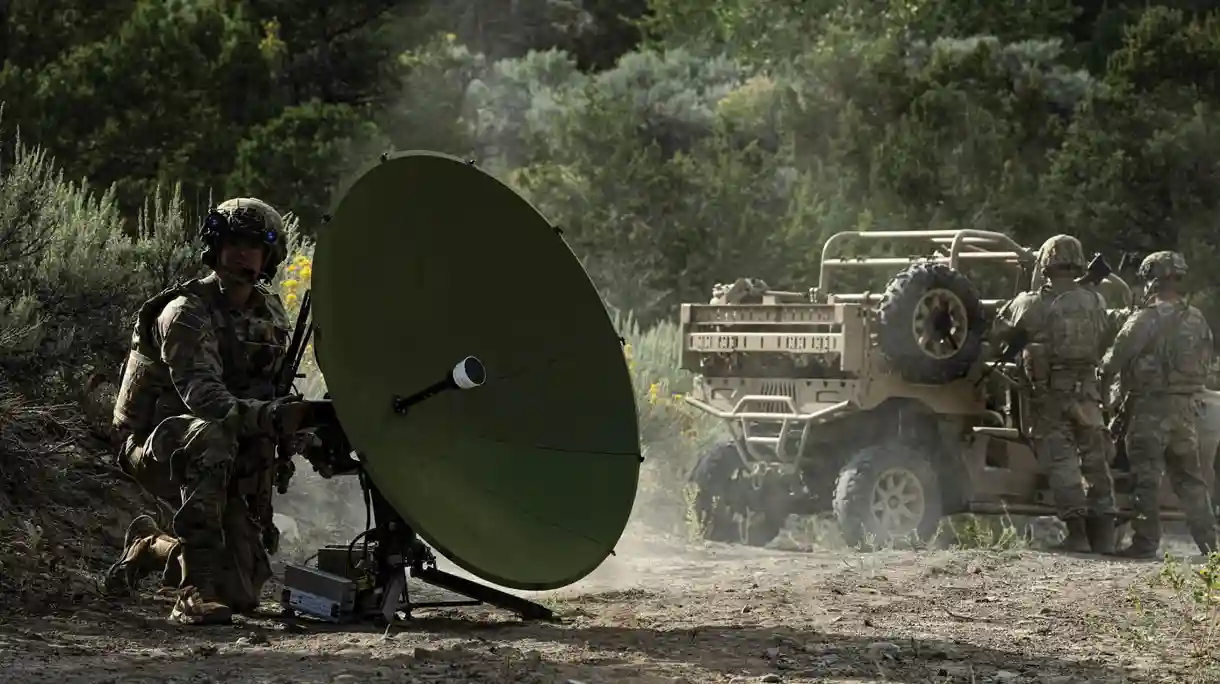
L3Harris Technologies has received a $36 million order from the U.S. Army for its Hawkeye 4 Lite satellite communications terminal, the company announced on November 3, 2026. The terminals will be fielded under the Army’s Command and Control Network Optimized for Warfighting (C2NOW) initiative, to deliver secure, seamless SATCOM interoperability between U.S. and NATO forces.
C2NOW is the Army’s effort to replace legacy network equipment as it fields Next Generation Command and Control (NGC2). In its fiscal year 2027 budget request, released on April 21, 2026, the Army sought $3.7 billion in procurement and investment funding across NGC2 and C2NOW, with the C2NOW line financing the divestment of legacy Warfighter Information Network-Tactical (WIN-T) and Tactical Server Infrastructure (TSI) hardware. The Hawkeye order follows by one day L3Harris’ disclosure of $121 million in Army production orders for its Low-Cost Data Radio (LOCODA), also tied to command and control requirements.
Hawkeye 4 Lite Terminal Architecture and Multi-Band Performance
According to L3Harris, the Army configuration relies on a rapidly deployable Hawkeye 4 Lite with field-swappable components, intended to give units flexibility in dynamic operational environments. “L3Harris is ready to support the Army with resilient, expeditionary communications capabilities that align with its modernization priorities,” said Faisal Munir, President, Mission Critical Communications, Communications & Spectrum Dominance, L3Harris. The company did not disclose terminal quantities, band configuration, delivery schedule, or receiving units.
Introduced in September 2021, the terminal is built around a 1.3-meter carbon fiber segmented, center-fed parabolic antenna. Manufacturer specifications indicate it operates in X, Ku, and Ka bands, with RF modules swappable in under five minutes without tools and a box-to-bird setup time of under 10 minutes. The base system packs into two cases, each under 84 pounds and sized for airline check-in, and deploys on a 4-by-4-foot footprint.
Published figures list an effective isotropic radiated power (EIRP) of 51.7 dBW in X band, 54.8 dBW in Ku band, and 56.6 dBW in Ka band, with G/T ratings of 16.7, 20.5, and 21.8 dB/K respectively. Those margins matter for a flyaway terminal expected to close links from austere sites rather than fixed hubs. An optional fiber module lets operators control the terminal from up to 1,500 meters away, separating the antenna’s emissions from the command post itself.
Multi-Orbit SATCOM Resilience for US and NATO Formations
Interoperability sits at the core of the requirement. The Hawkeye 4 Lite holds certifications for the Wideband Global SATCOM (WGS) constellation in X and Ka bands, Inmarsat Global Xpress in Ka band, and IntelsatOne FlexGovSecure and FlexMove in Ku band, giving U.S. units access to military and commercial capacity that allied forces also use.
The terminal accepts integrated modems from iDirect, Viasat, and L3Harris, as well as external modems, allowing a unit to match the waveform of a partner network. L3Harris is also developing a Comtech 5650C2/MP modem module that combines medium Earth orbit (MEO), geostationary (GEO), and highly elliptical orbit (HEO) operation with a direct sequence spread spectrum waveform for low probability of intercept and detection. The company lists that module, along with SES mPOWER and HEO certifications, as still in funded development. Whether the Army order includes the multi-orbit kit or the optional GATEKEEPER interference excision technology has not been disclosed.
Analysis: The order is modest against the $3.7 billion requested for NGC2 and C2NOW, but it shows where the Army is spending first: the transport layer. A data-centric C2 architecture is only as resilient as the links beneath it, and single-band, GEO-dependent terminals offer a predictable target for jamming in a peer conflict. A modular terminal that can change bands in the field today, and orbits once its MEO and HEO options mature, lets the Army hedge against electronic attack and commercial capacity constraints without buying new hardware for each threat.
The key unknowns remain the number of terminals covered by the $36 million, the units slated to receive them, and the fielding timeline. The next indicators to watch are WGS certification of the 5650C2/MP module, any follow-on C2NOW orders, and how congressional appropriators treat the Army’s FY2027 network request.