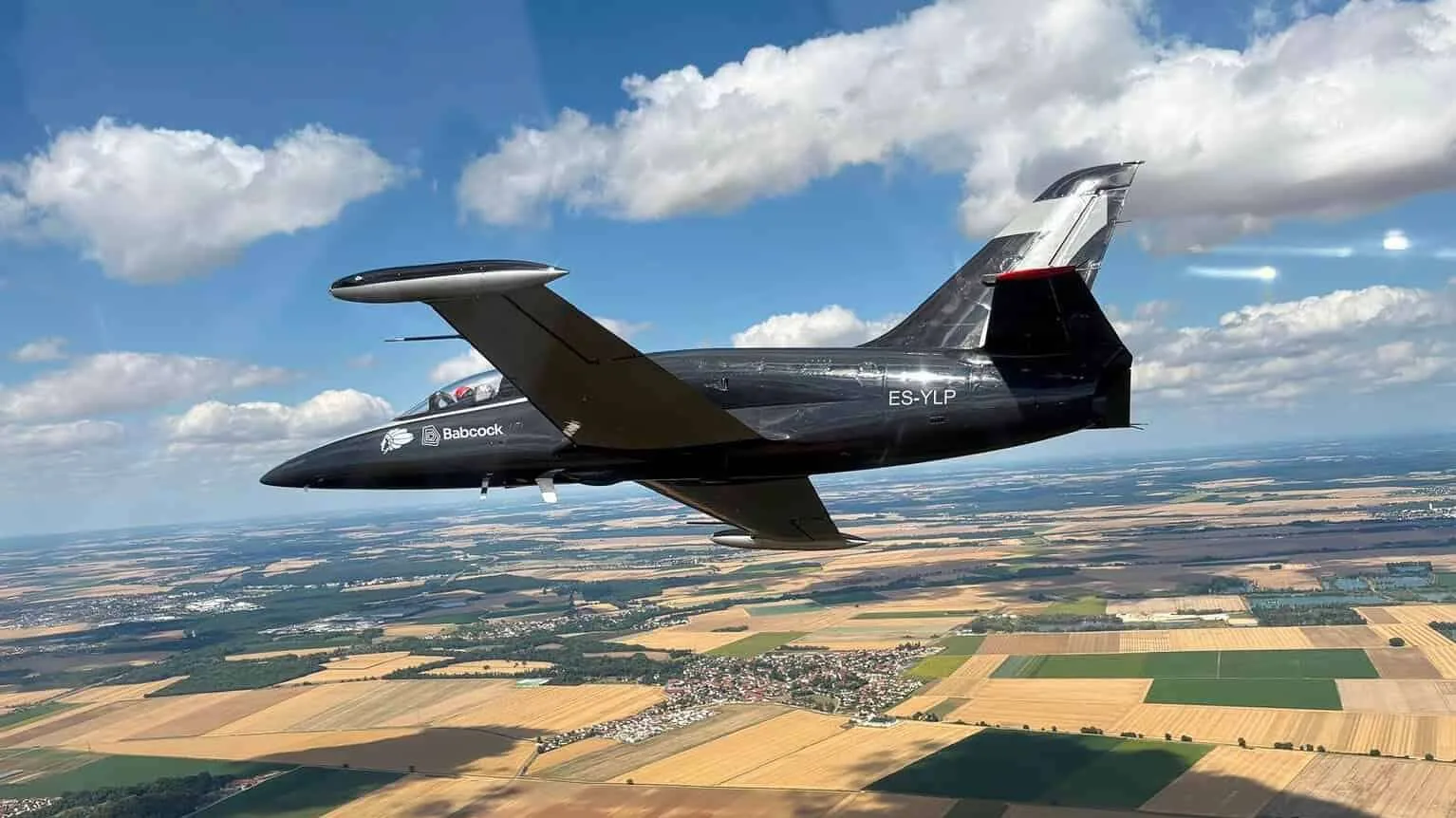
Babcock France has secured an eight-year contract from the French Armed Forces Commissariat Service (SCA) to provide contracted adversary, or “Red Air,” training to combat units of the French Air and Space Force, the French Navy and the French Army, the company announced on November 3, 2026. Working with Secapem Defence Training Solutions (SDTS) and Top Aces France, Babcock will deliver up to 400 sorties and more than 1,000 flying hours per year alongside the Rafale and Mirage 2000 fleets.
The award moves Babcock France from pilot training into operational readiness support. The company already operates 26 PC-21 trainers at Cognac-Châteaubernard Air Base, won a €795 million, 17-year contract in January 2025 covering 22 PC-7 MkX aircraft, and secured a separate SCA pilot training contract in February 2026. Its jet capability rests on 11 L-39 Albatros acquired from Apache Aviation in December 2024, whose first contract, announced in December 2025, supports flight test training and target simulation for the EPNER test pilot school. Babcock has not disclosed the contract’s value, start date or fleet sizes.
Red Air Training Fleet: Upgraded L-39s, A-4N Skyhawks and Alpha Jets
Babcock will maintain and operate its upgraded L-39s from its Dijon-Bourgogne base, while SDTS will maintain and operate A-4N Skyhawk Advanced Aggressor Fighters and Alpha Jets supplied by Top Aces France. Missions will launch from military air bases and civilian airports across France, allowing the providers to meet units near their home stations.
The A-4N is the most capable airframe in the package. The former Israeli Air Force jets carry Top Aces’ proprietary Advanced Aggressor Mission System (AAMS), an open-architecture suite that integrates an active electronically scanned array (AESA) radar, infrared search and track (IRST), tactical datalink, electronic attack and high-fidelity weapon simulation. Publicly available specifications indicate a single Pratt & Whitney J52-P-408 turbojet rated at roughly 11,200 lbf of thrust. For Rafale crews flying with RBE2 AESA radars, the value lies less in the Skyhawk’s kinematics than in its emissions: an adversary that radiates, jams and shares data like a modern fighter forces realistic sensor management and electronic warfare decisions.
The twin-engine Alpha Jet, which Top Aces also flies for Canada and Germany, serves as a lower-cost aggressor for visual-range work and larger threat presentations. SDTS brings French operating experience: the firm has flown Red Air for the French Navy from Nîmes-Garons since winning a 2015 tender, previously with jets leased from Draken International.
The stated annual output implies an average sortie of about 2.5 flying hours and up to 3,200 sorties over the contract’s life if the ceiling is reached every year.
ROVER-Equipped L-39s and the JTAC Training Mission
Babcock’s L-39s will carry Remotely Operated Video Enhanced Receiver (ROVER) equipment, which streams real-time video between aircrew and ground controllers. The jets will cover a spectrum running from basic visual-range air combat manoeuvres to Joint Terminal Attack Controller (JTAC) training, in which controllers coordinate air and ground fires, exchange tactical information and protect friendly forces while identifying and designating targets.
Publicly available specifications indicate the L-39 is powered by a single Ivchenko AI-25TL turbofan producing about 16.9 kN of thrust, with a maximum level speed near 750 km/h. Babcock has not detailed its upgrade beyond ROVER.
The JTAC tasking matters most for the Army and Navy. Controllers need repeated live-aircraft events to qualify and stay current, and every hour a Rafale spends supporting a training range is an hour withdrawn from front-line tasking.
Analysis: France is consolidating tri-service adversary and JTAC support under a single long-term contractor team, following Germany, where Top Aces won a 10-year contract worth up to €420 million in January 2026, as well as Canada and the United States. The model preserves scarce fighter hours while French fleets absorb operational commitments and the transfer of Mirage 2000-5F jets to Ukraine. Its limits are physical: subsonic L-39s, A-4Ns and Alpha Jets cannot replicate the speed or maneuver envelope of a Su-35 or J-20, so training value will depend on how much of the AAMS sensor and electronic attack suite reaches French skies.
Key unknowns remain the contract’s value, the date operations begin, the scope of Babcock’s L-39 upgrade beyond ROVER and how many A-4Ns will arrive in full AAMS configuration. Pierre Basquin, Chief Executive Aviation and CEO of Babcock France, said armed forces must train in conditions “as realistic, demanding and representative of modern combat as possible”; the first annual sortie tallies will test that standard.