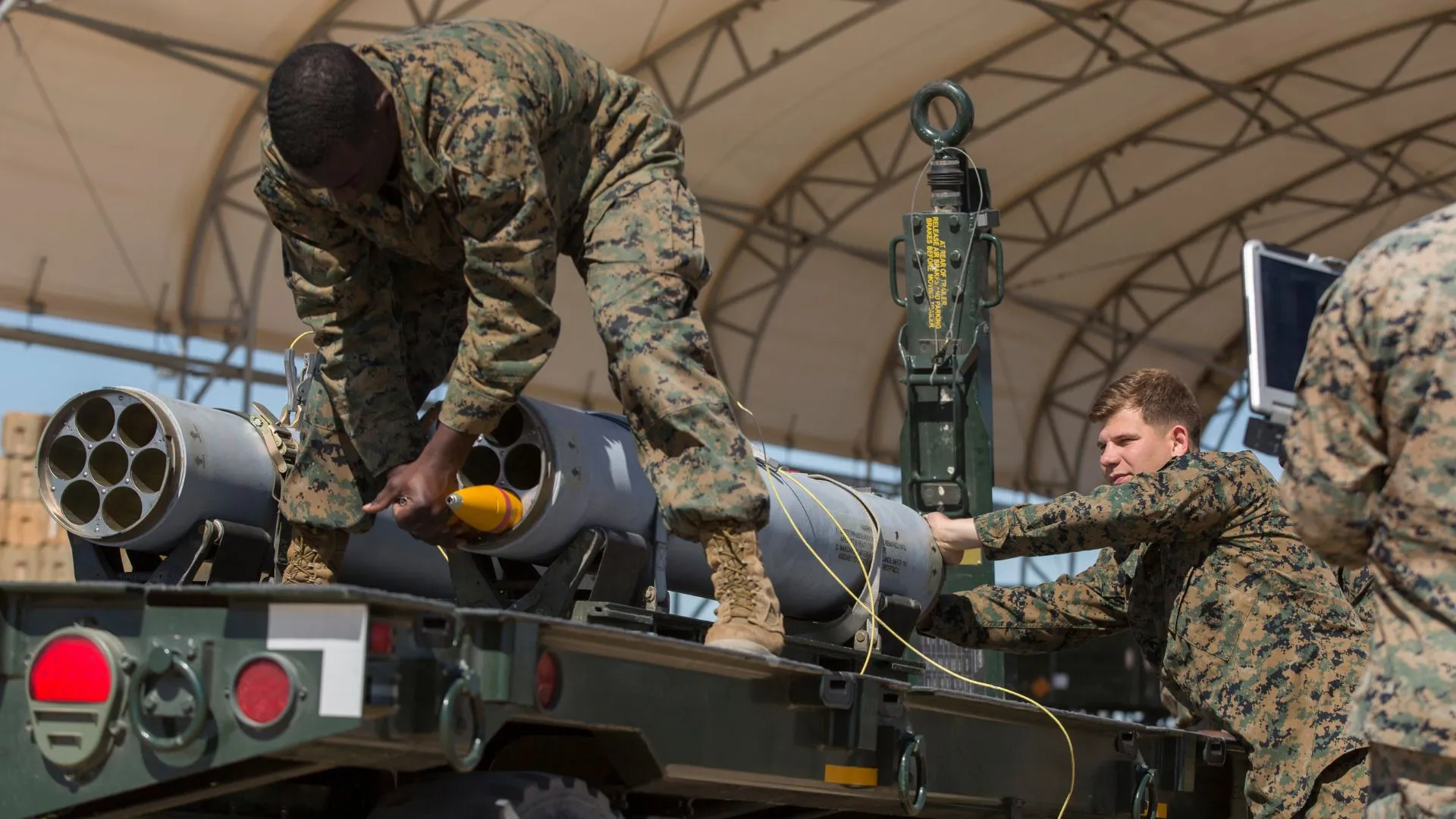
The U.S. State Department on November 2, 2026, approved a possible Foreign Military Sale to Jordan of up to 1,500 Advanced Precision Kill Weapon System II (APKWS II) laser-guided rockets and related equipment, at an estimated total cost of $100 million. BAE Systems, Inc., of Nashua, New Hampshire, is named as principal contractor. The notification was filed as Transmittal 26-95.
The approval comes as Jordan absorbs sustained Iranian missile and drone fire that began on February 28, 2026. By early April, the Jordanian Armed Forces said the Royal Jordanian Air Force (RJAF) had intercepted 261 of 281 Iranian missiles and drones aimed at the kingdom over five weeks. The State Department frames the purchase in explicit air defense terms, tying it to the Middle East Air Defense pillar of the Regional Security Construct and to the protection of U.S. military assets stationed in Jordan.
Inside the Jordan APKWS Package: Guidance Sections, Fuzes, and Motors
The request covers up to 1,500 WGU-59A/B or WGU-59B/B Single Variant Block Upgrade guidance sections, delivered either as all-up rounds or as guidance sections alone, configurable for air-to-air, ground-to-air, or air-to-ground engagements. Supporting items include launchers, Mk-152 high-explosive warheads, MK66 rocket motors, proximity fuzes, WTU-1/B practice warheads, inert MK66 motors, technical documentation, and U.S. Government and contractor engineering, training, and logistics support.
APKWS II converts the unguided 2.75-inch (70 mm) Hydra 70 rocket into a semi-active laser-guided munition by inserting a mid-body guidance section between the MK66 motor and the warhead. Publicly available specifications indicate the WGU-59 section measures about 47 cm (18.5 in) and weighs roughly 4.4 kg (9.8 lb), with flip-out wings spanning 24.3 cm. Its Distributed Aperture Semi-Active Laser Seeker (DASALS) optics sit in the leading edges of those wings and acquire the laser spot after launch. Because the rocket needs no lock-on before launch, crews can ripple shots against drone salvos with minimal delay.
The variant mix matters. The WGU-59A/B extended the kit from helicopters to fast fixed-wing aircraft. The WGU-59B/B is associated with the U.S. Air Force AGR-20F, known as FALCO (Fixed Wing, Air-Launched, Counter-Unmanned Aircraft Systems Ordnance), which pairs updated guidance software with a proximity fuze so the warhead detonates on a near miss against small aerial targets. The inclusion of proximity fuzes in the Jordanian package points directly at that counter-drone role. The notification does not specify launcher types; APKWS II rounds require extended-tube launchers such as the seven-tube LAU-68F/A or LAU-131A/A.
Cost per Intercept Drives Regional Demand for APKWS II Rockets
Dividing the $100 million ceiling by 1,500 rounds yields a nominal figure of about $66,700 per round. That figure includes support and training and is not a unit price; notifications state maximum case values. Even so, it sits well below publicly reported unit costs for the AIM-9X Sidewinder and AIM-120 AMRAAM, which fighters otherwise expend against one-way attack drones.
Jordan’s request follows a wave of APKWS II approvals. On July 15, 2026, the State Department cleared a possible $1.96 billion sale to Saudi Arabia of up to 20,000 guidance sections, split evenly between air-to-air and air-to-ground configurations. In August, it approved a $364 million case for Italy covering 5,031 WGU-59B/B air-to-air kits. The U.S. Air Force has already made APKWS II its principal air-to-air weapon against drones in the Middle East, where F-16s first used it operationally in 2024 before its use extended to F-15E Strike Eagles and A-10s.
Amman is not new to the system. Jordan became the first international APKWS customer in April 2014 and received an initial batch of 110 rockets in late 2015 for its CASA CN-235 gunship. The current notification does not name launch platforms. The RJAF’s F-16 fleet is a logical candidate given APKWS II integration on U.S. Air Force F-16s, but that remains unconfirmed.
Analysis: The case is small in dollar terms but revealing in structure. The State Department states that the buy will allow for the reduction of sustained U.S. support over time, language that signals Washington wants partners hosting U.S. forces to carry more of the counter-drone burden from their own magazines. For Jordan, 1,500 rounds provide real depth against the class of threat it has faced since February: the RJAF can engage low-cost drones without drawing down scarcer air-to-air missiles or ground-based interceptors. Combined, the 2026 Saudi, Italian, and Jordanian cases total more than 26,000 guidance sections, placing pressure on BAE Systems’ Nashua production line. Delivery schedules, not approvals, will determine how quickly the capability reaches the flight line.
Congress now has its review window to object, after which the two governments can move toward a Letter of Offer and Acceptance. No offset agreement has been proposed, and no additional U.S. personnel will be assigned to Jordan. Key unknowns remain the split between WGU-59A/B and WGU-59B/B sections, the intended launch platforms, and the delivery timeline.