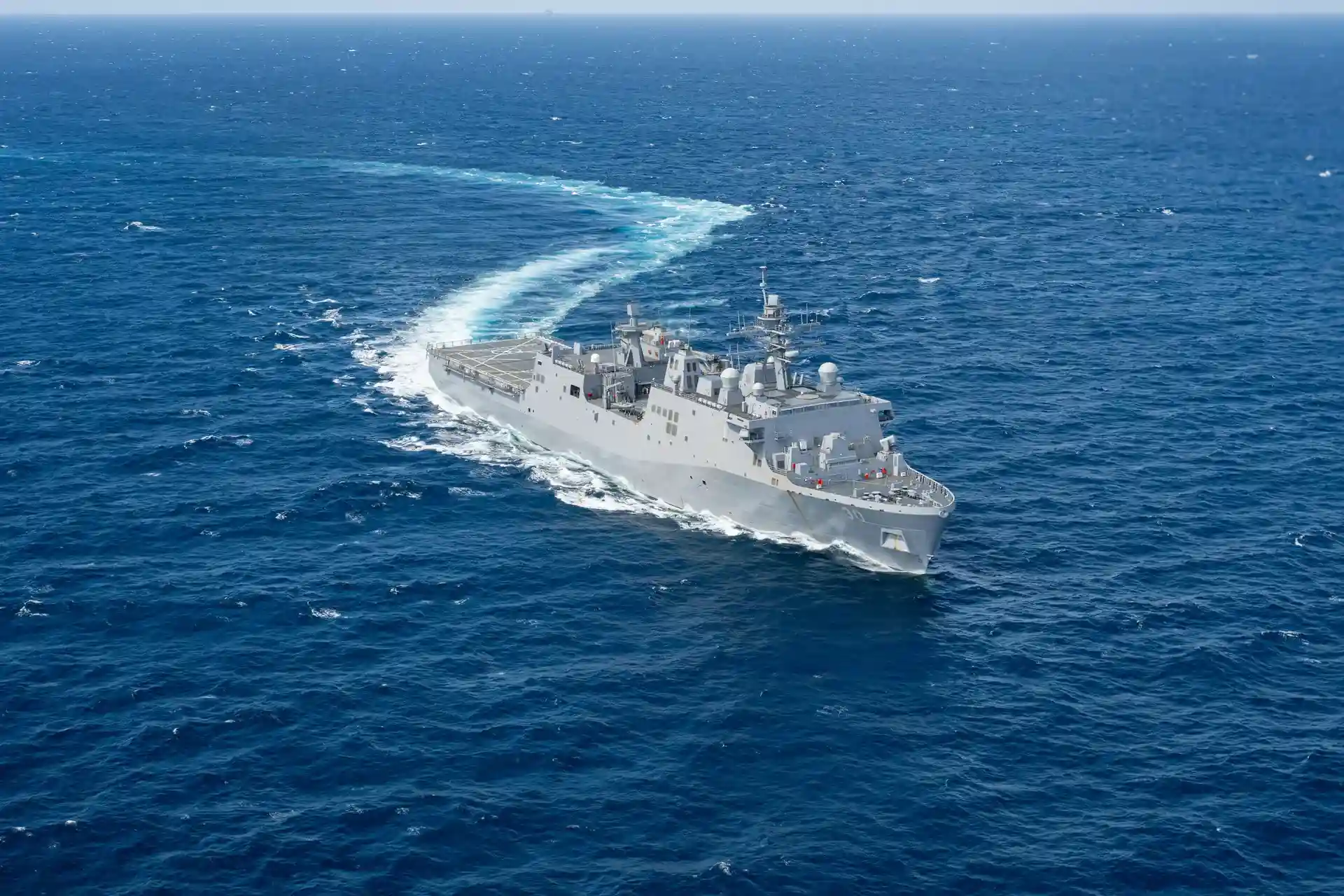
HII’s Ingalls Shipbuilding division has completed builder’s sea trials for Harrisburg (LPD 30), the first Flight II ship of the U.S. Navy’s San Antonio-class amphibious transport dock program, the company announced on November 3, 2026. The multiday at-sea period, which concluded on Saturday, October 31, verified propulsion, steering, ship control, communications, mission systems, and combat systems integration before the ship returned to the Pascagoula, Mississippi, yard with major test objectives met.
The milestone moves the lead ship of the follow-on flight closer to the fleet after a long build. The Navy awarded Ingalls a $1.47 billion detail design and construction modification for LPD 30 in March 2019, fabrication began in April 2020, the ship launched on October 5, 2024, and it was christened on January 11, 2025. Flight II is the functional replacement for the Whidbey Island-class (LSD 41) and Harpers Ferry-class (LSD 49) dock landing ships, and it underpins the 31-ship amphibious force floor set in law.
Harrisburg LPD 30 Flight II Configuration: Radar, Mast, and Aviation
Builder’s trials are the shipyard’s own at-sea test campaign, conducted before the Navy’s Board of Inspection and Survey runs acceptance trials. HII released no performance data, such as maximum speed achieved or open deficiencies. Stephen Janowski, Ingalls’ amphibious ship program manager, called the trials a critical step toward delivering the ship to the fleet.
For a lead ship, combat systems integration is the most consequential item on the test list. Harrisburg is the first San Antonio built from the keel up to the Flight II baseline, which incorporates more than 200 design changes. Its centerpiece is the Raytheon AN/SPY-6(V)2 Enterprise Air Surveillance Radar (EASR), the rotating variant of the SPY-6 radar family that equips Flight III Arleigh Burke-class destroyers, built from nine Radar Modular Assemblies. EASR replaces the legacy AN/SPS-48 air search radar used on earlier San Antonio-class ships and improves the ship’s ability to detect and track air threats.
The enclosed composite masts that defined the early San Antonio silhouette are gone, replaced by a conventional steel mast similar to those on Arleigh Burke-class destroyers. Flight II also carries the Lockheed Martin AN/SLQ-32(V)6 electronic warfare suite. Both features were introduced on the transition ship Fort Lauderdale (LPD 28), and the second transition ship, Richard M. McCool Jr. (LPD 29), was the first LPD to field a SPY-6 variant.
Mission capability largely tracks Flight I. The Navy’s fact file lists the same length of 684 feet, full-load displacement of about 24,900 long tons, and speed above 22 knots for both flights. The well deck accommodates two Landing Craft Air Cushion, including the new Ship-to-Shore Connector, or one Landing Craft Utility, while the flight deck and hangar support MV-22B Ospreys and the CH-53K King Stallion. The Navy lists an embarked landing force of 631 troops for Flight II, against 699, or 800 in surge, for Flight I, and congressional researchers have characterized the design as less expensive than Flight I but less capable in some respects.
Production Cadence and Cost Pressure Across the Flight II Line
Ingalls, the class’s sole builder, has delivered LPDs 17 through 29 and has three Flight II hulls under construction: Harrisburg, Pittsburgh (LPD 31), and Philadelphia (LPD 32). Early procurement and planning are under way for Travis Manion (LPD 33), LPD 34, and LPD 35.
Those three later hulls are covered by a $5.8 billion award announced on September 24, 2024, part of a combined $9.6 billion amphibious multi-ship procurement that also funded the America-class amphibious assault ship Helmand Province (LHA 10). The Navy said bundling the four ships would save roughly $901 million, largely through economies of scale in material purchases, with LPD work running through September 2035.
The award closed a period of uncertainty. The Pentagon’s fiscal 2023 budget request sought to stop the San Antonio line, which then-Navy Secretary Carlos Del Toro framed as a strategic pause to reassess how many of the ships the force needs, and the Office of the Secretary of Defense paused the program in spring 2023 to study its costs and capabilities. Congressional researchers have put the estimated unit procurement cost of a Flight II ship at about $2 billion.
Schedule is the other pressure point. Harrisburg took roughly seven and a half years from contract award to builder’s trials, reflecting the integration burden of a lead ship. How quickly Pittsburgh and Philadelphia follow will indicate whether lessons from LPD 30 translate into the predictable build sequence the multi-ship deal was structured to sustain.
Analysis: Harrisburg’s trials matter less as a single-ship event than as the first real test of whether the Flight II baseline can be delivered on a predictable schedule. The 31-ship floor, defined as 10 large-deck amphibious ships and 21 LPD- and LSD-type ships, depends on Flight II hulls replacing aging dock landing ships on a timeline the Navy has struggled to hold. A clean acceptance trial would signal that Flight II integration risk has been retired on the lead ship and strengthen the case for multi-ship buys. Further slips would reopen the cost debate that triggered the procurement pause and squeeze amphibious ready group availability as LSDs leave service.
Harrisburg now prepares for acceptance trials, and HII expects delivery to the Navy before the end of 2026, a tight window for a lead ship that has yet to complete government trials. Neither the company nor the Navy has announced a commissioning date, a homeport, or the post-delivery schedule for crew certification and combat systems qualification.