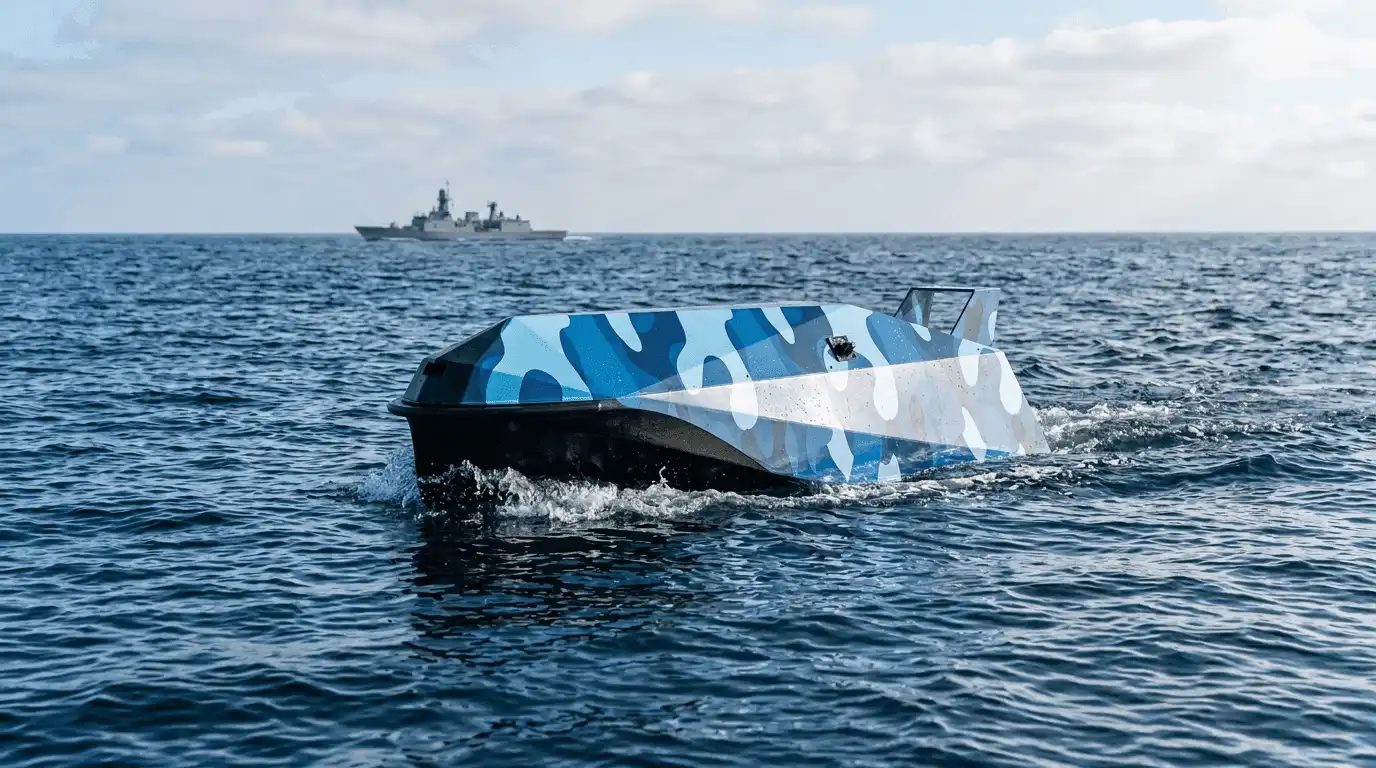
KNDS and SeaOwl Technology Solutions announced on November 3, 2026, at the Euronaval exhibition in Villepinte, outside Paris, the signing of a strategic cooperation agreement to develop and test an armed unmanned surface vehicle (USV) built around a qualified warhead from KNDS. The companies present the craft as a next-generation naval loitering munition for offensive and defensive missions, citing a maximum speed of 35 knots, a 30 kg payload and a combat range of up to 200 km.
The deal lands less than four weeks after France’s Defence Innovation Agency (AID) and the French Navy named SeaOwl Technology Solutions one of three finalists in DANAE (Drone de surface Autonome Naval avec capacité d’Armement Embarqué), the program meant to give the Marine Nationale an armed USV at scale. Launched in January 2026, DANAE put seven existing drones through sea trials off Saint-Mandrier, near Toulon, before the October 8 downselect. SeaOwl now faces the Orcas consortium of SEAir, Ægir, MBDA and Diadès Marine, and a Sirehna, Couach and Naval Group team, in a 12-month prototyping phase, with a production decision expected by the end of 2027. Neither partner has said whether the new system will be offered under DANAE.
KNDS SeaOwl USV Specifications: Speed, Payload and Combat Range
A 35-knot top speed, roughly 65 km/h, lets the craft close on fast attack craft and hostile drone boats before they reach a defended asset. The 200 km combat range equates to just over three hours of transit at maximum speed, enough for a launching ship or shore team to engage targets well outside the reach of short-range coastal weapons.
The companies say radar and optical signatures have been reduced to improve stealth, and that the system rests on a fully cyber-secure architecture with a highly protected firing chain. The craft can navigate autonomously in contested waters, but engagement stays under continuous human control: the final decision to engage and fire rests exclusively with the remote operator.
The press release gives no designation or hull data. Marine & Océans reported the system as TRACUS Combat, a 3.60-meter craft launched from a canister from heights of up to 7 meters, and Reuters also reported the 7-meter launch height and said the drone can be deployed in swarms. Displacement, propulsion type, sensor suite and datalink architecture remain undisclosed, and the companies have not specified whether the 30 kg figure refers to the warhead alone or to the full mission payload. It is also unclear whether the craft is strictly expendable or can be recovered after an aborted attack, as KNDS says its MX-10 aerial munition can be.
For scale, publicly available figures for Ukraine’s Magura V5 indicate an explosive charge of up to 300 kg and a range of up to 800 km. The KNDS-SeaOwl craft trades hull-breaching mass for speed and signature control, pointing toward small boats, enemy USVs and exposed topside systems as targets.
How KNDS Mataris Warhead Expertise Moves Into the Naval Domain
KNDS brings the munitions half of the equation. Through KNDS Ammo France, the group builds the warheads for its Mataris family of loitering munitions, unveiled at IDEX in February 2025. The family runs from the MT-10 and the MX-10 Damocles quadcopter, the latter with a 10 km reach, through the MV-25 Oskar at 25 km, to the turbine-powered MV-100 Veloce 330 at 100 km. Damocles carries a 550 g fragmentation-incendiary warhead and was developed, safety-qualified and produced in 12 months under the French MTO-CP short-range program. Veloce 330 carries a 2.5 kg anti-armor warhead derived from the BONUS 155 mm top-attack artillery round.
A 30 kg naval payload sits an order of magnitude above anything in the current Mataris lineup, and KNDS has not said whether it will adapt an existing design or develop a new charge. The operative word in the announcement is qualified. Safety qualification of the warhead, its safe-and-arm device and the firing chain is the most demanding step in fielding any armed drone in France, and it is the expertise KNDS says it wants to transfer to robotic maritime platforms. For a USV integrator, buying into an already qualified pyrotechnic chain removes the program risk that typically delays armed variants.
SeaOwl’s Path From Target Drones to Armed Naval Robotics
SeaOwl Technology Solutions is the innovation subsidiary of SeaOwl Group, a French mid-sized company reporting €120 million in annual revenue and 2,000 employees across energy and defense. As a shipowner, the group already supports French Navy fleet training with real-condition simulation services.
At Euronaval 2024, SeaOwl presented TRACUS, a training service using target USVs converted from jet-ski hulls to replicate kamikaze drone and swarm threats. The company works as a dronization integrator, fitting autonomy kits to hulls from builders such as Zodiac Milpro and Anytec rather than fielding a single standard platform. On April 26, 2025, the French Navy detonated a jet-ski-based one-way attack USV, launched from an offshore patrol vessel, against a decommissioned landing craft off Toulon. The Navy did not name the builder, though Naval News noted that the craft closely resembled the target version SeaOwl displayed at Euronaval 2024. SeaOwl Technology Solutions has also announced a plant of nearly €10 million at Ollioules, in the Var, due to be operational in 2028.
Analysis: The agreement reflects a structural shift in how European armed USVs are built: platform integrators are pairing directly with munitions houses that own the qualification process, rather than waiting for a prime to integrate both. In DANAE, SeaOwl’s rivals include a consortium that counts MBDA among its members; the KNDS link gives SeaOwl a comparable warhead and qualification partner. Rheinmetall’s Euronaval display of the Kraken K3 USV alongside its FV-014 loitering munition shows the same logic at work. For KNDS, a land systems group with €4.4 billion in 2025 revenue, it is a low-cost entry into naval strike drones, a segment where its maritime footprint has so far centered on guns such as the Narwhal remote-controlled turret.
KNDS and SeaOwl have not published a test schedule, a launch customer or a target in-service date. The next markers are the first firing trials of the KNDS warhead from the USV, official confirmation of the platform designation and hull data, and any confirmation that the system will feature in SeaOwl’s DANAE prototype ahead of the French Navy’s production decision expected by the end of 2027.