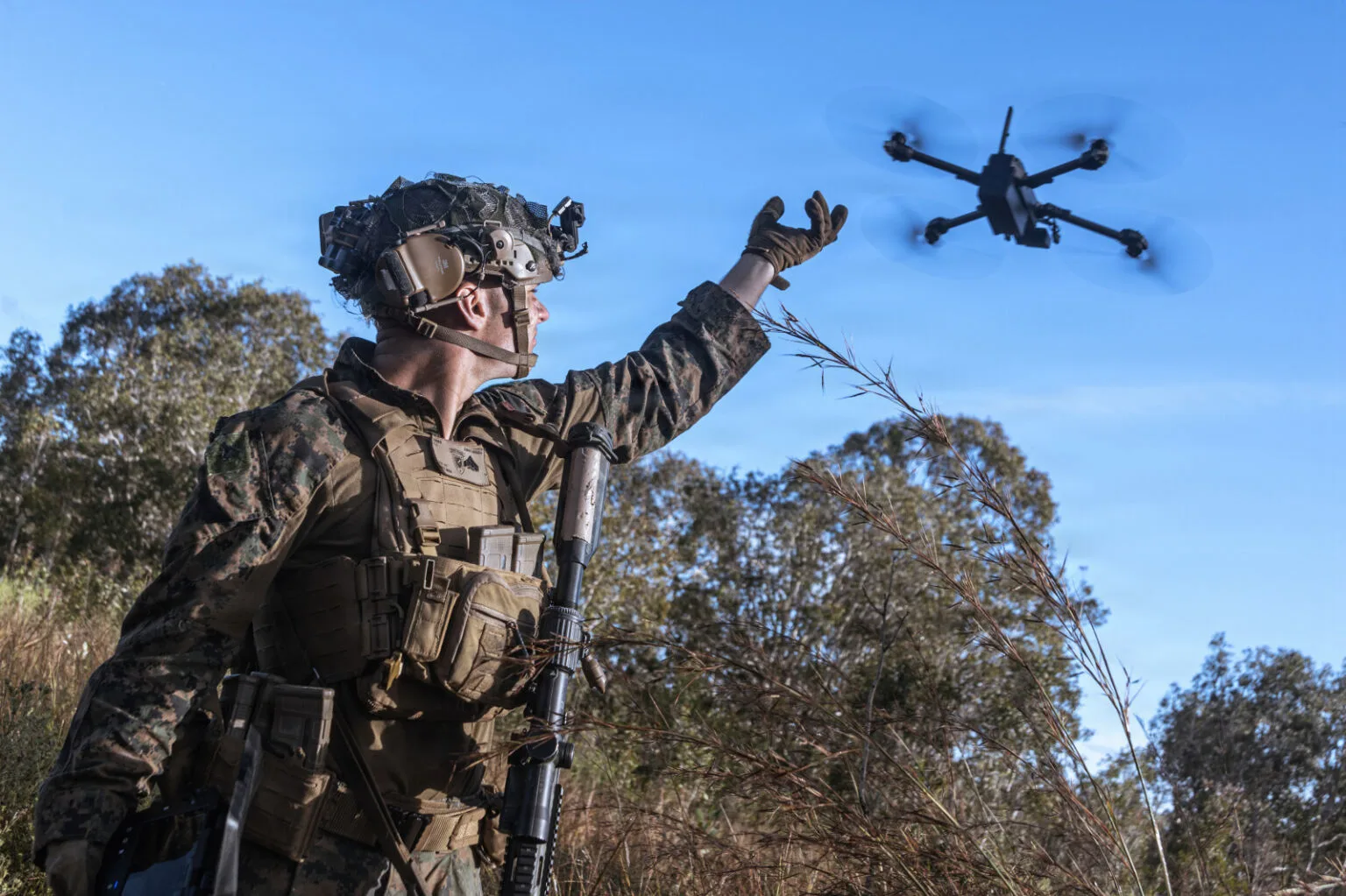
Frontline U.S. forces in the U.S. Central Command (CENTCOM) area of responsibility have received more than 25,000 unmanned aerial systems and counter-unmanned aircraft systems (counter-UAS) so far in 2026, the War Department said on November 4, 2026. The deliveries were driven by the Direct Reporting Portfolio Manager for Unmanned Systems (DRPM-UxS), an office that has existed for roughly four months.
DRPM-UxS stood up in July to execute the drone dominance agenda set by President Donald J. Trump and Secretary of War Pete Hegseth, whose July 10, 2025, memorandum directed that small Group 1 and Group 2 drones be accounted for as consumable commodities rather than durable property. The office brought Joint Interagency Task Force 401 (JIATF-401), the War Department Innovation Unit and the Defense Autonomous Warfare Group under a single portfolio manager, with a mandate to accelerate development, procurement and fielding of autonomous capabilities at scale. In September, Hegseth widened that mandate to include building a new combatant command.
Drone Dominance Deliveries to CENTCOM: Strike Drones and Counter-UAS
With an investment of approximately $782 million, DRPM-UxS has fielded more than 1,300 one-way attack unmanned aerial vehicles (UAVs) and more than 100 unmanned surface and underwater vessels to CENTCOM this year. Separately, JIATF-401 has delivered more than 24,000 counter-UAS to the theater, which the department describes as a multilayered defensive shield protecting deployed forces against adversary drone attacks.
The composition of that inventory is the most telling detail. Counter-UAS account for about 94 percent of the systems delivered, a ratio of roughly 18 defensive systems for every one-way attack UAV. That weighting tracks with the threat CENTCOM continues to report: on June 5, 2026, its forces shot down four Iranian one-way attack drones launched toward the Strait of Hormuz.
The department did not identify the specific platforms delivered, and the counter-UAS figure is not broken down by type. A count of 24,000 could span interceptor drones, kinetic effectors, electronic warfare systems and handheld defeat devices, categories that differ by orders of magnitude in cost and capability.
“The thousands of systems operating across Centcom this year are just the beginning,” said Owen West, the DRPM-UxS director, who added that the goal is to scale these capabilities across the joint force.
Project Agincourt Charts the Pathway to Autowarcom by October 2027
In September, Hegseth assigned DRPM-UxS a second mission: Project Agincourt, an interim effort to stand up the Autonomous Warfare Command, known as Autowarcom. The project is led by West and Navy SEAL Senior Chief Max Strasiser, the DRPM-UxS chief operating officer, and is designed to create the pathway to a four-star functional combatant command that will lead the joint force in unmanned autonomous warfare. In his September 30 State of the Force address at Marine Corps Base Quantico, Hegseth said the command would have service-like authorities to scale autonomous and robotic capabilities across the joint force.
In October, West and Strasiser published an open letter to industry partners setting out the vision for a command expected to stand up by October 1, 2027. “We are on the clock,” the letter said. It argued that Agincourt must remove the barriers that constrain service members by fusing operations and development, and it framed adaptation itself as the new command’s main product.
Several structural questions remain open. The department has not published changes to the Unified Command Plan, a budget profile for the command, or how Autowarcom will divide authority with the military services and the geographic combatant commands that own forces in theater. Agincourt has also not released a technical architecture, interface standards or a consolidated list of acquisition priorities.
Four Gauntlets, 300,000 Drones: The Industrial Base Demand Signal
Over the past year, the department has invested more than $6 billion in unmanned systems across the air, land and maritime domains. The highest-volume line is the Drone Dominance Program, which aims to get U.S. industry to manufacture about 300,000 low-cost drones through four competitive rounds the department calls gauntlets.
In the first gauntlet, which concluded in July, 12 vendors were tasked with collectively producing 30,000 drones at $5,000 per unit, for a total of $150 million. The second gauntlet is underway and is scheduled to end in January 2027. Ten vendors are participating, and the government will buy about 60,000 units at $5,000 each, implying roughly $300 million. West and program manager Travis Metz told the Senate Armed Services Committee in February 2026 that, starting with the second round, the department would not buy systems using motors or battery systems from covered countries, a statutory category that includes China.
The trajectory tightens at the end. By the close of the fourth gauntlet in January 2028, orders are set to climb from 30,000 to 150,000 drones while the unit price falls from $5,000 to $2,300, a 54 percent reduction. The stated objective is a demand signal stable enough to persuade U.S. manufacturers to commit capital to new production capacity.
Analysis: The CENTCOM figures show that the drone dominance effort’s first measurable output is defensive. Roughly 18 counter-UAS have reached the theater for every one-way attack UAV, which reflects where the threat to U.S. forces sits today. The offensive half of affordable mass depends on the gauntlets, and the decisive variable is not volume but whether domestic vendors can reach $2,300 per unit at 150,000-unit quantities while removing Chinese motors and batteries from their supply chains. If they can, Autowarcom inherits a working production base. If they cannot, the new command will hold authorities without the inventory to exercise them at scale.
The next checkpoints are the close of the second gauntlet in January 2027, the allocation of fiscal 2027 funding to DRPM-UxS and Agincourt, and the formal decisions required to create Autowarcom before October 1, 2027, including the nomination of a four-star commander. Further delivery tallies, and any breakdown of the counter-UAS inventory by system type, will show whether fielding at this pace can extend beyond CENTCOM to the rest of the joint force.