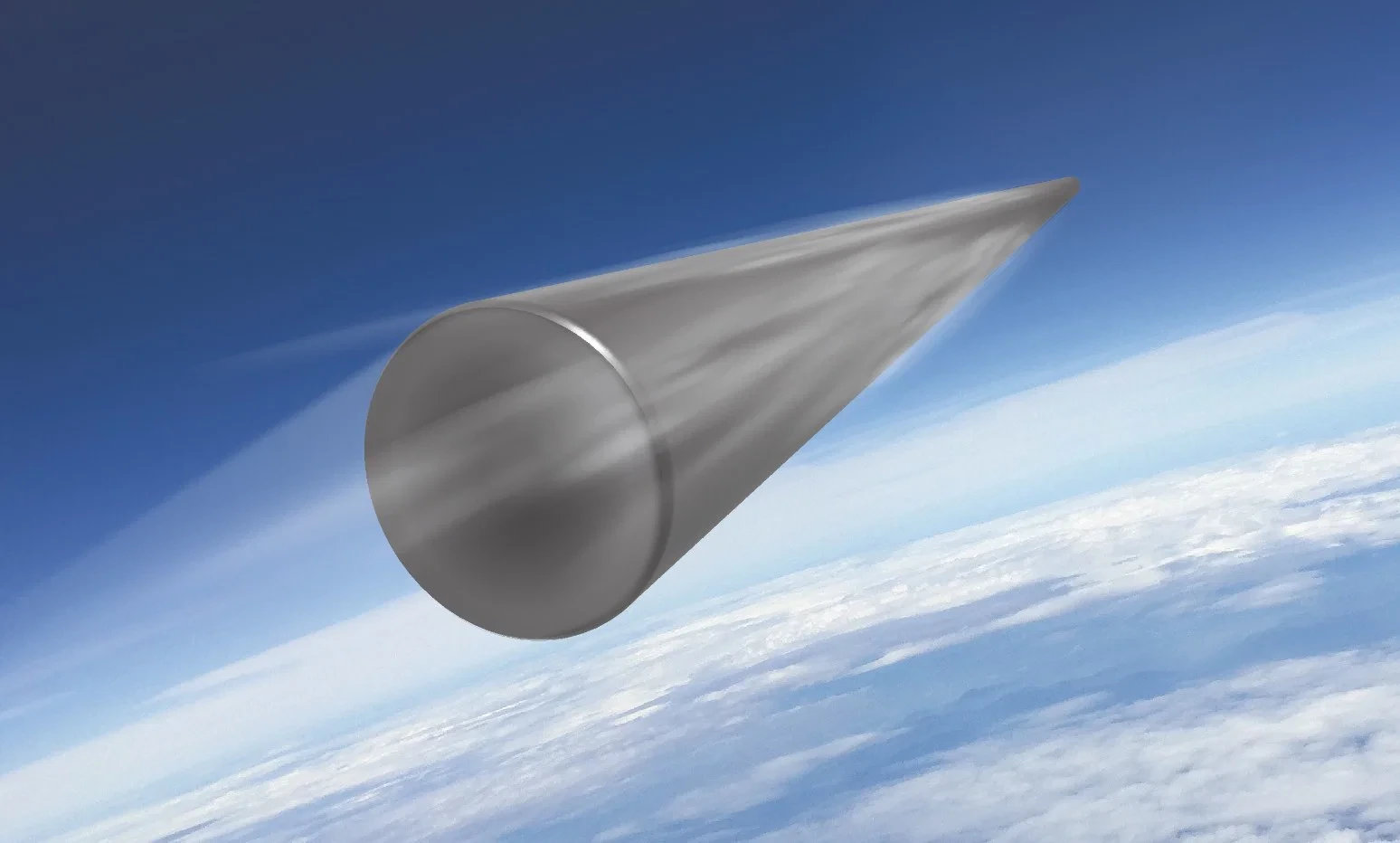
Lockheed Martin and the U.S. Air Force have completed a flight test of the unarmed, developmental Mk21A reentry vehicle, the warhead-carrying front end of the future LGM-35A Sentinel intercontinental ballistic missile (ICBM), launching it over the Pacific Ocean from Vandenberg Space Force Base, California. The company announced the result on November 4, 2026, stating that the flight demonstrated the maturity of the vehicle’s architecture and validated next-generation reentry technologies.
The test comes as the Air Force works to close out the Sentinel restructuring that followed the program’s 2024 Nunn-McCurdy cost breach, targeting a renewed Milestone B decision by the end of 2026 and initial capability in the early 2030s. The Mk21A will carry the National Nuclear Security Administration’s (NNSA) W87-1 warhead through atmospheric reentry to the target, succeeding the Mk21 now flown on Minuteman III. Lockheed Martin said data from the flight will feed design refinements as the vehicle moves toward its system-level Critical Design Review (CDR), which the Air Force has scheduled by March 2027.
Inside the Mk21A Reentry Vehicle Test Campaign and Rebaseline
Lockheed Martin’s announcement does not date the flight or identify the booster. The Air Force Nuclear Weapons Center (AFNWC) separately reported launching a developmental Mk21A on October 9, 2026, aboard a Northrop Grumman Minotaur I from Vandenberg, the first announced test of the vehicle since June 2024. The Minotaur I uses retired Minuteman and Peacekeeper rocket motors.
The program’s flight record is short and mixed. On July 6, 2022, a Minotaur II+ carrying an early Mk21A test article exploded roughly 10 seconds after liftoff from Vandenberg. On June 17, 2024, a Minotaur I flight succeeded, and a Pentagon acquisition report later confirmed it validated the vehicle’s heatshield. The same report noted that Lockheed Martin was integrating the arming and fuzing subsystem, the electronics that govern when and how the warhead functions, in February 2026. Air Force budget documents project flights of a heatshield test vehicle and a W87-1 environmental flight test unit across fiscal 2026 and 2027, placing the latest shot inside a multi-flight qualification sequence rather than a single proof event.
The contract base has shifted as well. AFNWC awarded Lockheed Martin a sole-source, $996.2 million engineering and manufacturing development contract in October 2023, following a $108.3 million technology maturation and risk reduction award in October 2019. A $453 million modification in November 2025 set a new baseline designed to decouple the Mk21A schedule from external programs, adding an alternate flight test strategy and additional test assets. The Air Force requested nearly $540 million for Mk21A development in fiscal 2027, up $184 million from fiscal 2026.
From Mk21 to Mk21A: Carrying the W87-1 on Sentinel
The Mk21A evolves the Mk21, which entered service on the LGM-118A Peacekeeper, a missile that carried up to 10 reentry vehicles, before migrating to Minuteman III with the W87-0 warhead. Lockheed Martin positions the new design as an integrated vehicle: aeroshell and thermal protection, the arming and fuzing assembly, the warhead interface and associated support equipment, developed together rather than as separate upgrades, drawing on what the company describes as more than 65 years of ICBM partnership with the Air Force. The Air Force has also said the vehicle is meant to accommodate future warhead designs over Sentinel’s service life. Detailed mass, dimensions and reentry velocity remain classified and have not been disclosed.
Its payload, the W87-1, is an NNSA modification program led by Lawrence Livermore National Laboratory to replace the W78, one of the oldest warheads in the stockpile, which flies on Minuteman III aboard the Mk12A. The W87-1 reuses previously tested nuclear components and adds an insensitive high-explosive primary for improved safety and security; open-source reporting puts its yield at approximately 300 kilotons. The fiscal 2026 National Defense Authorization Act authorized $649 million for the warhead. The Air Force plans to deploy Sentinel initially with the existing W87-0, and how that warhead will be packaged on early missiles has not been publicly detailed.
Lockheed Martin credits digital engineering for the pace, using high-fidelity modeling and simulation anchored in prior flight data to compress schedules and retire technical risk before hardware flies. Jason Watson, the company’s vice president of Strategic Reentry Programs, called testing “the engine that drives maturity and reliability” for modernized defense programs.
Analysis: The flight is less a capability milestone than a schedule signal. Officials have tied most of Sentinel’s cost growth to its ground infrastructure rather than to the reentry vehicle, and the November 2025 rebaseline was written explicitly to keep Mk21A from inheriting those delays. A reentry vehicle that clears CDR on its own timeline gives the Air Force a mature front end ready for integration once the missile flies. It also bears on W78 retirement: until the W87-1 and its delivery vehicle are ready, the oldest ICBM warhead in the inventory remains on alert aboard Minuteman III, a fleet the Air Force already spends more than $2 billion a year to sustain.
The next markers are the Mk21A CDR, planned by March 2027, and the W87-1 environmental flight test unit shot projected in budget documents. The Air Force has stacked an inert Sentinel at Vandenberg and still targets a first flight in 2027, although a February 2026 Government Accountability Office report placed it in March 2028. Still unpublished: performance data from the latest Mk21A flight, the total cost of the rebaselined effort and the date the Mk21A and W87-1 will first fly together atop a Sentinel.