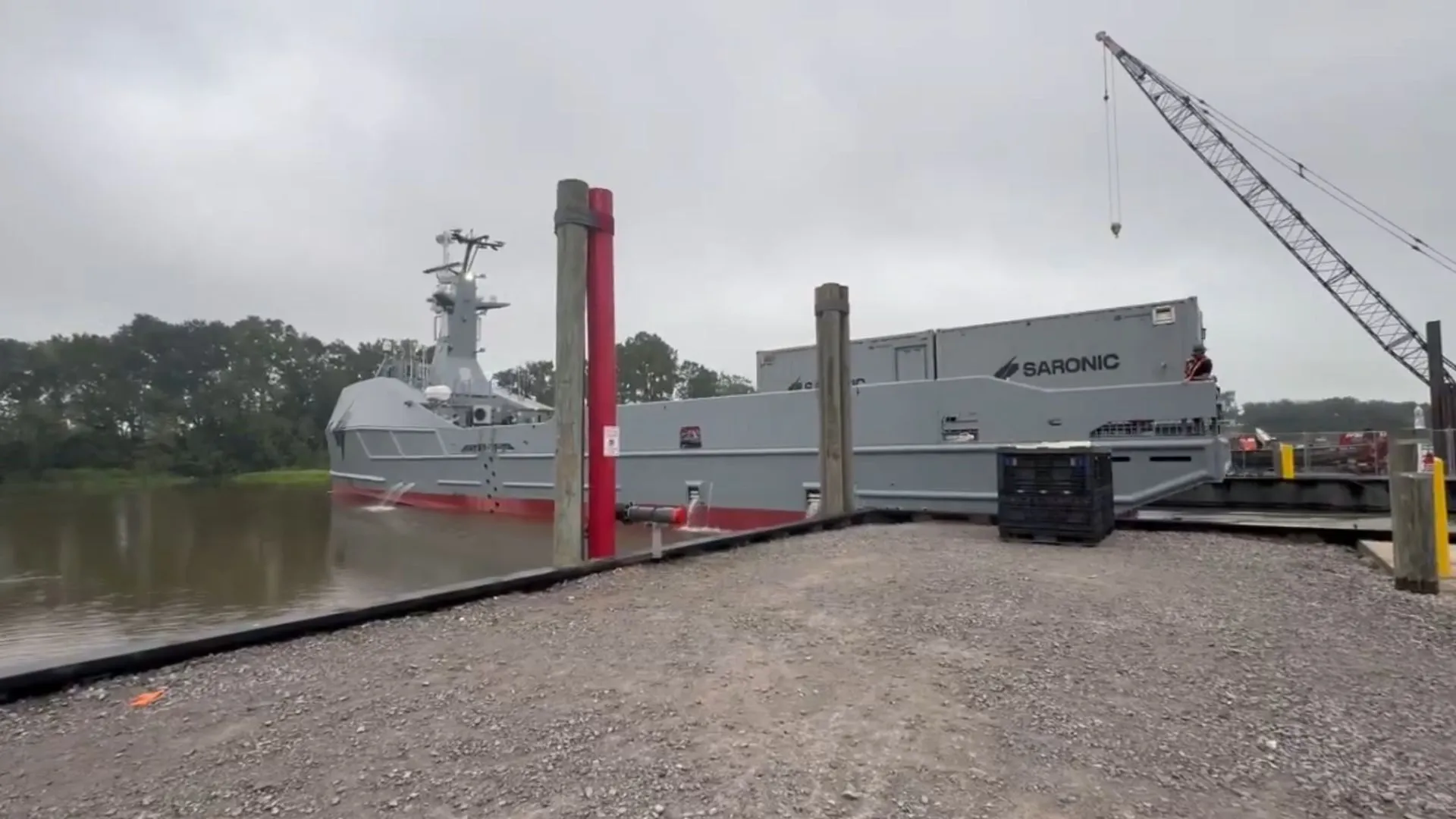
Saronic Technologies has put its second Marauder medium unmanned surface vessel (MUSV) in the water at its shipyard in Franklin, Louisiana, with the hull now running under its own power, co-founder and CEO Dino Mavrookas said in a post on X on November 3, 2026. Mavrookas said the second hull required 8% fewer labor hours to build than the first and that the yard will produce 20 Marauders a year once fully ramped.
The launch follows the U.S. Navy’s late September 2026 decision to award Saronic a firm-fixed-price production Other Transaction agreement for Marauder through its MUSV Marketplace, after an at-sea evaluation in which the vessel completed more than 140 test scenarios over eight days of continuous operations. The agreement covers 10 Marauders and is one of three 10-vessel production awards, alongside Galliano Marine Services and Huntington Ingalls Industries, in a planned 30-vessel buy that the Navy priced at an average of about $40 million per vessel, with first deliveries scheduled before the end of fiscal 2027. The value of Saronic’s individual agreement has not been disclosed. Saronic was one of seven companies the Navy selected in May for Marketplace at-sea demonstrations, alongside Sea Machines, Leidos, Galliano Marine Services, PacMar Technologies, Birdon and Huntington Ingalls Industries.
Saronic Marauder Production: Labor Hours, Hull Count, and Yard Capacity
Saronic laid the first Marauder keel on August 22, 2025, and launched that hull, designated MR-001, in late May 2026, less than a year after initial design. The second hull was flipped in March 2026 and moved into outfitting with mechanical, electrical and autonomy systems. At the time of the first launch, the company said work on hull two was running about 25% faster than on hull one at the same stage, and that hulls three and four were under construction.
The 8% figure measures something different. Schedule compression can come from parallel work packages and added headcount; a labor-hour reduction measures how much effort each hull actually consumes, which is the number that drives unit cost under a fixed-price agreement.
Saronic acquired the roughly 100-acre Franklin site on April 16, 2025, when it bought Gulf Craft, an aluminum boatbuilder founded in 1965 that built ferries and offshore support vessels. Saronic retained a workforce of about 30 people. Mavrookas wrote that capacity at the yard was “trending towards 0” when the company took over, his characterization of the yard’s prior state. The company is now executing a $300 million expansion that adds more than 300,000 square feet of production space, three new slips, expanded warehousing and a dedicated large-vessel assembly line, with completion targeted for the end of 2026. That expansion underpins the 20-per-year rate.
Payload, Range, and Propulsion: What the 180-Foot MUSV Carries
Marauder measures 54.9 meters (180 feet), up from the 150-foot design Saronic unveiled in April 2025. Company specifications list an aluminum hull with diesel engines driving waterjets, a top speed above 25 knots and a cruise speed of 12 knots. Range is 5,400 nautical miles with a 25-metric-ton base load and 4,100 nautical miles at the maximum 150-metric-ton payload.
The modular aft deck accepts four 40-foot or eight 20-foot ISO containers, separating the hull, which supplies mobility, power, communications and autonomy, from the mission package. Saronic lists logistics, intelligence, surveillance and reconnaissance (ISR), communications relay, decoy operations and maritime domain awareness among intended roles. During trials, MR-001 was seen carrying navigation radars, optical sensors and three 20-foot containers. Saronic has not published engine models, sensor designations or any weapons integration plan.
Marauder runs the same autonomy software as Saronic’s 24-foot Corsair and 52-foot Mirage, paired with a fleet intelligence platform that gives operators human-in-the-loop visibility into onboard systems; every major hardware component exposes a software interface for monitoring and actuation. Navy evaluators also tested passive perception, requiring the vessel to detect, track and follow traffic without active radar, a capability directly relevant to operations under emissions control.
Analysis: The 8% reduction is the most useful number Saronic has released on Marauder. Moving from the first to the second unit doubles cumulative output, so an 8% cut implies a unit learning curve of roughly 92%. That is a credible start, but it is a single data point, and the lead hull of any new class carries one-time design and rework hours that inflate the baseline. The real test is whether hulls three through eight hold or steepen that slope once the expanded yard comes online. For a Navy that is buying commercially built hulls at fixed prices rather than funding a traditional shipbuilding program, the labor curve in Franklin matters more than any single specification.
Mavrookas did not say whether the second Marauder will join MR-001 in trials, deliver against the Navy award or carry a specific payload. The next milestones are completion of the Franklin expansion by the end of 2026, first Marauder deliveries to the Navy before the end of fiscal 2027, and progress on Port Alpha, the more than $3 billion shipyard Saronic is developing in Brownsville, Texas, with operations expected in 2028.