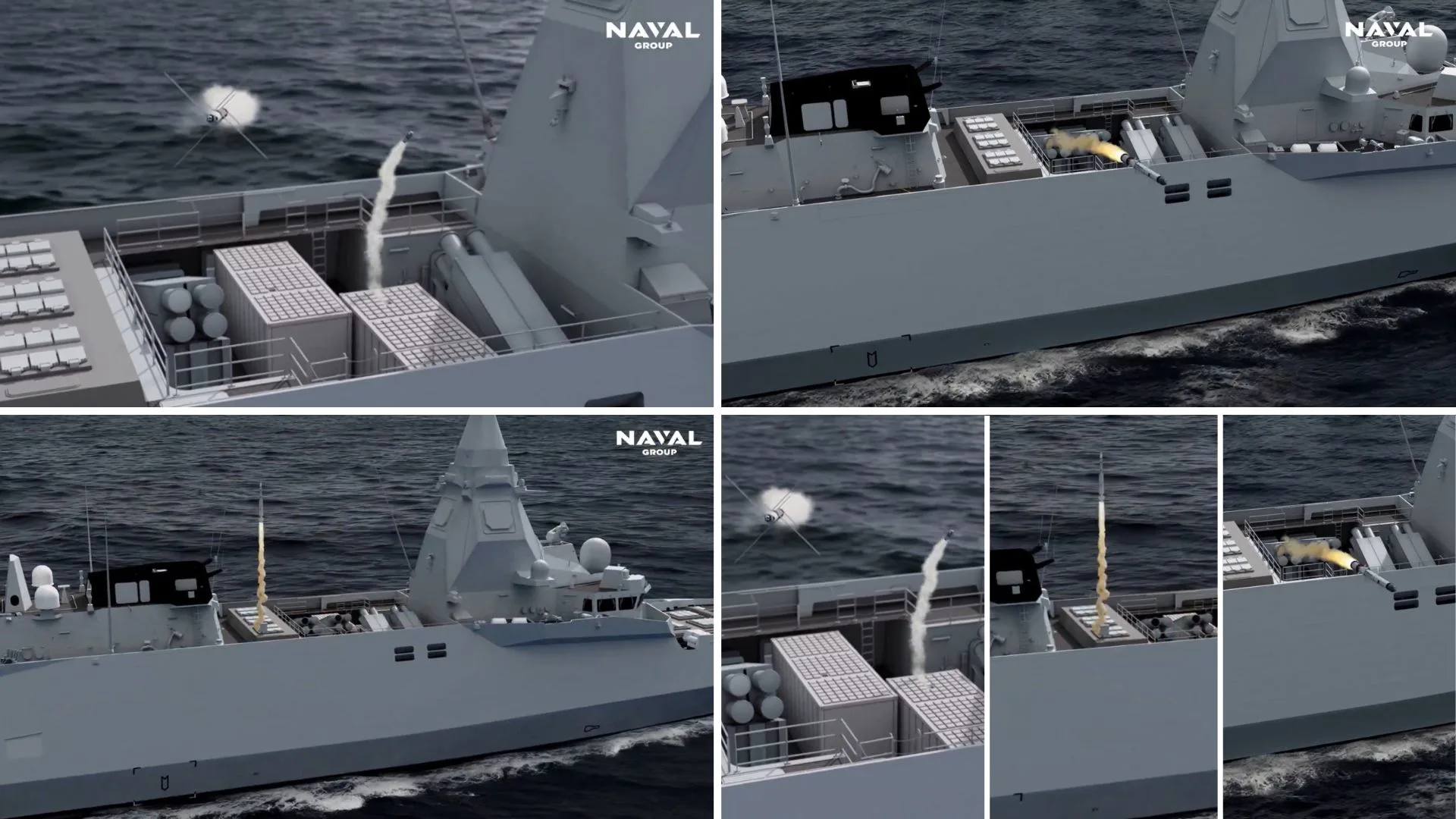
Naval Group unveiled an enlarged version of its Defense and Intervention Frigate (FDI), referred to as the FDI XL, at the Euronaval 2026 exhibition in Paris on November 3, 2026. The concept adds 18 vertical launch cells for air defense missiles and a modular mission bay that takes either eight additional Exocet MM40 anti-ship missiles or two containerized launchers holding 336 loitering munitions or interceptor drones. The French shipbuilder has announced no customer, price, or construction schedule.
The design surfaces as the French Navy moves its five Amiral Ronarc’h-class frigates from 16 to 32 Aster missile cells, a change then-Navy Chief of Staff Admiral Nicolas Vaujour confirmed before lawmakers on April 9, 2026. It also follows Red Sea deployments in which European escorts spent high-end interceptors on low-cost drones. Naval Group summarized the logic in its Euronaval video post on X: “high intensity demands high density and high flexibility.”
How the FDI XL Frigate Grows to 50 Air Defense Cells
The FDI XL inserts a central hull section between the Panoramic Sensors and Intelligence Module (PSIM) integrated mast and the funnel, where the baseline ship carries its Exocets. Naval Group has not published dimensions. Open-source estimates put the plug at about 10 meters, stretching the hull from 122 to 132 meters and raising displacement from 4,500 tonnes to between 5,300 and 5,500 tonnes.
The 18 new cells sit in three groups of six, a layout that does not match the eight-cell Sylver A50 modules installed forward. That points to shorter Sylver A35 or A43 launchers, although Naval Group has not confirmed the type. The A35 accepts the VL MICA family, while the A43 can also take the Aster 15. A likely candidate is the VL MICA NG, with a stated range of up to 40 km, layered beneath the Aster 15, credited with about 30 km, and the Aster 30, which reaches beyond 100 km.
The result would be 50 interceptors, a 56.25 percent increase over a 32-cell FDI, but not 50 interchangeable area defense rounds. Assuming two missiles per engagement, a 50-cell ship could prosecute 25 theoretical engagements, against 16 for a 32-cell FDI and eight for the original 16-cell French fit. The tiered load matters more than the raw count: it lets the ship spend short-range missiles on drones and subsonic threats while holding Aster 30 for supersonic anti-ship missiles. The Thales Sea Fire radar, with four fixed gallium nitride AESA panels and a publicly cited range of up to 350 km, already tracks far more targets than 32 cells can engage.
Exocet or 336 Drones: Two Options for the FDI XL Mission Bay
In its anti-surface configuration, the mission bay doubles the Exocet MM40 Block 3C load from eight to 16 rounds. Publicly available specifications indicate the Block 3 family uses a turbojet, inertial and satellite navigation, programmable flight paths, and active radar terminal guidance, with a range exceeding 200 km. The Block 3C adds a digital radio frequency seeker that improves target discrimination and resistance to electronic countermeasures. Sixteen rounds allow two eight-missile salvos. They do not extend the ship’s radar horizon; over-the-horizon targeting still depends on the embarked helicopter, uncrewed aircraft, or offboard data.
The alternative replaces the extra Exocets with two containers totaling 336 launch positions, or 168 each if split evenly. Naval Group has not identified the munition. Its range, mass, warhead, guidance, and launch rate are unknown, so engagement capacity cannot yet be calculated. The intent is clearer: a deep, low-cost counter-UAS and light-strike layer that keeps Aster rounds for threats that justify them, a cost-exchange problem the war in Ukraine has made central to air defense planning.
Swapping containers would require lifting gear, power and data connections, ammunition handling, and safety checks, making reconfiguration a port activity rather than an at-sea capability. Choosing the drone fit also leaves the ship with the standard eight Exocets.
Retained FDI Systems, Propulsion Limits, and the Lorient Production Line
The rest of the fit appears unchanged: a 76 mm Oto Melara Super Rapid gun, two 20 mm Narwhal 20B mounts, MU90 torpedoes, CAPTAS-4 variable depth sonar, and KingKlip Mk2 hull sonar, all managed by the SETIS combat management system.
Propulsion is the open engineering question. The baseline FDI’s four MTU 16V 8000 M91L diesels deliver 32 MW to two controllable-pitch propellers for 27 knots, a range of 5,000 nautical miles, and 45 days of endurance, or 7.11 kW per tonne at 4,500 tonnes. Without added power, that ratio falls to about 5.82 kW per tonne at 5,500 tonnes, an 18 percent reduction. A longer waterline recovers some efficiency, but holding 27 knots depends on final hull form.
The industrial case rests on an established line of 13 frigates: five for France, four for Greece, and four for Sweden. Greece received HS Nearchos on October 30, 2026, and Sweden signed a SEK 47 billion contract on August 31, 2026, for four Luleå-class ships due from 2030. Lorient is targeting up to two FDIs a year.
Analysis: The FDI XL answers a magazine-depth problem rather than creating a new warship class. Recent operations show that frigate sensors detect more threats than magazines can service across successive raids. By stretching an in-production hull instead of drawing a destroyer, Naval Group keeps the PSIM, SETIS, Sea Fire, and Lorient tooling while fielding more vertical launch cells than the 142-meter, 6,000-tonne FREMM. That trade suits navies wanting more missiles without the cost and timeline of a larger hull such as Naval Group’s SCX 26 destroyer concept, reported at 8,000 to 10,000 tonnes.
The unknowns remain substantial: the cost of adding 800 to 1,000 tonnes, any propulsion change, the missile chosen for the 18 new cells, the identity of the containerized munition, and the integration and qualification work each implies. None of the 13 FDIs on order is an XL. Naval Group’s FDI campaigns in Denmark, Saudi Arabia, and Indonesia will show whether the concept moves from animation to contract.