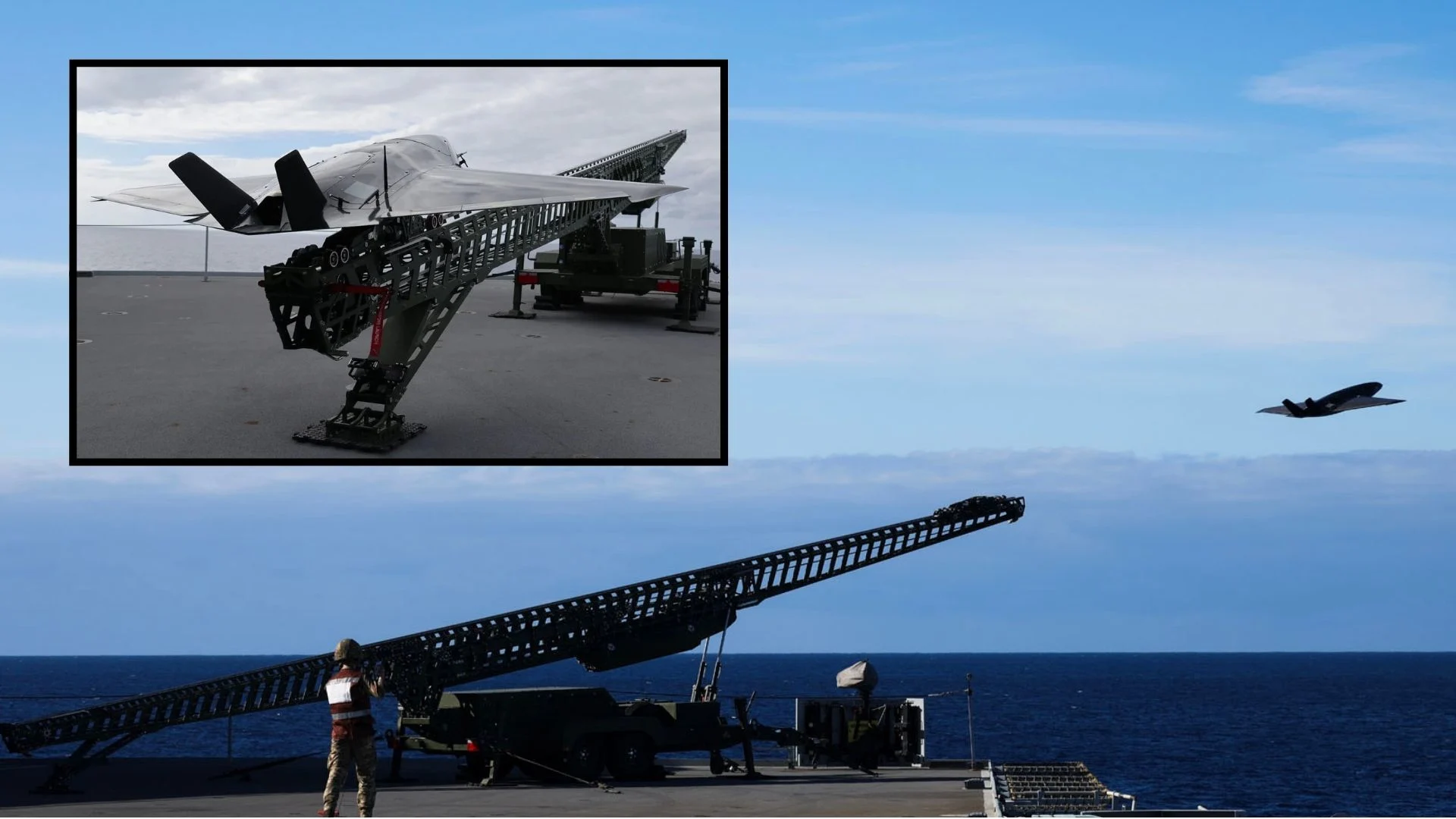
The Royal Navy has launched strike drones from an aircraft carrier for the first time, firing four British-built Nyan Maritime one-way effectors from the flight deck of HMS Queen Elizabeth during trials in the North Atlantic in mid-October 2026. The Royal Navy announced the trials on November 5, 2026, alongside a second carrier first: a Tekever AR5 fixed-wing uncrewed aircraft operating from the same deck.
The activity is the latest step toward the Royal Navy’s hybrid carrier air wing, a concept that pairs the F-35B Lightning II with uncrewed aircraft to extend the reach and lethality of the two Queen Elizabeth-class carriers while keeping personnel further from danger. It follows the first at-sea launch of Nyan from the experimentation ship XV Patrick Blackett in early June 2026, and comes months after the Defence Investment Plan committed more than £5 billion to autonomous systems by 2030, the largest drone investment in the history of UK Defence.
Nyan Strike Drone Moves From Patrick Blackett to the Carrier Deck
Nyan is designed and manufactured in Wiltshire by Callen-Lenz, a BAE Systems company that sits within the group’s FalconWorks technology hub. The carrier serial, run as Exercise Neptune Reach B under the tri-service Project Vantage, produced four launches; the manufacturer states that all four aircraft reached their designated strike points.
BAE Systems has not released a full specification sheet, but publicly available data describe a compact carbon-fibre flying wing with a 2.9-metre wingspan, powered by a small gas-turbine engine and launched from a pneumatic catapult. The launcher fitted to XV Patrick Blackett in June accelerated the aircraft to as much as 55 metres per second, removing any need for a ski-jump run or a recovery cycle. The British Army credits Nyan with a range of more than 250 kilometres, and open-source reporting puts its unit cost at about £100,000. Warhead type, seeker configuration and terminal guidance against moving maritime targets have not been disclosed.
That price point drives the concept. Nyan sits in a cost bracket far below conventional cruise missiles, allowing a task group to trade individual weapon performance for volume. The system is also already in production: Callen-Lenz reports more than 1,000 units built, and the British Army deployed it to Estonia during Exercise Spring Storm, held from May 4 to June 1, 2026, as part of the UK’s contribution to NATO deterrence and defence. Open-source reporting indicates the type has also seen operational use in Ukraine. A land-proven airframe shortens the path to a maritime capability.
Tekever AR5 and Heavy Lift Challenge 3 Aboard HMS Queen Elizabeth
In parallel, HMS Queen Elizabeth hosted Heavy Lift Challenge 3 on October 17, 2026, during which the Tekever AR5 operated from an aircraft carrier for the first time. Official imagery shows the aircraft landing on deck; the Royal Navy has not detailed its launch method.
The Royal Navy cites a 7-metre wingspan and an 80-kilogram carrying capacity, enough to support both logistics and operational missions. Publicly available manufacturer specifications list the twin-engine, medium-altitude, medium-endurance aircraft at 7.3 by 4.0 metres, with a 50-kilogram payload capacity, a cruise speed of about 100 km/h, satellite communications and 16 to 20 hours of endurance depending on payload. The gap between the two payload figures has not been explained publicly. Ashore, the AR5 typically operates from unprepared strips of roughly 200 to 300 metres, a requirement close to the roughly 280-metre length of a Queen Elizabeth-class flight deck.
The British Army has selected the AR5 for its Project CORVUS requirement under a contract worth up to £400 million, opening the prospect of a common intelligence, surveillance, target acquisition and reconnaissance (ISTAR) fleet across services. At sea, the trials tested ISTAR and strike drones operating from the same ship.
Lieutenant Commander David Burton, trials sponsor for Navy Capability, said: “These trials give us the evidence and confidence to decide how uncrewed systems can work alongside crewed aircraft.”
Project Pantheon Funding and the Hybrid Carrier Air Wing Roadmap
The carrier trials sit inside a funded roadmap. The Defence Investment Plan allocates almost £250 million to Project Pantheon, which develops autonomous systems for the hybrid carrier air wing and funds trials of jet-powered drones alongside the F-35B force under the linked Project Vanquish. It also earmarks at least £1.3 billion for a hybrid fleet of crewed and uncrewed ships, with the first large autonomous vessels due in service by 2030, and at least £210 million for low-cost, long-range one-way attack drones for the Royal Navy, British Army and Royal Air Force.
The October serials follow General Atomics Mojave flights from HMS Prince of Wales in late 2023. Defence Secretary Wes Streeting framed the latest trials in terms of deterrence: “The more ready we are to fight and win, the less likely we are to have to.”
Analysis: The October trials give the Queen Elizabeth-class carriers their first demonstrated strike effect that does not consume an F-35B sortie or put a pilot at risk. That matters for a carrier built without catapults or arresting gear: a short take-off and vertical landing deck can still generate uncrewed strike mass from a compact launcher. The harder problem is scale. Useful combat mass requires the ship to store, prepare and launch dozens of effectors in a compressed window while sustaining F-35B and helicopter operations, and four launches do not yet prove that. Nyan’s reported reach of more than 250 kilometres also makes pairing it with persistent ISTAR platforms such as the AR5 central to its value.
Next milestones include the Project Vanquish demonstration of a jet-powered drone from a Queen Elizabeth-class carrier, the allocation of the £210 million one-way attack drone line, and whether Nyan Maritime moves from experimentation to a programme of record. Procurement quantities, magazine stowage arrangements and a maritime seeker solution remain undisclosed.