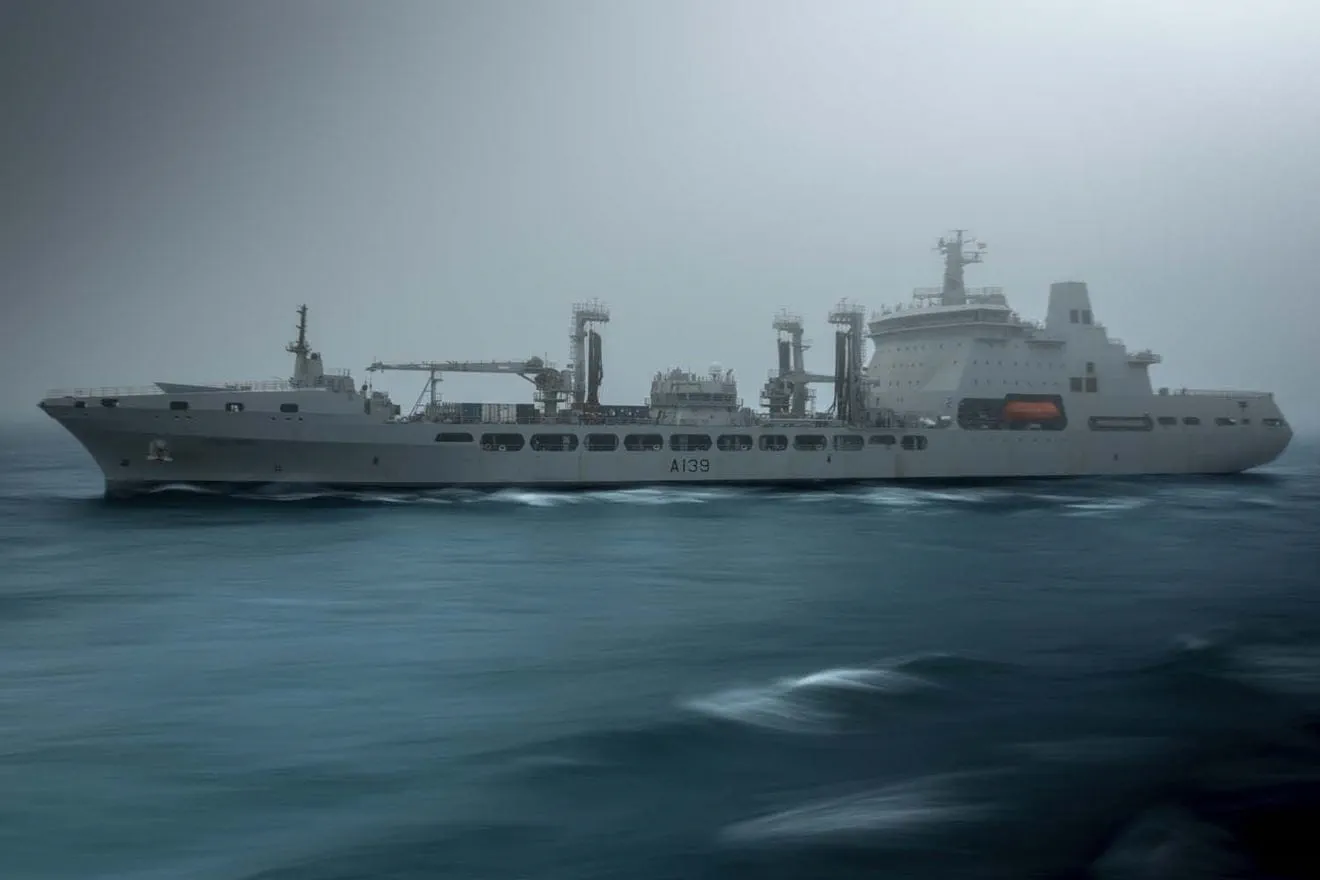
The Royal Fleet Auxiliary (RFA) tanker RFA Tideforce has completed six weeks of front-line operations across the North Atlantic and Arctic, delivering more than 2.9 million litres of fuel, sailing 7,500 miles and supporting both of the Royal Navy’s Queen Elizabeth-class aircraft carriers, the Royal Navy announced on November 3, 2026. The ship also hosted a submarine-hunting Merlin helicopter that flew intelligence-gathering sorties against Russian naval units in the English Channel and North Atlantic.
Tideforce operated throughout under Combined Task Force 320 (CTF 320), the UK command responsible for maritime security, anti-submarine warfare and day-to-day oversight of UK waters. The deployment overlapped with phase two of Operation Firecrest, the UK Carrier Strike Group’s 2026 mission on NATO’s northern flank, which resumed when HMS Prince of Wales sailed from Portsmouth on October 18, 2026.
RFA Tideforce Under CTF 320: Fuel, Merlin Sorties and Russian Shadowing
The 2.9 million litres Tideforce delivered equates, by the Royal Navy’s own comparison, to filling roughly 50,000 cars. Recipients included French and Dutch warships in the High North, plus HMS Queen Elizabeth and HMS Prince of Wales during carrier operations. In the Irish Sea, the tanker ran a day-into-night replenishment at sea (RAS) with HMS Queen Elizabeth as the carrier departed Belfast.
A Merlin helicopter from 814 Naval Air Squadron, based at Royal Naval Air Station Culdrose in Cornwall, remained aboard for the full deployment and used the tanker as a launch platform for intelligence-gathering missions, including operations reporting on Russian units in the English Channel and North Atlantic. Publicly available specifications indicate the Merlin HM2 flown by 814 NAS carries a Blue Kestrel maritime surveillance radar, a FLASH dipping sonar and sonobuoys, giving a non-combatant hull genuine anti-submarine and surface surveillance reach.
Weather and machinery tested the ship’s endurance. Heavy seas forced Tideforce to shelter off Iceland’s northern coast, and the crew later rode out Storm Boelo off Ireland. While at anchor, the engineering department carried out major defect rectification on the port main drive engine, including removal of a cylinder head, keeping the ship on task. Commanding Officer Captain Chris Clarke said the unpredictability of 320 operations “is still as rewarding as it ever was,” citing intelligence work, varied tasking and complex repairs at sea.
How Tide-Class Tankers Sustain the Carrier Strike Group on Firecrest
Tideforce (A139) is the fourth and final Tide-class fast fleet tanker, built by Daewoo Shipbuilding and Marine Engineering at Okpo, South Korea, to a BMT Defence Services design derived from the AEGIR-26 family, and entered service in 2019. Publicly available specifications indicate a full-load displacement of 39,000 tonnes and a length of about 201 metres, making the Tide class the largest ships in RFA service. Cargo tanks hold roughly 19,000 cubic metres of diesel and aviation fuel plus 1,400 cubic metres of fresh water. Three abeam RAS stations and an astern refuelling rig allow multiple receivers to draw fuel, while a hybrid combined diesel-electric or diesel (CODELOD) plant drives twin shafts to a reported top speed of about 20 knots. An enclosed Merlin-capable hangar and a Chinook-capable flight deck explain how Tideforce sustained an 814 NAS detachment for six weeks. The class has provision for two 30 mm guns and two Phalanx close-in weapon systems, with a core crew of 63.
That capacity defines carrier endurance. Because carriers and escorts draw marine diesel and aviation fuel from the same hull, one Tide-class tanker effectively sets how long a task group can operate far from UK ports. After a short logistics stop in Loch Striven to load cargo, Tideforce sailed in support of the Carrier Strike Group on Firecrest phase two and, after avoiding three storms in quick succession, replenished the task group’s units.
Analysis: The deployment shows how thinly the RFA’s tanker capacity now stretches. With the two Wave-class tankers retired under a November 2024 decision, the four Tide-class ships form the RFA’s only fast fleet tanker class, and the same hulls must cover CTF 320 home-waters security, allied replenishment and carrier strike group sustainment. RFA Tidespring supported Firecrest’s first phase; Tideforce then combined CTF 320 tasking with direct support to both carriers. Basing a Merlin on a tanker to monitor Russian units also shows a constrained escort fleet using any aviation-capable hull at sea. The approach works, but it concentrates logistics and surveillance on one ship, where a single engine defect could ripple across a task group.
Firecrest phase two continues in northern European waters alongside Norway, Denmark and Germany. The Royal Navy has not said which RFA tanker will sustain the group for the remainder of the phase, or when Tideforce will next deploy. Demand on CTF 320 is not easing: on November 2, 2026, the Royal Navy reported three separate operations over 17 days to monitor Russian vessels in UK waters.