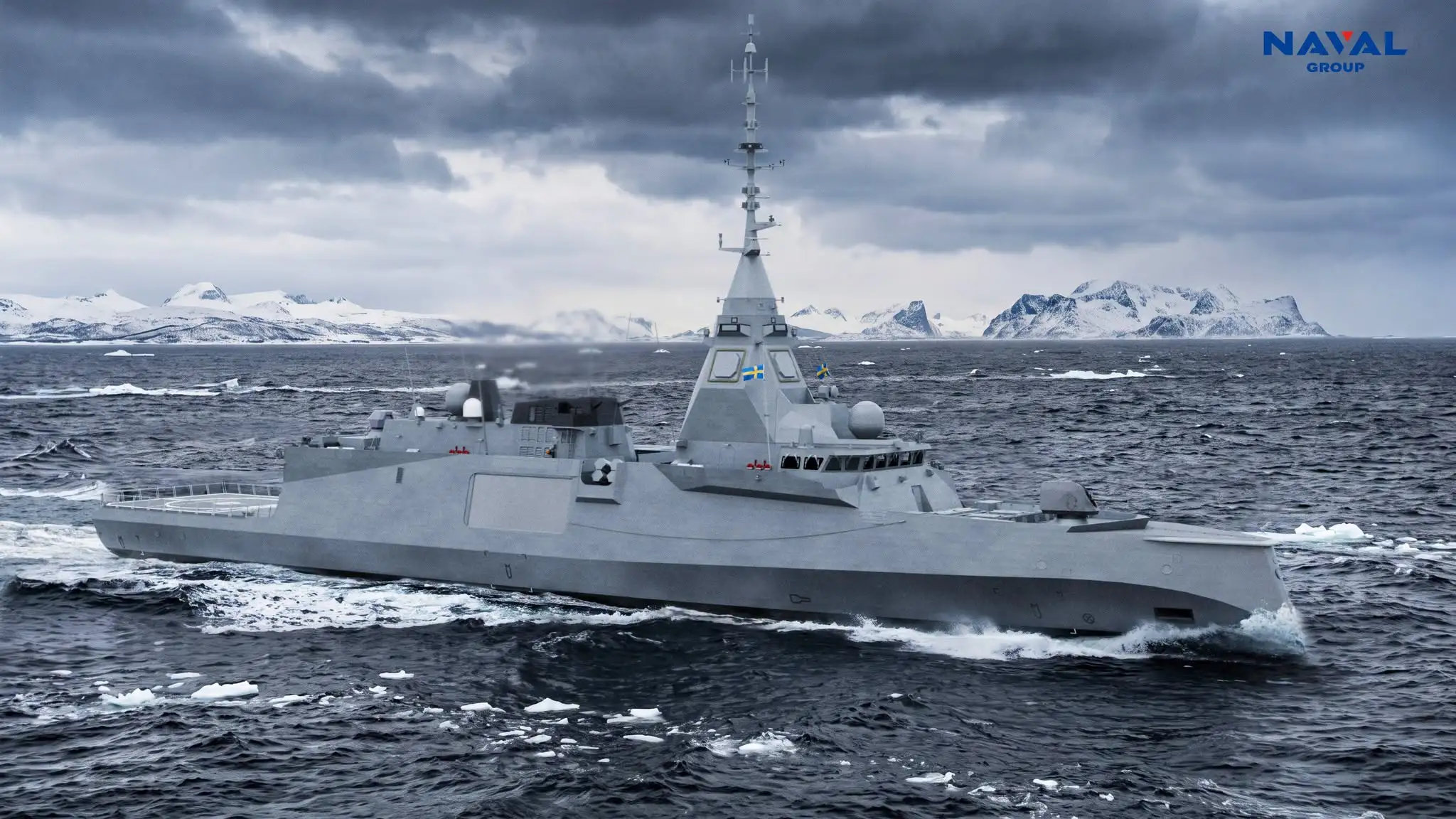
Saab has signed a contract with Naval Group worth approximately SEK 2 billion to deliver and integrate weapon control systems and sensors for the four Frégate de Défense et d’Intervention (FDI) frigates the French shipbuilder is building for the Royal Swedish Navy, the Swedish company announced on November 6, 2026. Deliveries to Naval Group will run from 2027 to 2034, spanning the full build of the future Luleå class.
The order follows the contract worth approximately SEK 47 billion that the Swedish Defence Materiel Administration (FMV) signed with Naval Group on August 31, 2026, aboard the French lead ship Amiral Ronarc’h in Stockholm. Sweden selected the FDI on May 19, 2026, after weighing proposals from Navantia and from Babcock, which had partnered with Saab, and cited delivery speed as decisive. Steel was cut for the lead ship, HSwMS Luleå, at Naval Group’s Lorient yard on October 1, 2026. Luleå is due in 2030, followed by Norrköping in 2032, Trelleborg in 2033 and Halmstad in 2034. When it opened negotiations in May, the Swedish government named the Saab and BAE Systems Bofors systems it wanted aboard.
Inside Saab’s Sensor and Weapon Package for the FDI Frigates
The contract comprises a Weapon Control System, the Ceros fire control director, the EOS 500 electro-optical director, the RBS15 anti-ship missile, the Saab Lightweight Torpedo, the Trackfire remote weapon station and the Sea Giraffe 1X multi-mission surveillance radar. Naval Group remains prime contractor and overall system integrator. Mats Wicksell, head of Saab’s Naval business area, said the Swedish Navy will gain “advanced and integrated capabilities to detect, deter, and respond to threats above and below the surface.”
The Weapon Control System is the connective element, linking Saab directors and effectors to the ship’s combat system and sequencing engagements. Saab has not disclosed how it interfaces with the Naval Group combat management system fitted to the baseline FDI, nor whether it draws on the next-generation 9LV architecture the company unveiled on November 3, 2026.
Ceros is a combined radar and electro-optical tracking director that generates fire control quality tracks for gun engagements. EOS 500 adds a lighter electro-optical director, weighing about 140 kg, with TV and infrared cameras and a laser rangefinder, according to Saab. Together they provide fire control for the Bofors 57 mm Mk3 and 40 mm Mk4 guns, supplied by BAE Systems Bofors.
Sea Giraffe 1X is a compact X-band active electronically scanned array (AESA) radar; Saab advertises a detection range of up to 75 km for the Giraffe 1X. On the Luleå class it will operate alongside the Thales Seafire main radar, adding a dedicated sensor for small, low and slow targets such as uncrewed aerial and surface vehicles. That requirement has sharpened after drone and uncrewed surface vessel attacks in the Black Sea and Red Sea. Trackfire, a stabilized remote weapon station with its own electro-optical sensor head, can mount 12.7 mm machine guns, 30 mm cannon or automatic grenade launchers for close-in defense against fast attack craft and drones.
RBS15 and Torped 47 Define Luleå-Class Anti-Ship and ASW Roles
The two Saab weapons replace the French baseline effectors. RBS15 takes the place of the MM40 Exocet carried by French FDIs, and the Saab Lightweight Torpedo, designated Torped 47 in Swedish service, replaces the MU90.
RBS15 is a turbojet-powered, sea-skimming anti-ship missile already in Swedish service aboard the Visby-class corvettes. Publicly available specifications credit the RBS15 Mk3 with a range beyond 200 km, while the newer Mk4 Gungnir is marketed with extended reach. A Naval Group rendering of the Luleå class shows launchers that Navy Lookout identifies as RBS15 Gungnir, but Saab’s announcement does not specify which variant the frigates will receive or how many launchers each ship will carry.
Torped 47 is a 400 mm lightweight torpedo of roughly 340 kg, with pump-jet propulsion, an active and passive digital sonar seeker, and the option of wire guidance or fire-and-forget operation. Sweden developed it for the shallow and acoustically difficult conditions of the Baltic, and Saab has test-fired it from both a surface ship and a submarine.
Commonality is the operational payoff. Fielding the same anti-ship missile and torpedo as the corvette and submarine forces consolidates training, magazine stocks and maintenance within one national logistics chain, and keeps wartime resupply of those weapons under Swedish control. The Saab package sits beside an air-defense battery sourced outside Sweden: Aster 30 interceptors in Sylver A50 vertical launch cells and CAMM-ER in a new cold-launch module, complemented by the CAPTAS-4 towed sonar. Defense Minister Pål Jonson has said the four ships will triple Sweden’s air-defense capabilities.
Analysis: At roughly SEK 2 billion, Saab’s share equals just over 4 percent of the ship contract, yet it covers most of the Swedish-specific mission equipment that separates the Luleå class from French and Hellenic FDIs. That makes integration, not hardware, the program’s principal risk. Naval Group must fuse a French combat management system and radar, Franco-Italian and Anglo-Italian missiles, and a Swedish weapon and sensor layer into one kill chain without slipping the 2030 lead-ship date that won the competition. For Saab, the deal keeps a foreign-designed hull from pushing Swedish industry out of the combat loop.
Saab’s first deliveries in 2027 must align with lead-ship outfitting at Lorient ahead of the 2030 handover. Open questions include the RBS15 variant and launcher count, the final split between Aster 30 and CAMM-ER, and whether Sweden exercises a reported option to swap one Sylver A50 module for a deeper A70 module able to host a naval cruise missile. Talks on that missile have begun; no order exists.