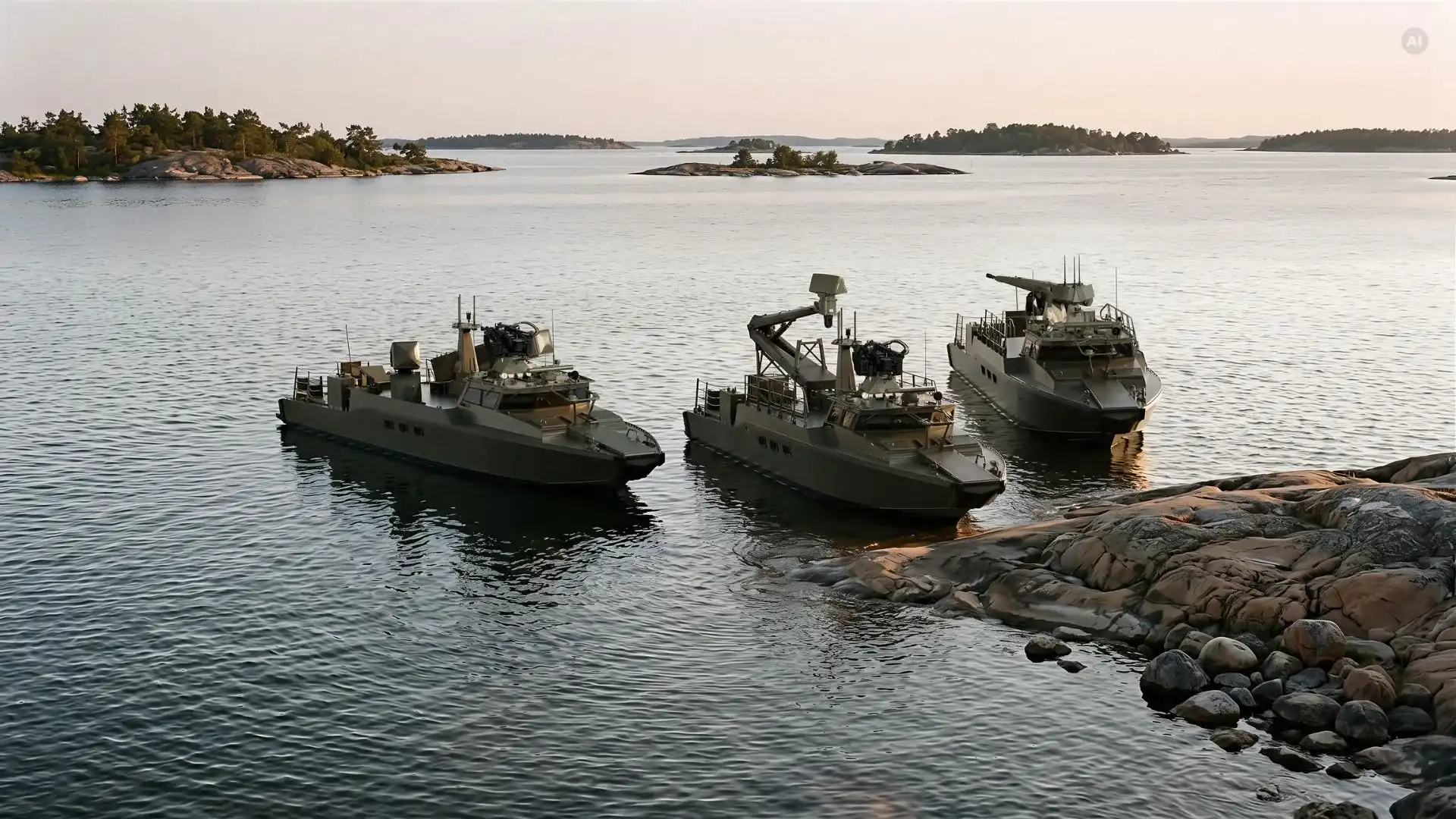
Saab on November 2, 2026, unveiled the Combat Boat 90 Capability X (CB90 CX), a larger, optionally crewed derivative of its CB90 fast assault craft offered in three initial configurations: intelligence, surveillance and reconnaissance (ISR), anti-ship warfare, and short-range air defense (SHORAD). Sweden is the launch customer, and the first boat is in final acceptance trials ahead of delivery.
The announcement, timed ahead of the Euronaval 2026 exhibition in Paris, extends a 36-year-old design built to move amphibious troops through archipelago and littoral terrain. More than 300 CB90s serve with nine navies. Saab cites Baltic infrastructure incidents, the use of small distributed systems against naval forces in the Black Sea and Red Sea strikes on shipping as drivers. For Sweden, a NATO member since March 2024, the boat arrives as its amphibious forces modernize under the Amphibious Battalion 2030 program.
CB90 CX Combat Boat Design: Larger Hull, Combat Core and Autonomy
The CB90 CX measures 18 meters overall, with a 4-meter beam and a 1.1-meter draught, against 16.3 meters for the CB90 Next Generation (CB90 NG). Two 1,100-horsepower engines driving waterjets replace the CB90 NG’s 900-horsepower pair, delivering more than 40 knots fully loaded and a range exceeding 300 nautical miles at around 40 knots, according to Saab. The boat carries up to 10 personnel.
Payload is the decisive change. Saab says the larger hull raises capacity by more than 50 percent on a like-for-like basis, from about 3 tonnes on the CB90 NG to beyond 5 tonnes. That margin lets a radar mast, missiles or a 30 mm gun fit without sacrificing speed. The hull is built to the DNV HSLC R2 class notation, permitting operations up to 100 nautical miles from a safe haven in summer and 50 nautical miles in winter, enough to cover the entire Baltic. Saab kept the profile low to limit signature and preserve road and air transportability.
A common architecture called Combat Core merges ship automation, platform monitoring, fire control and a new steer-by-wire system into one open backbone that accepts national sensors and weapons. Saab’s Autonomous Ocean Core, a vessel-agnostic control system first unveiled in November 2024, runs on top of it. Every CB90 CX is delivered prepared for uncrewed operation, controllable from a remote station or through onboard autonomy functions, with operators kept in the decision loop.
ISR, Anti-Ship and SHORAD: Three Configurations for One Distributed Force
The ISR configuration carries the Sea Giraffe 1X, an X-band 3D active electronically scanned array (AESA) radar rotating at 60 rpm for 360-degree air and surface coverage. Saab now quotes an air detection range above 100 km for this installation, against the 75 km instrumented range long advertised for the 1X. The radar sits on a new telescopic mast that extends to 11 meters to see over archipelago islands and retracts to 4 meters for high-speed transit. A Trackfire remote weapon station with a 12.7 mm or 30 mm gun adds counter-drone self-protection.
The anti-ship configuration was shown with MBDA’s Marte ER, a sea-skimming, fire-and-forget missile with a range above 100 km when cued by external targeting data. Saab calls the fit a flexibility demonstrator: Sweden’s amphibious battalion is acquiring a different missile, which the company did not name. The boat stops ferrying missile teams ashore and becomes the launcher.
The SHORAD configuration mounts Rheinmetall’s Seasnake 30 naval gun, firing KCE 30 x 173 mm ammunition against helicopters, drones and loitering munitions. Sweden’s Defence Materiel Administration (FMV) ordered an initial eight Seasnake 30 systems for its CB90 fleet in February 2026.
“CB90 CX reflects this evolution, moving beyond troop transport to connecting sensors and weapons and delivering combat capability directly from the boat, whether crewed or uncrewed,” said Anders Hellman, head of Saab’s business unit Docksta.
Analysis: The CB90 CX turns the amphibious combat boat from a transport into a networked sensor and shooter node. An ISR boat can, in principle, supply the off-board targeting a 100 km-class anti-ship missile needs, while a SHORAD boat screens both against the cheap drones that reshaped Black Sea naval operations. Spreading anti-surface and air defense capacity across many small, low-signature hulls rather than a few corvettes complicates adversary targeting in the Baltic’s island-dense littorals. Uncrewed operation lets boats hold high-risk positions without crews, though it depends on resilient datalinks Saab has not detailed.
The next milestones are delivery of the first Swedish boat after acceptance trials and the public debut at Euronaval. Saab has not disclosed how many of the 36 CB90s Sweden has on order will be CX hulls, nor unit cost or the delivery schedule. Saab is developing drone launch and torpedo options and building a new Docksta facility to double output, targeting NATO and allied navies in the Baltic and Mediterranean. The CB90 NG stays in production.