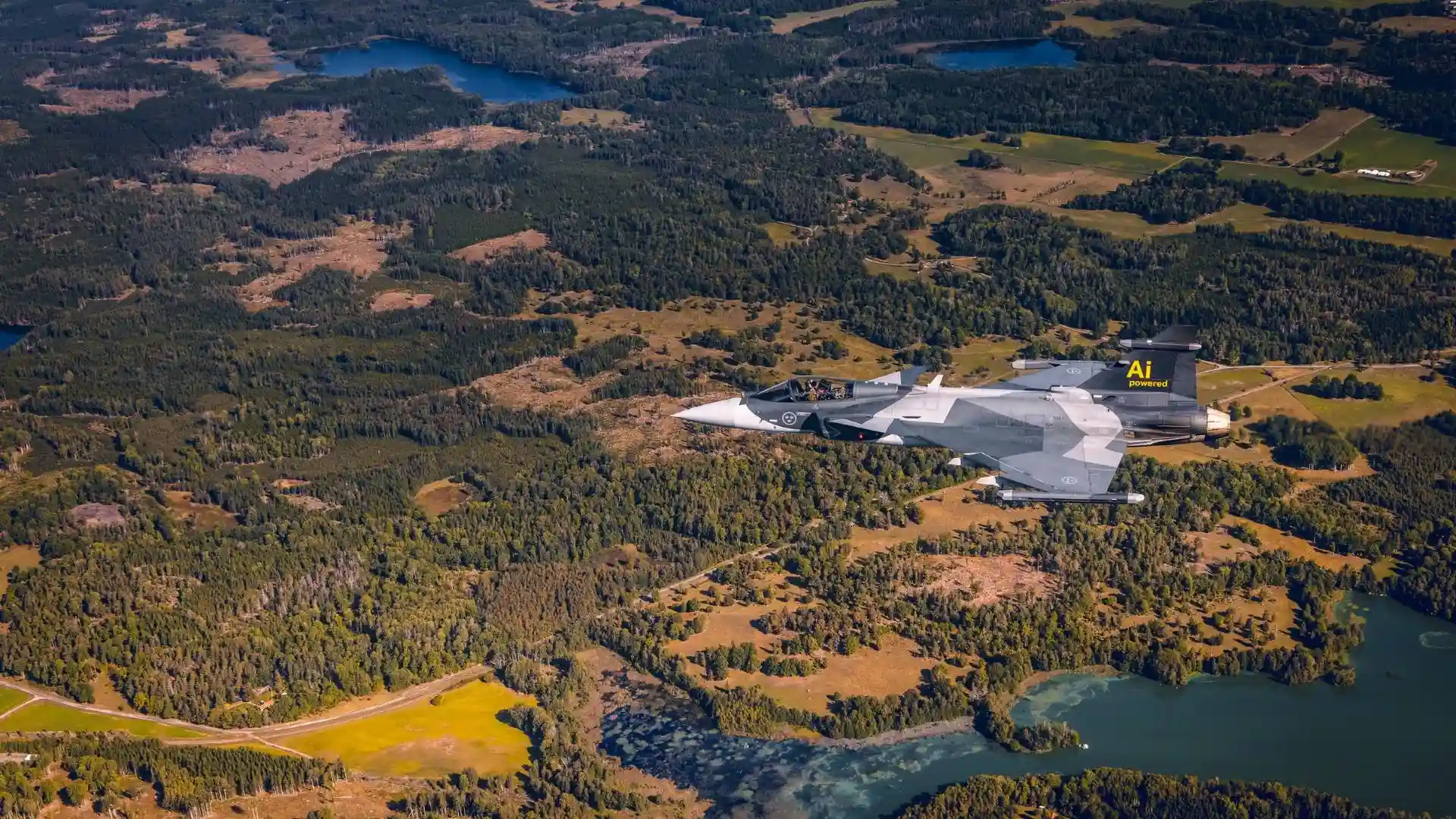
Saab announced on November 3, 2026, that it has developed a family of artificial intelligence (AI) agents in-house and flown them on the Gripen E multirole fighter, with an agent autonomously controlling the aircraft in beyond visual range (BVR) air combat scenarios. The work, led by the company’s Advanced Programs unit, takes Saab’s air combat AI from concept to an operational fighter without a dedicated experimental platform.
The announcement follows Project Beyond, under which Saab and German firm Helsing flew Helsing’s Centaur agent on a Gripen E over the Baltic Sea between May 28 and June 3, 2025. Centaur autonomously flew BVR maneuvers against a crewed Gripen D and cued the pilot when to fire. The difference now is ownership: Saab says it built the agents, training environments, and development tools internally. Sweden’s future fighter concept effort, known as KFS, is expected to inform a post-Gripen decision around 2030, and on September 9, 2026, the Swedish Defence Materiel Administration (FMV) awarded Saab approximately SEK 2.9 billion for flying and ground demonstrators covering systems integration, autonomy, propulsion, and digital development through 2028, with options for 2029 and 2030.
How Saab AI Agents Flew Autonomous BVR Combat on Gripen E
Saab describes a family of agents that apply various AI techniques to tactical decision-making, designed either to support a pilot in the cockpit or to operate alongside crewed aircraft from an uncrewed platform. BVR combat is the capability the company says it has now validated under real flight conditions.
Saab has not disclosed sortie numbers, dates, test area, adversary configuration, or whether the agent issued weapon cues as Centaur did. Gripen E is a single-seat fighter, so a pilot was necessarily aboard, but the handover procedure and safety envelope remain undisclosed. Those details matter because BVR combat turns on geometry and timing: when to commit, when to launch, and when to turn away to defeat an incoming missile.
Publicly available specifications indicate what an agent can draw on aboard Gripen E. The Leonardo Raven ES-05 active electronically scanned array (AESA) radar sits on a swashplate repositioner that extends its field of regard to plus or minus 100 degrees, the Leonardo Skyward-G infrared search and track (IRST) sensor adds passive detection, and Saab’s Arexis suite handles electronic warfare. The primary BVR weapon is the MBDA Meteor ramjet missile, with up to seven carried. Saab has not said which of these feeds its agents used.
“We have not only built our own AI agents, but we have also flown them,” said Peter Nilsson, head of Advanced Programs at Saab’s Aeronautics business area. “The future of air combat will not be defined by individual platforms acting alone, but by networks of crewed and uncrewed systems working together as a coordinated force.”
Inside the AI Fighter Pilot Academy and Sferical AI Compute
The agents come out of Saab’s AI Fighter Pilot Academy, which develops agents while building the infrastructure to create, train, and evaluate them across scenarios and platforms. In simulation, agents accumulate millions of flight hours, exploring tactics no individual pilot could experience in a career, and improve through continuous evaluation against defined objectives. The framework is reusable across new capabilities, scenarios, and platforms, and Saab says safety and control are built in from the outset rather than added afterward. It has published neither its learning methods nor its verification methodology.
Scaling depends partly on Sferical AI, a sovereign compute initiative co-founded by AstraZeneca, Ericsson, Saab, SEB, and Wallenberg Investments. Its supercomputer, Sferical One, built on NVIDIA DGX GB300 systems with 1,152 GPUs in Linköping, was officially launched on October 15, 2026. Saab has not said how much of that capacity supports agent training.
How Gripen E Software Architecture Feeds Saab’s Uncrewed ACP Roadmap
The enabler is the Gripen E avionics design, which keeps tactical software separate from the flight control system. That split lets Saab integrate and fly new AI code on an operational-standard aircraft, even in civilian airspace. Publicly available data put the fighter at a maximum takeoff weight of 16,500 kilograms, powered by a single General Electric F414G turbofan rated at about 98 kN with afterburner.
The longer-term destination is uncrewed. Saab says the academy’s infrastructure is a foundation for its own unmanned platforms. On August 22, 2026, the company unveiled a full-scale mock-up of its A3-001 Autonomous Collaborative Platform (ACP) concept at Malmen Air Base, presented as a possible mid-2030s system teamed with Gripen E and the GlobalEye airborne early warning aircraft. Two flying demonstrators, A1 and A2, are planned, with A1 described as a supersonic, AI-driven aircraft powered by an F414. Saab intends to fly uncrewed demonstrators with fighter-like characteristics before 2030, though Sweden has not committed to an operational ACP.
Analysis: The move from a partner’s agent to an in-house one is the substantive shift. In 2025, Saab proved Gripen E could quickly host third-party AI; it now claims the full autonomy chain, from training and sovereign compute to verification and flight test. That reduces Sweden’s dependence on external suppliers in the most sensitive layer of a future combat air system and strengthens Saab’s case for a national path at the KFS decision rather than joining the Global Combat Air Programme (GCAP) or the European Future Combat Air System (FCAS). It also contrasts with the U.S. Defense Advanced Research Projects Agency’s Air Combat Evolution (ACE) program, which flew its agents on the X-62A VISTA, a modified F-16D test aircraft. Saab’s announcement does not mention Helsing, and Project Beyond’s current status is unclear.
Saab says it will expand the agents’ capabilities and fly them in broader scenarios. Indicators to watch include which capabilities beyond BVR reach flight test next, how the work feeds FMV’s demonstrator program, and when an uncrewed demonstrator flies with Saab agents aboard. Saab has not addressed certification of autonomous control or human authority over weapons release. The KFS decision around 2030 will show whether Sweden treats sovereign AI as the core of its next fighter system.