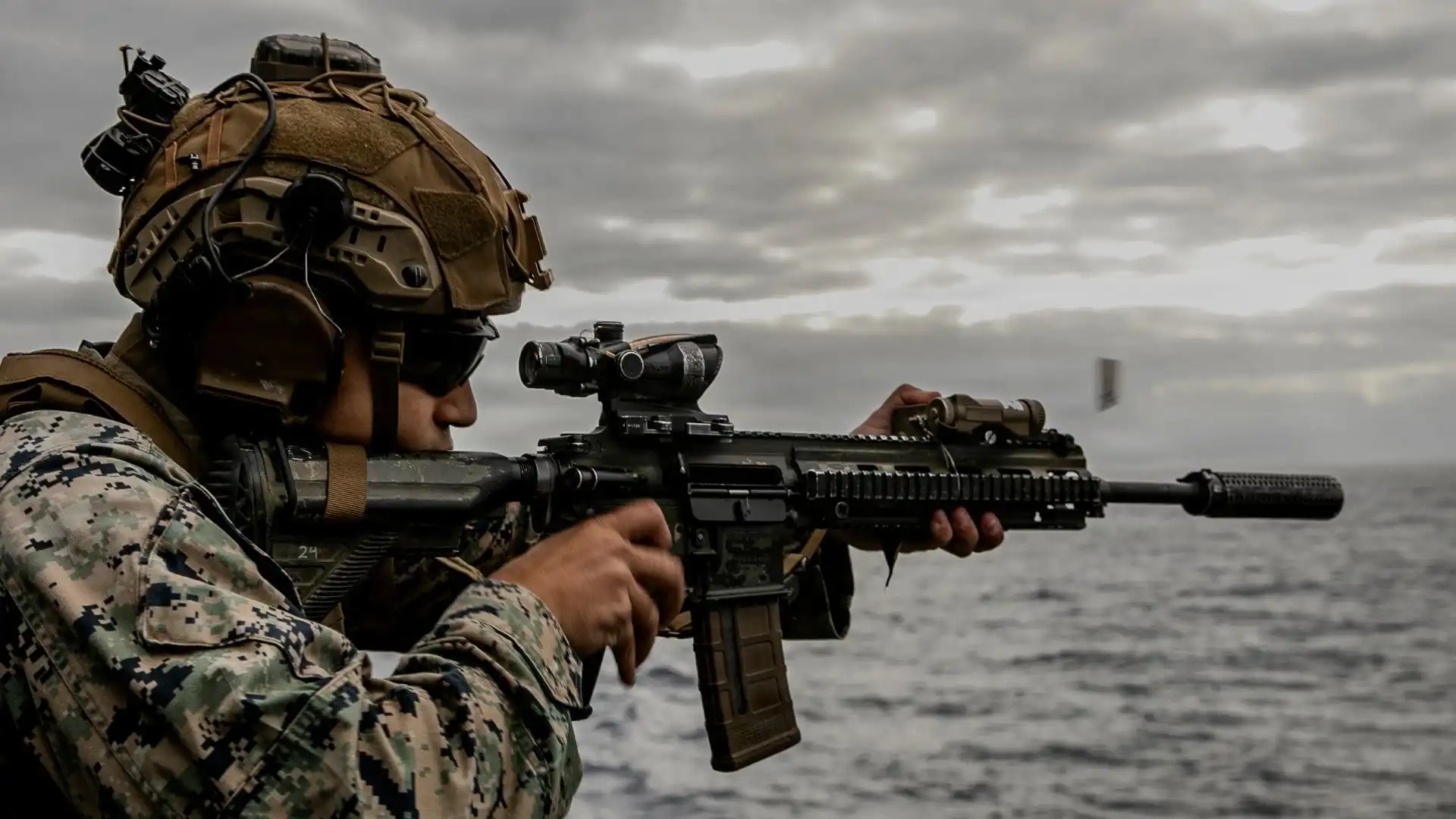
The US Marine Corps has raised the ceiling on its sole-source M27 Infantry Automatic Rifle (IAR) contract with Heckler & Koch Defense Inc. by $45,399,959, lifting the indefinite-delivery/indefinite-quantity (IDIQ) vehicle from $39,228,340 to $84,628,299, according to a Department of War contract announcement dated November 6, 2026. The M27 IAR contract modification covers continued procurement of the rifle systems, spare parts, and associated equipment through April 27, 2028.
The action extends a buying arrangement first awarded in April 2018, when the Marine Corps set a $29.4 million ceiling for up to 15,000 M27s to arm every rifleman in its infantry squads, a decision then-Commandant Gen. Robert Neller announced in December 2017. It also follows the service’s confirmation in February 2026 that it will retain the 5.56mm M27 rather than adopt the Army’s 6.8mm M7 rifle from the Next Generation Squad Weapon (NGSW) program. The contracting activity is Portfolio Acquisition Executive Marine Corps (PAE-MC), the organization established at Quantico, Virginia, on April 10, 2026, replacing Program Executive Office Land Systems.
M27 IAR Contract Ceiling More Than Doubles Under Modification P00016
Modification P00016 to contract M67854-18-D-1248 obligates no funds at award. Money will flow through individual task orders as the Marine Corps issues them, giving the service headroom to order rifles and parts without committing fiscal-year dollars upfront. Work is split between Heckler & Koch’s facility in Oberndorf, Germany (70%), and its US site in Columbus, Georgia (30%).
The Pentagon justified the noncompetitive award under Federal Acquisition Regulation 6.302-1, which applies when only one responsible source can satisfy the requirement. That justification has underpinned the M27 line since 2017, when Marine Corps market research identified Heckler & Koch as the only qualified producer, a finding that drew congressional scrutiny of the sole-source approach the following year.
The base contract’s ordering period, originally set to close in April 2023, has since been extended to April 27, 2028, matching the completion date in this modification. The announcement does not specify how many rifles the additional $45.4 million covers. The initial 2018 delivery order of $7.4 million bought 5,650 rifles at roughly $1,300 per system, but current unit pricing has not been disclosed and cannot be extrapolated from that figure.
M27 Specifications and the Marine Corps Decision to Skip the M7
The M27 is a select-fire derivative of the HK416, using a short-stroke gas piston and rotating bolt rather than the direct-impingement system of the M4 carbine it displaced in infantry squads. Publicly available specifications indicate a 16.5-inch free-floating barrel, an empty weight of 7.9 pounds, and an overall length of 33 to 36.9 inches with an adjustable stock. The rifle fires 5.56x45mm NATO from 30-round STANAG magazines at a cyclic rate of 700 to 900 rounds per minute, with a sustained rate of 36 rounds per minute and effective ranges of 550 meters against point targets and 700 meters against area targets.
Those figures explain the weapon’s dual identity. Introduced in 2010 to replace the belt-fed M249 Squad Automatic Weapon in the automatic rifleman role, the M27 traded sustained volume of fire for accuracy and mobility. The piston system keeps combustion fouling out of the receiver during automatic fire, and the free-floating barrel supports precision at range. An optics-equipped variant serves as the M38 Squad Designated Marksman Rifle.
The Marine Corps cited that profile when it declined the M7. A service spokesperson said the M27 best fits its close combat formations, amphibious employment, and modernization priorities while preserving interoperability with coalition partners. The M7, chambered in 6.8x51mm, feeds from 20-round magazines against the M27’s 30, and a caliber change would force new ammunition logistics across an expeditionary force built around NATO-standard 5.56mm. The service said it will keep monitoring M7 development.
Analysis: The ceiling increase keeps Marine infantry in the HK416 family through at least 2028 and signals that the service treats the M27 as a long-term platform, not a bridge to NGSW. The price of that choice is concentration risk. Seventy percent of the work sits in Germany, while Heckler & Koch is simultaneously ramping up G95 rifle deliveries to the Bundeswehr under a framework amended in December 2025 to cover up to 250,000 weapons. A sole-source supply chain anchored overseas and competing for capacity with a major European order is a vulnerability the Marine Corps has accepted to avoid the cost of a caliber transition.
The next indicators will be the task orders themselves. Their size and timing will show how many rifles the Marine Corps intends to buy before the ordering window closes on April 27, 2028, and whether spares outweigh new rifles. Beyond that date, the service must decide whether to issue a new sole-source vehicle, open a competition, or revisit the M7 question it has deferred.