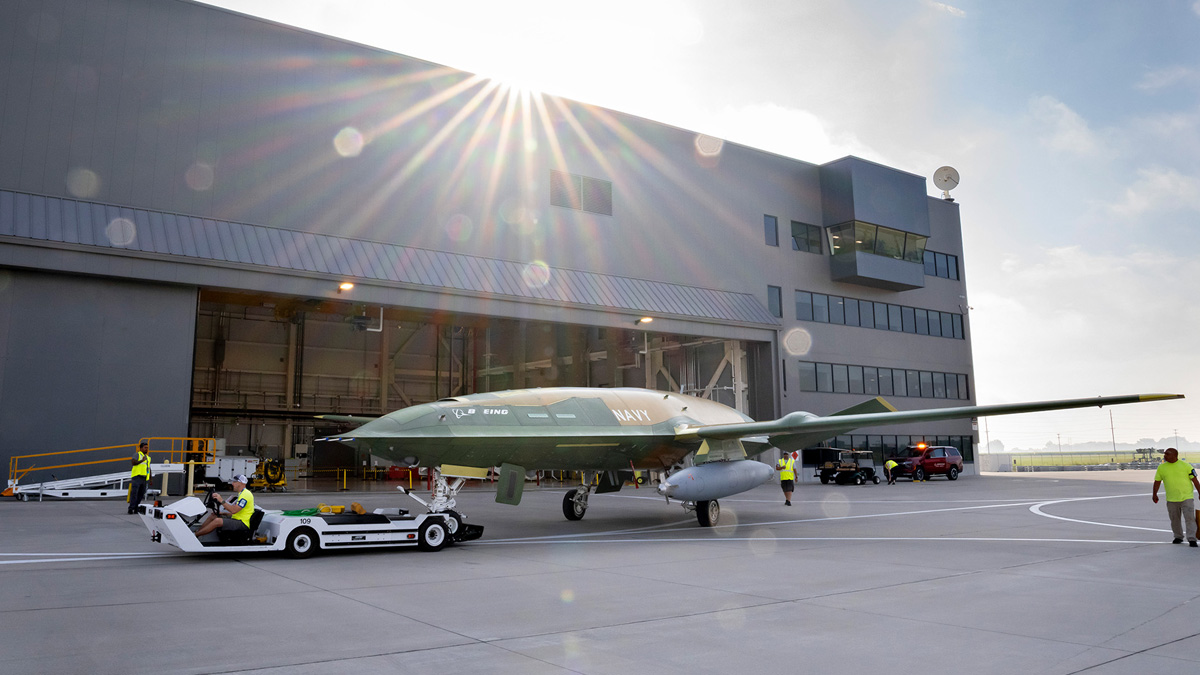
Boeing has flight-tested Manned-Unmanned Teaming (MUM-T) software developed for the U.S. Navy’s MQ-25A Stingray unmanned carrier tanker, using two surrogate aircraft to demonstrate airborne command and control over Link 16 during the Emerald Flag test exercise at Eglin Air Force Base, Florida. The company has not disclosed the dates of the flights.
The test lands as the Stingray program moves from development into production. The first production-representative MQ-25A flew on April 25, 2026, from MidAmerica St. Louis Airport in Mascoutah, Illinois. The program received Milestone C approval on May 19, and on September 14 the Navy awarded Boeing a $562 million fixed-price incentive contract for three Low-Rate Initial Production (LRIP) Lot 1 aircraft, plus long-lead material for three Lot 2 airframes. That award brings 14 aircraft under contract against a program of record of 76. Initial operational capability, defined as three MQ-25As with trained personnel ready to deploy aboard an MQ-25A-capable carrier, has slipped to fiscal 2029.
How Boeing Tested MQ-25 Stingray Teaming Software Over Link 16
Boeing engineers loaded the software onto a Beechcraft 1900D and a Beechcraft King Air E90, and company test pilots then exercised command and control between the two aircraft in flight over Link 16, the primary tactical data link across U.S. forces. Neither airframe resembles a tanker or a fighter; the pair served as flying surrogates for the message exchange that will eventually run between an MQ-25A and a manned receiver. Emerald Flag is a joint, multi-domain test event hosted at Eglin that places developmental programs in a realistic, data-driven range environment.
Boeing describes the software as platform-agnostic, built on open-architecture command-and-control messaging. Teams from Boeing Phantom Works and the company’s MQ-25, F/A-18 and F-22 programs developed it in collaboration with the Navy, and Boeing says the code could serve multiple Navy and Air Force platforms. The stated plan is to field it first on the MQ-25A and the F/A-18E/F Super Hornet once test and evaluation are complete.
The flights move Stingray teaming work out of the laboratory. In a 2021 virtual demonstration sponsored by the Office of Naval Research, simulated Super Hornets and E-2D Advanced Hawkeyes used Link 16 messages to pull an MQ-25 off its preplanned mission and redirect it to a new refueling location and fuel quantity, across 16 scenarios. That work found the E-2D needed no software changes, while the Super Hornet would require updates to add message types already resident in the Hawkeye’s Link 16 library. A 2024 simulator demonstration then showed an F/A-18 pilot commanding a refueling directly from the cockpit.
MD-5 Control Architecture and the Carrier Air Wing Tanker Mission
Publicly available specifications indicate the MQ-25A is 51 feet long, with a 75-foot wingspan that folds to 31.3 feet for deck handling. A single Rolls-Royce AE 3007N high-bypass turbofan rated at more than 8,000 pounds of thrust powers the aircraft. The Navy requires roughly 14,000 pounds of fuel delivered at 500 nautical miles from the carrier, comparable to a Super Hornet configured for buddy tanking. That figure is the core of the program’s rationale: every tanking sortie the Stingray absorbs returns an F/A-18E/F to strike, escort or fleet air defense tasking.
In the baseline concept, an air vehicle operator flies the Stingray from the Unmanned Carrier Aviation Mission Control System, designated MD-5, which the Navy is buying in ship-installed MD-5C, shore-based MD-5D and mobile MD-5E versions. USS Theodore Roosevelt (CVN-71) became the first carrier fitted with an Unmanned Air Warfare Center for MQ-25A operations in March 2026. The aircraft flies its plan autonomously, but changes to a rendezvous point, timing or offload quantity route through that operator.
MUM-T adds a second command path. A receiving pilot could retask the tanker directly over Link 16 instead of relaying requests through the carrier. Boeing program officials frame the payoff as faster tanker response, less logistical friction and a higher operational tempo for the carrier strike group. In practice, that shortens the decision loop when a strike package’s timeline shifts and preserves a command channel when the carrier restricts emissions or its links degrade. Because Link 16 is a jam-resistant, frequency-hopping network already fielded across U.S. and NATO fleets, the capability rides on installed terminals rather than a new waveform.
Analysis: The Emerald Flag flights target one of the less visible risks in the Stingray program. An unmanned tanker that depends on a shipboard operator for every replan is a constrained asset in exactly the contested, emissions-controlled scenarios that justify buying it. Link 16 teaming turns the MQ-25A into a responsive node the air wing can task in real time. The pacing item now sits on the manned side: each receiving platform needs flight software changes, certification and dedicated funding. The F-22 team’s involvement suggests Boeing intends the same code to reach Air Force fleets, and its platform-agnostic design bears directly on the Navy’s longer-term plans for carrier-based collaborative combat aircraft.
Boeing says additional test flights will precede integration into the operational MQ-25A software, but neither the company nor the Navy has published a schedule, a funding line or the Super Hornet configurations involved. Stingray flight testing is expected to run through the end of 2026, the Lot 2 award is planned for 2027, and the first Lot 1 aircraft are due in 2029.