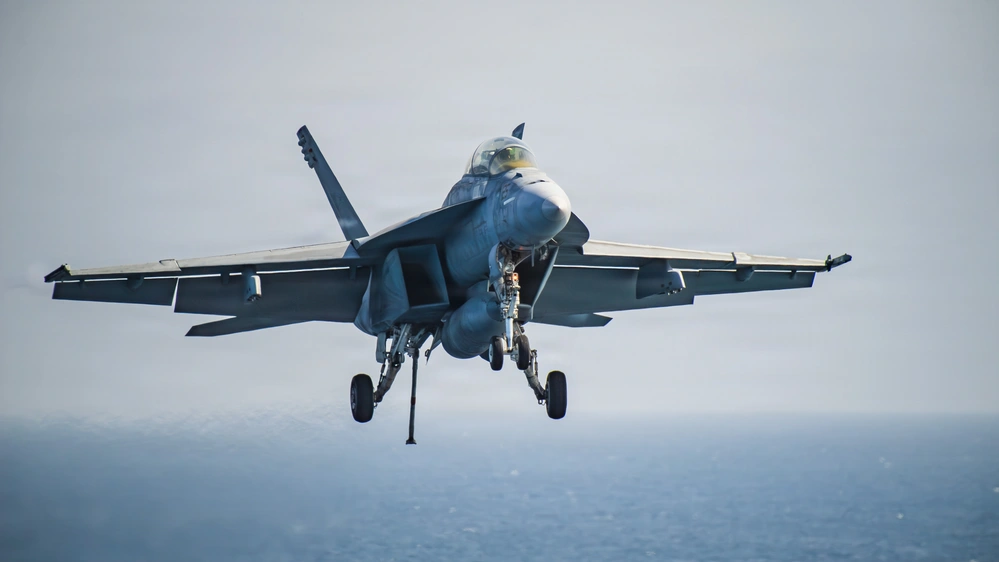
The U.S. Navy has awarded Boeing a $16,667,607 firm-fixed-price order to plan the shutdown of the F/A-18E/F Super Hornet and EA-18G Growler production lines, the Department of War announced on September 29, 2026. The award landed the same day the department named Boeing winner of the F/A-XX sixth-generation carrier fighter competition, with a full-scale development contract valued at more than $20 billion.
The two announcements frame a generational handover in U.S. naval aviation. The Navy placed its last planned Super Hornet buy on March 19, 2024, ordering 17 Block III jets from Lots 46 and 47, with final deliveries expected by spring 2027. Boeing no longer builds the Growler, having closed out U.S. Navy and Royal Australian Air Force orders in the late 2010s. The F/A-XX is slated to augment and eventually replace both aircraft beginning in the 2030s, operating alongside the F-35C Lightning II.
What the Super Hornet Production Shutdown Order Covers
Naval Air Systems Command (NAVAIR) at Patuxent River, Maryland, placed the order (N0001926F1139) against an existing basic ordering agreement (N0001926G1002). It funds planning, analysis, engineering, and program management support for closing both lines. Boeing will inventory and assess government-owned production equipment and tooling, develop retention, storage, and disposition recommendations, and deliver a master property inventory and disposition plan.
The full $16,667,607 comes from fiscal 2024 Aircraft Procurement, Navy funds and was obligated at award. The order was not competitively procured, consistent with work tied to the incumbent prime’s own production system. Work runs through November 2030, more than three years after the final Block III delivery.
The workshare maps onto the program’s industrial geography. St. Louis, Missouri, which accounts for 60% of the effort, hosts final assembly along with forward fuselage and wing production. El Segundo, California, at 37%, is where Northrop Grumman built the center and aft fuselage sections and vertical tails as Boeing’s principal subcontractor; it completed the final shipset in 2025. Bethpage, New York, at 3%, hosted Northrop Grumman’s airborne electronic attack (AEA) system integration work for the EA-18G. The order does not specify which subcontractors will perform the El Segundo and Bethpage portions.
Sustaining Super Hornets and Growlers Into the 2040s
Closing the line does not retire the aircraft. NAVAIR has said the Super Hornet will remain a predominant aircraft in the carrier air wing into the 2040s, and the Growler is the Navy’s only tactical airborne electronic attack platform. That longevity rests on two efforts that continue after the last delivery.
The first is the Service Life Modification (SLM) program. Publicly available specifications indicate it extends Block II airframes from 6,000 to roughly 10,000 flight hours while installing the Block III capability suite: an advanced cockpit system with a large-area touchscreen display, the Distributed Targeting Processor-Networked (DTP-N) mission computer, the Tactical Targeting Network Technology (TTNT) datalink, and signature reduction treatments. Boeing is shifting SLM work out of St. Louis to San Antonio, Texas, and Fleet Readiness Center Southwest in San Diego.
The second is Growler modernization, anchored on the AN/ALQ-218(V)2 receiver, the AN/ALQ-227 communication countermeasures set, and the AN/ALQ-249(V)1 Next Generation Jammer Mid-Band replacing legacy AN/ALQ-99 pods.
Tooling disposition matters because upgrade kits do not replace worn structural parts. The March 2024 final production contract also bought Phase One of the F/A-18E/F and EA-18G technical data package, covering operation, maintenance, installation, and training data for post-production sustainment. The new disposition plan is the physical complement to that data: it determines which jigs, fixtures, and production equipment the government keeps for long-term fleet support.
Boeing’s F/A-XX Award and the St. Louis Fighter Transition
The F/A-XX contract covers the full-scale development phase and procures multiple test aircraft for ground, airworthiness, systems, and weapons integration testing. The Navy said the aircraft will operate with crewed and uncrewed platforms, including Collaborative Combat Aircraft (CCA). Boeing cited an open mission systems architecture but said technical and program details remain classified. Contract type, test aircraft quantity, and a permanent designation have not been disclosed.
Boeing beat Northrop Grumman in the final round; Lockheed Martin had reportedly been eliminated earlier. The win gives Boeing both U.S. sixth-generation crewed fighter programs, following the Air Force’s selection of its F-47 on March 21, 2025.
The fiscal 2026 budget request carried only about $74 million for F/A-XX, with the White House arguing that more money could strain the aviation industrial base and delay the higher-priority F-47. Congress pushed back, adding $750 million through the 2025 reconciliation law and further development funding in the fiscal 2026 appropriations act.
St. Louis will close its Super Hornet line while ramping F-47 and F/A-XX development in its secure manufacturing facilities, alongside continuing F-15EX Eagle II, MQ-25 Stingray, and T-7A Red Hawk work.
Analysis: A $16.7 million order rarely carries strategic weight, but this one sets the terms of the Navy’s hedge against F/A-XX schedule risk. Final Super Hornet deliveries end in spring 2027, and the F/A-XX has no public first-flight or initial operational capability date beyond a fielding window in the 2030s. Through that gap, the F-35C is the Navy’s only carrier-capable fighter in production. Fighter development programs have historically slipped, and the Navy has not signaled any intent to reopen the Super Hornet line. Retained tooling is nonetheless what would keep a restart technically plausible if the gap widens, and the November 2030 completion date lets the Navy defer irreversible scrapping decisions until F/A-XX development matures. How much tooling survives the disposition plan will indicate how much confidence the Navy places in its new fighter’s schedule.
The next milestones are the final Block III deliveries in spring 2027 and the disposition plan itself, which will define what the government keeps, stores, or scraps before November 2030. On F/A-XX, key unknowns remain the contract structure, the number of test aircraft, the formal designation, and a first-flight target. Whether Northrop Grumman will protest the award has not been disclosed. The fiscal 2027 appropriations cycle will show whether Congress funds full-scale development at the pace the award implies.