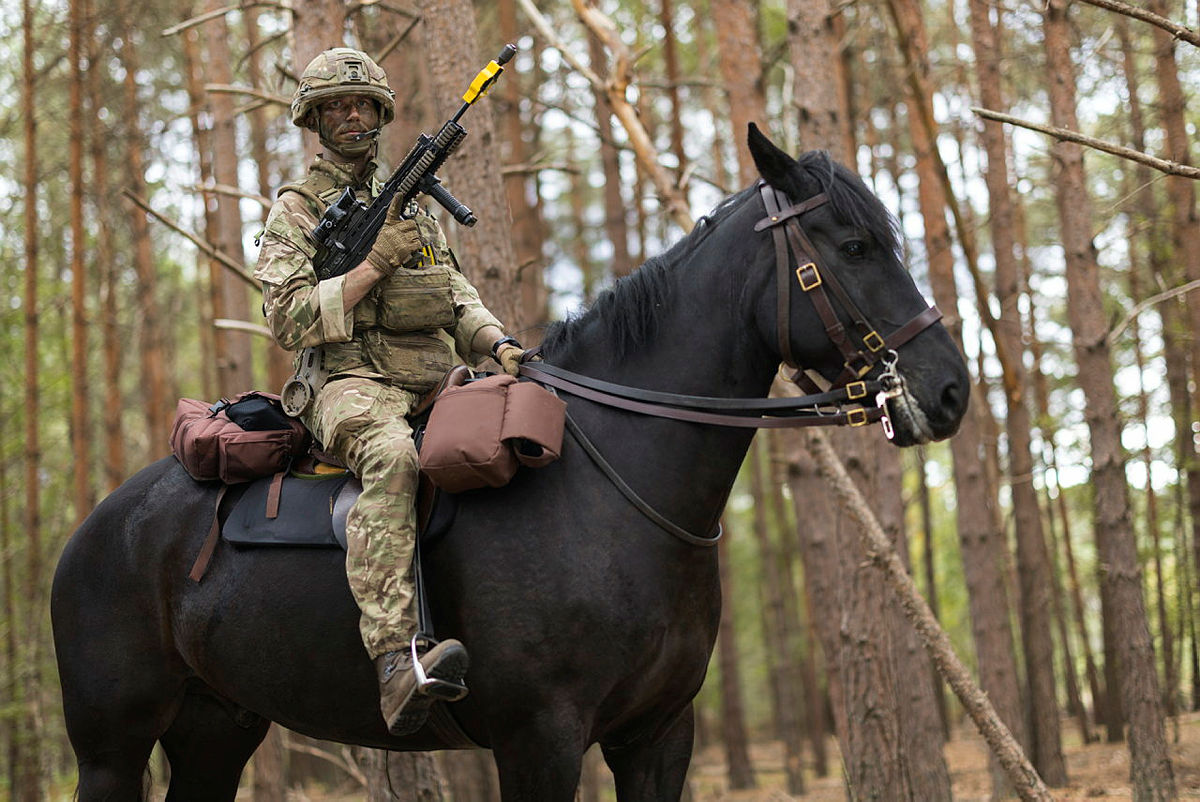
The British Army has put Household Cavalry horses through a mounted combat capability experiment, testing whether Military Working Horses can carry reconnaissance, patrol and security tasks across terrain where vehicles cannot operate. Soldiers of the Household Cavalry Mounted Regiment (HCMR) ran the serial on September 23, 2026, on the Barossa training area at the Royal Military Academy Sandhurst, according to Ministry of Defence (MOD) imagery and captions.
Barossa marks the third step in a mounted trials series that began in April 2026, when the HCMR added a map-and-compass navigation exercise on horseback to its Princess Elizabeth Cup competition. The regiment then used its summer camp at Longmoor Training Area in Hampshire to test concealment, sustainment and equine welfare, ending with a 24-hour mounted navigation and reconnaissance challenge.
Household Cavalry Horses Run Paired Recon Patrols at Sandhurst
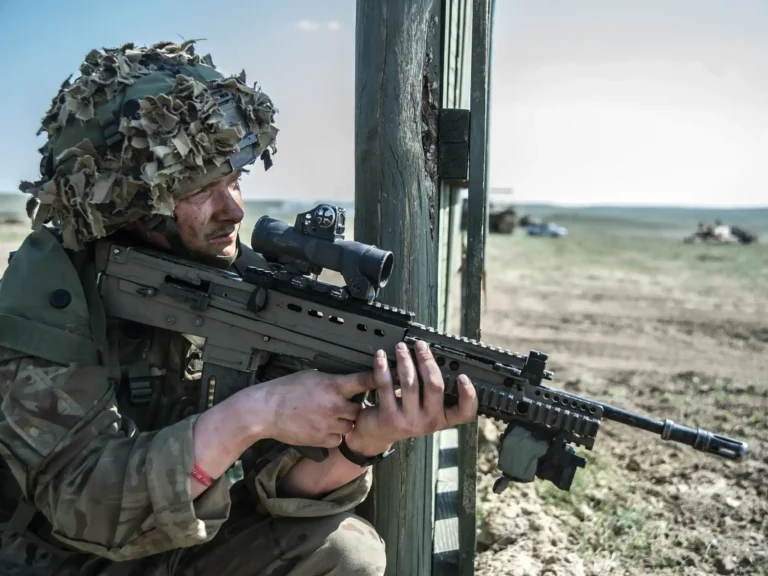
MOD imagery shows HCMR troopers working in pairs from the saddle, using the sights of their SA80 rifles to locate and track simulated enemy positions. One caption identifies Lance Corporal of Horse Chapman carrying his SA80 during the mounted serial. Riders had to maintain observation of the surrounding ground and identify potential enemy activity while controlling their horses across difficult terrain.
The training area was chosen for that friction. Barossa’s tracks cut through thick gorse, deep mud and dense woodland, ground that already tested riders during the spring navigation event, when horses reared and spun at the sound of gunfire from nearby ranges. The core human factor is clear: a mounted scout must navigate, observe and manage a powerful, sometimes unpredictable animal at the same time.
The MOD described the September activity as focused on experimentation, innovation and the professional development of soldiers and horses, drawing on lessons from international partners while developing skills beyond the regiment’s ceremonial role. The Army has framed the work as an examination of a niche capability for restricted environments, not a return to cavalry formations or an Army-wide mounted combat role.
Key data remain unpublished. The MOD has not disclosed how many riders or horses took part, the distances covered, the communications fit carried by patrols, or any metrics comparing mounted scouts with dismounted or vehicle-borne reconnaissance. No evaluation report has been released.
The Cavalry Black as a Platform: Mobility, Load and Signature
Treated as a platform, the HCMR horse carries a specification sheet of its own. The regiment holds roughly 250 horses, predominantly Cavalry Blacks bred in Ireland from Irish Draught and Thoroughbred lines. Troop horses must stand at least 16.2 hands, about 1.68 meters at the withers, and are selected to carry a trooper plus 44 kilograms of ceremonial equipment. Officers’ chargers are preferably 17 hands or taller.
Publicly available equine data indicate a walk of about 6 kilometers per hour, a working trot of 13 to 16 kilometers per hour and short gallops above 40 kilometers per hour. That envelope is slow against any wheeled or tracked vehicle on roads, but a horse can follow narrow forest paths, ford streams and climb broken slopes that stop or canalize vehicles. A mounted observer’s eye line sits at an estimated 2.5 meters, an advantage for observation over low scrub.
The signature profile cuts both ways. A horse emits no engine noise or exhaust, but an animal typically weighing around 600 kilograms, with a core temperature near 38 degrees Celsius, presents a clear target to handheld and drone-mounted thermal imagers. The bespoke camouflage coverings HCMR soldiers devised at Longmoor address visual concealment only.
Sustainment is the binding constraint. Open-source husbandry figures put a working horse’s daily forage requirement at around 2 percent of body weight, roughly 12 kilograms, plus 25 to 50 liters of water, alongside farriery and veterinary care. The Royal Army Veterinary Corps already supports the Army’s Military Working Horses, providing a small existing support base.
How Allied Mounted Units Shaped the British Army Experiment
The Army credits a volunteer initiative in Estonia as its inspiration. Around a dozen volunteers, including former soldiers, formed a horse-mounted unit within the Estonian Defence League and, after exercises in southern Estonia, concluded that horses can outperform armored vehicles in thick forest and boggy ground. Estonia’s regular forces field CV90 infantry fighting vehicles; the volunteers argued heavy vehicles bog down there.
Other armed forces retain niche equine roles. India uses horses for patrolling and border reconnaissance, Chile for high-altitude scouting and Russia for frontline logistics, while France and Finland are studying tactical applications. The United States maintains an expeditionary mounted and pack-animal capability for austere terrain, a lineage reinforced when US special operations forces fought on horseback in northern Afghanistan in late 2001.
Those precedents share a pattern: horses appear in small numbers where terrain, altitude or infrastructure deny vehicles, usually attached to light or special forces rather than as stand-alone maneuver units. The HCMR draws its troopers from the Life Guards and the Blues and Royals, which also man the armored Household Cavalry Regiment (HCR). Its commanding officer, Lieutenant Colonel Ben McNeil, has described the cavalryman’s craft as constant whatever the platform, horse or armored vehicle.
Analysis: The experiment matters less as a return to the horse than as a test of cheap, quiet mobility for the forested, waterlogged terrain of NATO’s northeastern flank, where the UK leads the alliance battlegroup in Estonia. The HCR, the Household Cavalry’s armored arm, led the General Dynamics Ajax tracked reconnaissance vehicle to initial operating capability, but training use of Ajax was suspended after about 30 personnel reported noise and vibration symptoms on Exercise Titan Storm in November 2025, with a phased restart outlined in April 2026. A mounted element cannot replace that sensor and firepower, and its thermal signature, logistics demand and exposure to first-person-view drones confine it to a supporting niche.
The MOD has announced no follow-on serial, formal evaluation or change to the HCMR’s establishment. Indicators to watch include whether mounted patrols appear on exercises alongside the UK-led battlegroup in Estonia, whether the Army publishes assessment criteria, and whether equine reconnaissance enters formal Field Army concept work.