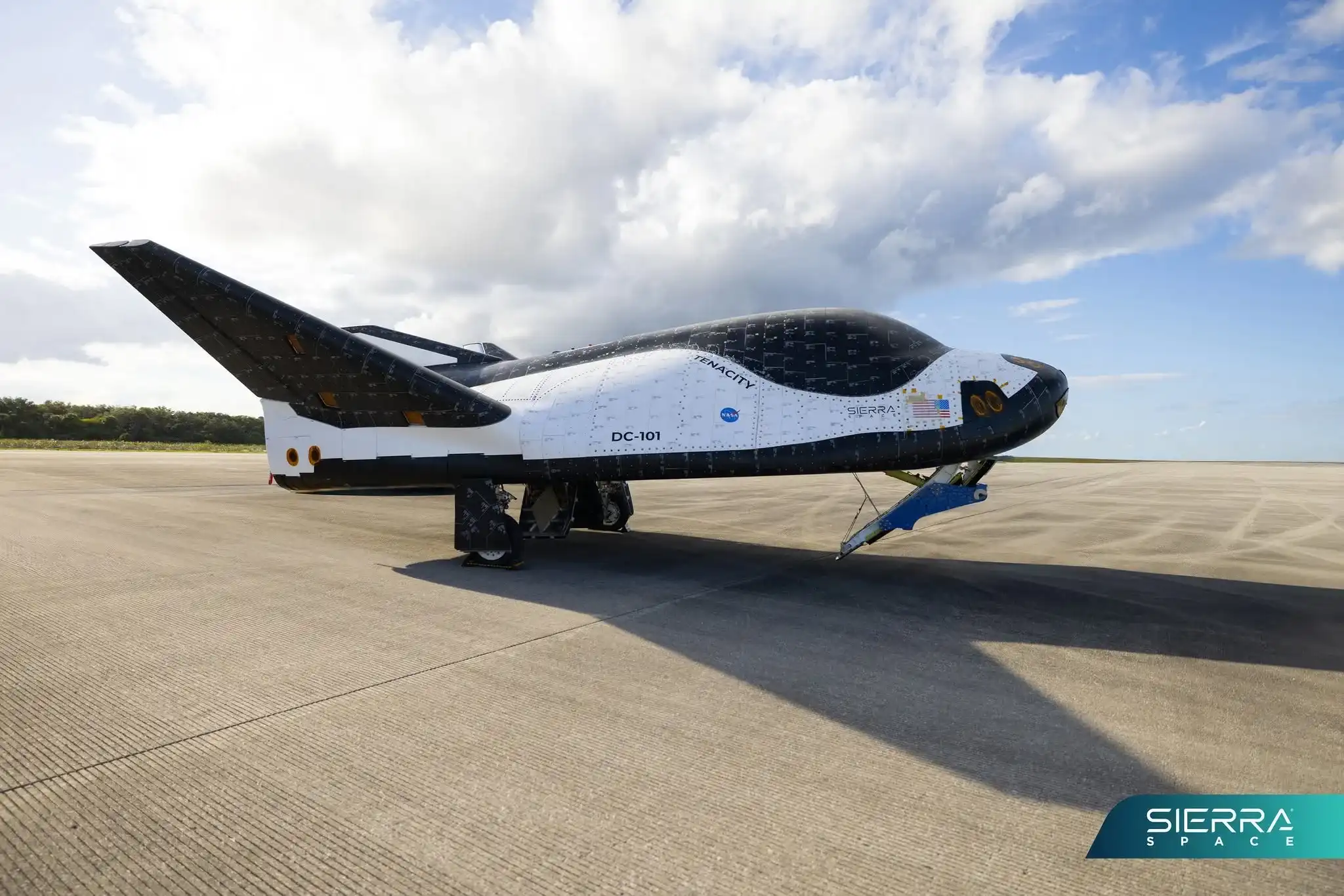
The Federal Aviation Administration (FAA) has issued Sierra Space a vehicle operator license authorizing its Dream Chaser reusable spaceplane to reenter the atmosphere and land at Vandenberg Space Force Base (SFB), California. The FAA announced the Part 450 license on November 9, 2026. It runs for five years and allows up to four reentries per year, provided the vehicle configuration and mission profile remain unchanged.
The approval clears one of the last regulatory gates before the debut of Tenacity, the first Dream Chaser airframe. The program has slipped repeatedly since NASA selected Dream Chaser in 2016 for the second round of Commercial Resupply Services (CRS-2) to the International Space Station (ISS). On September 25, 2025, NASA and Sierra Space amended that contract, turning the first flight into a free-flyer demonstration that will not dock with the station and removing NASA’s commitment to seven guaranteed resupply missions. Sierra Space acknowledged the license on X, thanking the FAA “for its collaboration and support of commercial space innovation.”
Dream Chaser FAA License Shifts Primary Landing Site to Vandenberg
The license formalizes a change in concept of operations. When the FAA opened its environmental review in July 2024, Sierra Space proposed landing at the Shuttle Landing Facility (SLF) at Kennedy Space Center, Florida, with Vandenberg listed only as a contingency reentry site. The license issued this week names Vandenberg.
The mission now spans both coasts. Tenacity will launch from Florida aboard a United Launch Alliance (ULA) Vulcan Centaur, conduct several days of orbital operations, and return to the Vandenberg runway. Sierra Space confirmed that profile on September 2, 2026, announcing it had signed national security and commercial customers to fly payloads alongside NASA cargo. The company has not identified those customers, the payloads, or contract values, and says the manifest is still being finalized.
Under Part 450, the FAA assesses public safety, property, and national security risks and coordinates an interagency payload review before licensing. The four-reentry annual cap leaves room for a multi-flight cadence, but Sierra Space has only one flight-ready vehicle: production of the second airframe, Reverence, was put on hold in late 2025 so the company could concentrate on Tenacity.
Tenacity Design: Folding Wings, Lifting Body, and 1.5g Runway Return
Dream Chaser is a lifting-body spaceplane derived from NASA’s HL-20 Personnel Launch System studies of the 1980s and 1990s. Publicly available specifications from the FAA review describe a vehicle roughly 30 feet (9.1 m) long, with a 27-foot (8.2 m) wingspan and a mass of about 24,600 pounds (11,160 kg). Its wings fold so the spaceplane fits inside Vulcan’s 5-meter payload fairing.
Cargo rides partly in the spaceplane and partly in Shooting Star, an expendable module mounted behind the vehicle that also carries the solar arrays. Upmass is rated at about 5,500 kg (12,100 pounds) of pressurized and unpressurized cargo. Return capacity is smaller; publicly available figures place it at roughly 1,750 to 1,850 kg (3,860 to 4,080 pounds). Shooting Star separates before reentry and burns up along with any disposal cargo.
A reaction control system burning hydrogen peroxide and kerosene (RP-1) handles orbital maneuvering, the deorbit burn, and high-altitude attitude control. Near Mach 4, the vehicle transitions to its aerodynamic control surfaces and glides to an autonomous runway landing. Sierra Space says loads on returning cargo stay below 1.5 g and that any runway able to accept a Boeing 737 can serve as a landing site. That is a gentler recovery path for sensitive payloads than an ocean splashdown.
Analysis: Moving the primary landing site from the SLF to Vandenberg puts Dream Chaser’s return leg on a Space Force installation with controlled access and a history of runway recoveries; the X-37B Orbital Test Vehicle landed there on its first three missions. For the undisclosed national security customers on the first flight, returned hardware will come down inside a military perimeter rather than at sea. Paired with Sierra Space’s stated push into the defense market, the Vandenberg license recasts Dream Chaser less as a station freighter and more as a dual-use orbital logistics and test platform. That positioning still rests entirely on a successful first flight.
The binding constraint is now the launcher. Vulcan has not flown since February 12, 2026, when a GEM 63XL solid rocket booster nozzle failed during the USSF-87 national security mission, grounding the rocket for nine months. ULA has scheduled its return to flight for November 13 with 40 Amazon Leo satellites. Sierra Space still describes the Tenacity mission as targeted for late 2026 but has not announced a launch date. With seven weeks left in the year, meeting that target would require ULA to slot Tenacity in shortly after a clean return to flight. A successful demonstration would also reopen the path to NASA resupply orders under the amended CRS-2 contract.