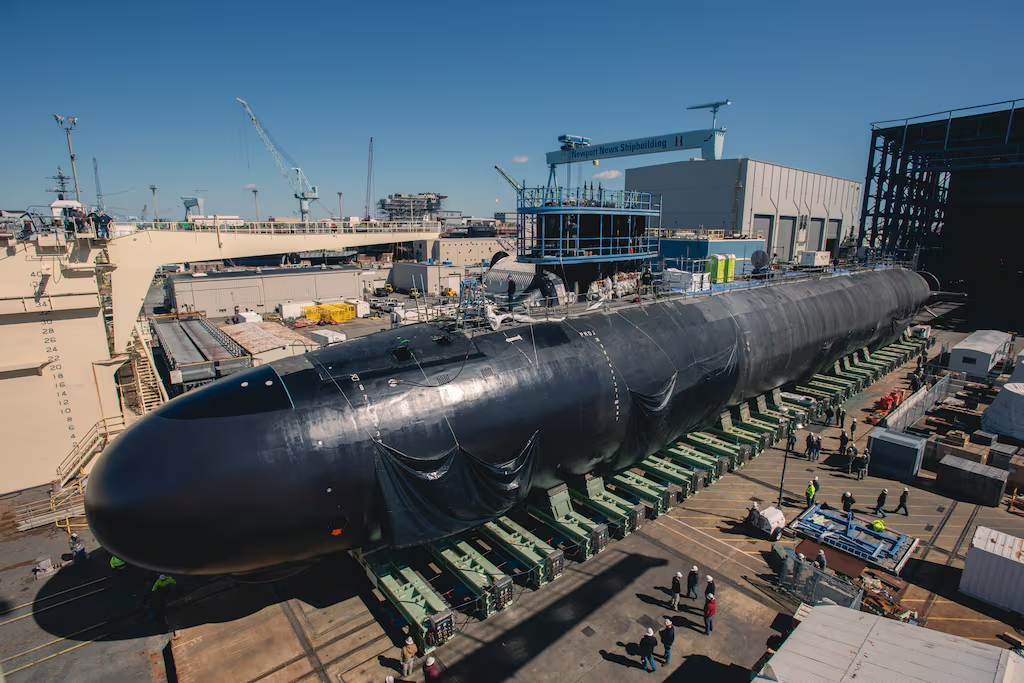
Anduril Industries said on October 6, 2026, that it will invest $3.7 billion to build a new shipyard in Baltimore County, Maryland, dedicated to components for the US Navy’s Virginia-class nuclear-powered attack submarines. In parallel, the Navy awarded the company a contract worth up to $2.9 billion to manufacture submarine parts, with payments tied directly to production output and Anduril carrying most of the execution risk, according to the company.
The deal targets the most persistent bottleneck in US naval shipbuilding. The Navy procured Virginia-class boats at two per year from fiscal 2011 through fiscal 2024, yet actual output has run at roughly 1.2 boats per year since 2022, according to the Congressional Research Service (CRS). The Navy’s long-range shipbuilding plan, released in May 2026, sets fiscal 2031 as the target for building two Virginia-class and one Columbia-class submarine annually. The planned sale of three to five boats to Australia under the AUKUS security pact among Australia, the United Kingdom and the United States pushes the required Virginia-class rate to 2.33 per year. A 2026 Government Accountability Office (GAO) review found that both Virginia-class boats delivered in 2025 arrived more than three years late.
Anduril Submarine Shipyard Plan: Arsenal-2 Scope, Jobs, and Contract Terms
The Baltimore County facility, designated Arsenal-2, will occupy 187 acres at Tradepoint Atlantic, the former Bethlehem Steel site at Sparrows Point, with more than 2 million square feet of buildings. It is expected to be operational by the end of the decade. Anduril projects 3,100 direct jobs at the site, more than 11,000 indirect jobs across the regional supply chain, and about 9 million labor hours of annual capacity.
Maryland and Baltimore County have committed to match up to 13% of the private investment, or about $481 million, and the county has offered a personal property tax break worth up to $210 million over 30 years.
Production will proceed in two stages. Anduril is already building out a facility in California to manufacture critical Virginia-class components such as torpedo tubes, aimed at urgent capacity shortfalls in the submarine supply base. Once Arsenal-2 comes online, the company plans to move up the value chain into larger submarine modules and hull sections. The company has not identified the California site or its output targets.
The contract structure departs from the standard model for submarine industrial base funding, in which the Navy finances supplier facilities and workforce growth directly. Christian Brose, Anduril’s chief strategy officer, described the award as “the government buying the results” of output from a facility built mainly with Anduril’s own capital. The combined $6.6 billion figure therefore pairs a private capital commitment with a contract ceiling, not obligated federal funds. The contract vehicle, period of performance, ordering mechanism, and unit quantities have not been made public.
Arsenal-2 follows the roughly $1 billion Arsenal-1 campus near Columbus, Ohio, which began producing the YFQ-44A Fury collaborative combat aircraft in March 2026. Co-founded in 2017 by Palmer Luckey, Anduril built its business on autonomous systems and the Lattice command-and-control software before expanding into undersea vehicles, including the Ghost Shark extra-large autonomous undersea vehicle ordered by Australia.
From Torpedo Tubes to Hull Modules: Anduril’s Virginia-Class Role
Publicly available specifications indicate that Block I through IV Virginia-class boats measure 377 feet in length with a 34-foot beam and displace roughly 7,800 tons submerged. An S9G pressurized-water reactor drives a pump-jet propulsor for speeds above 25 knots, and four 21-inch torpedo tubes launch Mk 48 Advanced Capability (ADCAP) heavyweight torpedoes. Block V introduces the Virginia Payload Module (VPM), an 84-foot hull insert with four large-diameter tubes carrying seven Tomahawk-class missiles each, which raises vertical strike capacity from 12 to 40 missiles and submerged displacement to approximately 10,200 tons.
Torpedo tubes are a logical entry point. They penetrate the pressure hull, must seal against sea pressure at operating depth, and fall under the Navy’s Submarine Safety (SUBSAFE) quality-assurance regime, which makes supplier qualification slow and attrition costly. Hull sections and modules are a heavier lift. VPM-equipped Block V and Block VI boats add steel, welding hours, and outfitting work per hull at the moment the Navy is trying to accelerate the build rate. With four tubes per hull, the value of a new line lies less in raw volume than in added qualified capacity for a component where one late delivery can stall a boat’s construction sequence.
General Dynamics Electric Boat and Huntington Ingalls Industries’ Newport News Shipbuilding jointly build the class and have already pushed module work to outside yards, including Austal USA, which is building a module fabrication facility in Mobile, Alabama, under an Electric Boat contract. Anduril would enter that outsourced structural tier with its own capital rather than prime- or Navy-funded facilities.
Analysis: The arrangement tests whether venture-scale private capital can do work Congress has funded through submarine industrial base appropriations since fiscal 2018. If Anduril delivers qualified hardware on schedule, the Navy gains capacity without carrying construction risk, plus a new structural supplier outside the Electric Boat and Newport News footprints. The timeline cuts the other way: a yard operational around 2030 offers little relief before the fiscal 2031 two-per-year target, so near-term impact rests on the California torpedo-tube line. Anduril also has no track record in nuclear-grade structural fabrication, where the learning curve runs in years and a single first-article defect can stall a build sequence.
Next milestones include disclosure of the contract vehicle and ordering terms, along with permitting and site preparation at Tradepoint Atlantic. Qualification of the first California-built torpedo tubes will offer the earliest measurable test of Anduril’s submarine manufacturing claims, while the fiscal 2028 budget request will show whether the Navy intends to extend the pay-for-output model to other suppliers.