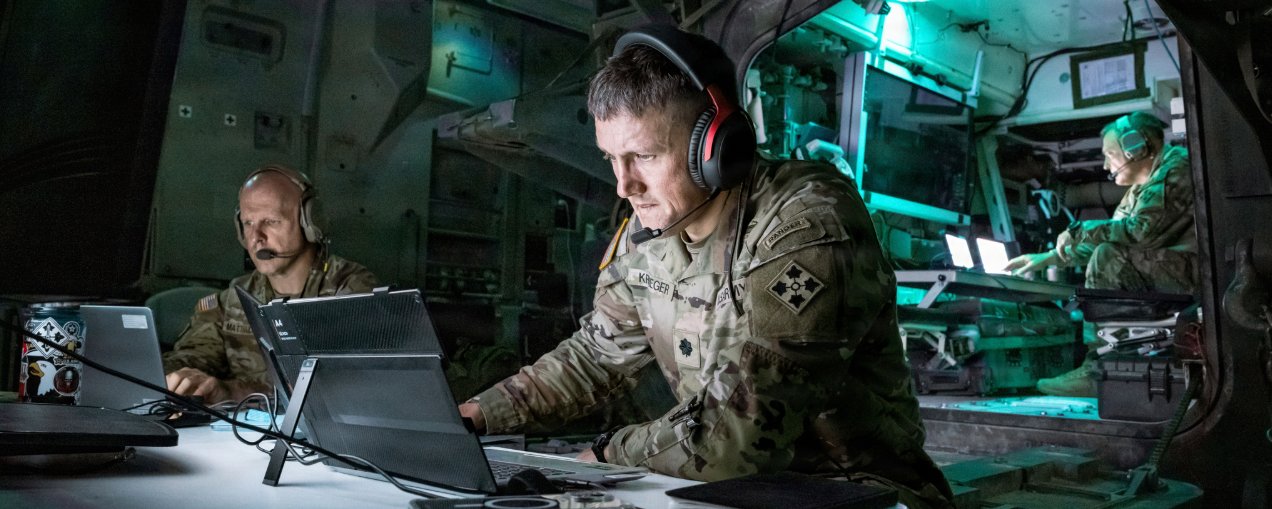
The U.S. Army has awarded Anduril Industries a contract worth up to $1.8 billion over five years to field the Next Generation Command and Control (NGC2) common data layer across I Corps, the Pacific-focused corps headquarters at Joint Base Lewis-McChord, Washington. Anduril announced the award on October 5, 2026, and said the initial base period is valued at $162.8 million, with options making up the remainder.
The contract moves NGC2, one of the Army’s top modernization priorities, from division-scale prototyping to operational fielding. The program replaces stovepiped command, fires, intelligence and sustainment systems, each tied to its own hardware and upgrade cycle, with a single software and data architecture that sensors, weapons and applications from different vendors can join. It comes nearly 15 months after the Army issued a $99.6 million Other Transaction Authority (OTA) agreement on July 18, 2025, for a prototype built around the 4th Infantry Division at Fort Carson, Colorado.
Army NGC2 Contract Shifts Focus to I Corps and the Pacific
Anduril has not disclosed which I Corps formations will receive the system first, how many vehicles, command posts or end-user devices will be equipped, or when fielding begins. The contract vehicle was also not specified. It remains unclear whether the award runs under the 10-year enterprise agreement, valued at up to $20 billion, that the Army signed with Anduril on March 13, 2026, to consolidate more than 120 procurement actions around the Lattice software suite.
I Corps presents a harder problem than home-station experimentation in Colorado. The corps, which Anduril describes as commanding four Army divisions, includes the 25th Infantry Division at Schofield Barracks, Hawaii, and carries much of the Army’s posture in the Indo-Pacific. Its units can be separated by thousands of miles, must exchange data with joint and allied forces, and are expected to operate through disrupted and intermittent communications. The architecture therefore has to let subordinate units keep planning and executing when links to higher headquarters drop, then resynchronize when connectivity returns. How Lattice prioritizes data over thinner, contested long-haul transport will determine how much of the Fort Carson performance carries over to the Pacific.
From Ivy Sting to Ivy Mass: NGC2 at Division Scale
Team Anduril, which included Palantir, Microsoft, Govini, Instant Connect Enterprise, Research Innovations Inc. and Striveworks under the prototype OTA, began working with 4th Infantry Division soldiers within weeks of the award. The Ivy Sting series ran as software sprints, each adding a warfighting function.
At Ivy Sting 1 in September 2025, the division fired M777A2 155mm howitzers using a beta version of the Artillery Execution Suite (AXS) running on Lattice Mesh, as the division began retiring the Advanced Field Artillery Tactical Data System (AFATDS), in Army service for more than 30 years. According to Anduril, crews fired 26 live missions, reached digital readiness in under 30 seconds, and fired the first round 12 hours after the beta software was installed.
Five Ivy Sting events led to Ivy Mass in May 2026, the division-wide risk-reduction exercise. Connected soldier devices grew from roughly 10 at Ivy Sting 5 to more than 2,500, and soldiers took over node provisioning and remote software updates themselves. Anduril says NGC2 cut artillery fire timelines by 90 percent against legacy systems, accelerated airspace deconfliction, let Army, Marine Corps and Navy systems share data without manual transfer, and kept supporting units after they lost connectivity to higher headquarters. Those figures are company-reported and have not been independently verified.
The division then employed NGC2 at division scale during Project Convergence Capstone 6, held July 20 to 29, 2026, at the National Training Center, Fort Irwin, California, alongside British, Australian, Canadian and New Zealand forces.
Lattice, Foundry and Raft: Inside the NGC2 Common Data Baseline
NGC2 is built as a four-layer stack: transport, integration, data and applications. On June 22, 2026, the Army established the NGC2 common data layer baseline and named Anduril to lead it. Lattice serves as the tactical data layer at the edge and Palantir’s Foundry as the cloud data layer, forming an edge-to-cloud data mesh, while Raft supplies data and services registries, transformation tools and data federation.
The baseline matters most for the 25th Infantry Division, which sits inside I Corps. The 25th ran a separate prototype led by Lockheed Martin, which received a $26 million award in September 2025 and teamed with Raft and Accelint. Unlike the 4th Infantry Division stack, the Hawaii prototype ran on the division’s existing transport and compute environment, and, according to Lockheed Martin, soldiers used it to fire HIMARS rockets and M777 howitzers during Lightning Surge 2 in February 2026. The Army said Lockheed Martin would keep leading full-stack implementation at the 25th while adopting the common baseline, so corps fielding will require two industry-built stacks to converge on one data layer.
Analysis: The award turns Anduril from prototype integrator into the steward of the Army’s tactical data backbone at corps scale, but its structure preserves Army leverage. The $162.8 million base is about 9 percent of the ceiling, so most of the value depends on options the service can withhold if fielding stalls. The larger test is architectural. Anduril argues that a common data layer keeps any single company from controlling the Army’s C2 stack, yet the layer itself runs on Lattice, which the Pentagon’s own contract language describes as proprietary. Whether NGC2 stays multi-vendor will depend on government control of data standards, registries and interfaces. I Corps, with a Lockheed-led division already inside it, is where that claim gets tested first.
Army officials said in July that they aimed to begin fielding NGC2 equipment to I Corps units in 2027, with lessons from Project Convergence shaping the basis of issue. Open questions include the sequencing of I Corps divisions, equipment quantities, the transport layer that will carry Lattice traffic across Pacific distances, and the timing of the first option exercise. The Army has not said when NGC2 will extend beyond I Corps.