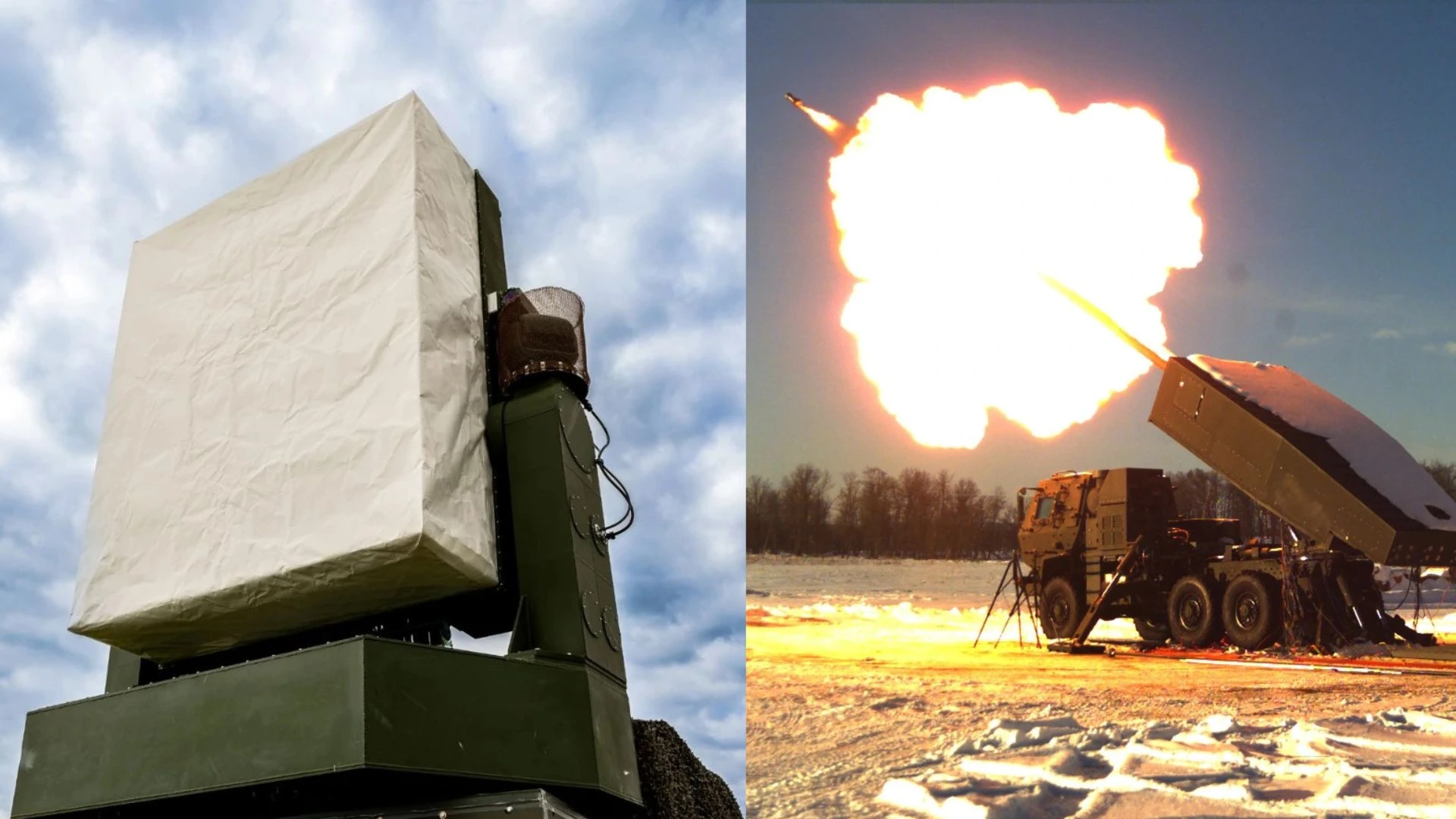
BAE Systems unveiled two counter-drone and counter-missile capability demonstrators, the Multi-Domain Artillery Cannon System (MDACS) and a High Power Microwave (HPM) directed energy weapon, at the Association of the United States Army (AUSA) Annual Meeting and Exposition in Washington on October 12, 2026. The company is pitching the pair to the US Army as kinetic and directed energy layers against saturation drone attacks on installations and maneuver forces.
The timing reflects a magazine problem the Army has yet to solve. Massed one-way attack drones and cruise missiles can exhaust interceptor stocks faster than industry can replace them, and the Pentagon stood up Joint Interagency Task Force 401 (JIATF-401) in August 2025 to accelerate counter-unmanned aircraft systems (C-UAS) fielding. MDACS already sits inside an Army effort: the Rapid Capabilities and Critical Technologies Office (RCCTO) sole-sourced the cannon and its Hypervelocity Projectile (HVP) to BAE in a December 20, 2024 notice, with about $67 million planned for fiscal 2025. BAE has announced no Army contract for HPM.
How BAE Systems MDACS Turns 155mm Artillery Into Air Defense
The RCCTO requirement calls for a full MDACS battery by the fourth quarter of fiscal 2027, followed by an operational demonstration in fiscal 2028. A battery comprises eight Multi-Domain Artillery Cannons, four Multi-Function Precision Radars (MFPR), two Multi-Domain Battle Managers and at least 144 HVPs, and it must plug into the Army’s Integrated Battle Command System (IBCS) fire control network. The wheeled, self-propelled 155mm cannon must be transportable by air, rail and sea, with an automated high rate of fire. BAE first showed it at the Land Forces Pacific (LANPAC) symposium in Honolulu in May 2026, unloading from a C-130 Hercules, and released live-fire footage on July 2, 2026.
The HVP is what turns a howitzer into an interceptor. BAE describes it as a common, low-drag guided round developed for Navy 5-inch guns, 155mm systems and the electromagnetic railgun; its aerodynamics deliver velocity and maneuverability without a rocket motor. The Army intends to guide it from offboard sensors, removing the onboard seeker that drives up interceptor costs and making the MFPR and IBCS fire control chain the system’s center of gravity. Open-source reporting credits MDACS with about eight rounds per minute and a 15-pound (6.8 kg) payload per projectile; BAE has not confirmed either figure. In September 2020, an Army 155mm howitzer firing an early HVP downed a BQM-167 aerial target simulating a cruise missile.
For surface fires, MDACS fires Scorpio-XR, formerly designated XM1155-SC, a low-drag projectile that BAE says doubles the range of existing 155mm cannon-launched precision guided munitions; open-source reporting places it beyond 70 kilometers. In October 2025 tests with the Army’s Combat Capabilities Development Command Armaments Center (DEVCOM AC), it struck targets from 52-caliber Joint Ballistics Memorandum of Understanding howitzers. The same tube can therefore defend a base or strike ground targets.
Four Power Tiers: How BAE’s High Power Microwave Scales Drone Defense
BAE’s HPM generates high power microwave pulses that disrupt or destroy target electronics at the speed of light. It draws on no finite stock of rounds; as long as power holds, it keeps engaging. That matters most against swarms built to exhaust a magazine, and microwave effects can cover an area rather than a single airframe, giving the defender a one-to-many engagement ratio kinetic layers cannot match.
The company rates the system at Technology Readiness Level (TRL) 6, meaning a prototype demonstrated in a relevant environment, and says outdoor range testing has fired billions of pulses downrange to document target effects. More than 99% of its components are commercial off-the-shelf, sourced from a US supply chain, and a common core of controllers, interfaces and power systems lets BAE shift frequency bands without restarting development. A modular array scales output and aperture across four configurations: grid-tied strategic sites, generator-powered towed units, vehicle-integrated maneuver systems and shipboard installations.
Jason Casciotti, vice president of BAE’s Weapon Systems product line, framed the pitch around speed: “The threat environment is evolving faster than traditional procurement cycles can keep up with.”
BAE draws on more than a decade of HPM work, including a naval variant displayed on a Mk 38 gun mount in 2019 and participation in Air Force Research Laboratory counter-drone HPM testing. Key parameters remain undisclosed: output power, operating frequency, effective range and power draw per engagement. Those gaps matter because the Army has already evaluated HPM prototypes from Epirus under its Indirect Fire Protection Capability High Power Microwave (IFPC-HPM) effort, the benchmark BAE will have to meet.
Analysis: BAE is selling an architecture, not individual effectors. Pairing a funded kinetic program with an uncontracted directed energy layer gives the Army a complete inner tier for base defense: HVP for cruise missiles and larger drones at range, HPM for close-in swarms that would otherwise consume guided rounds. That tracks with JIATF-401’s position that no single effector solves the drone problem. The economic case rests on one unpublished number: HVP unit cost. If guided rounds approach the price of short-range interceptor missiles, MDACS loses its core argument.
The next milestone is delivery of the prototype battery by September 30, 2027, followed by a battery-level operational assessment in fiscal 2028. For HPM, the question is whether JIATF-401 or the Army opens a competitive path BAE can enter. HVP pricing and HPM range figures, neither released at AUSA, will decide whether either system moves beyond the show floor.