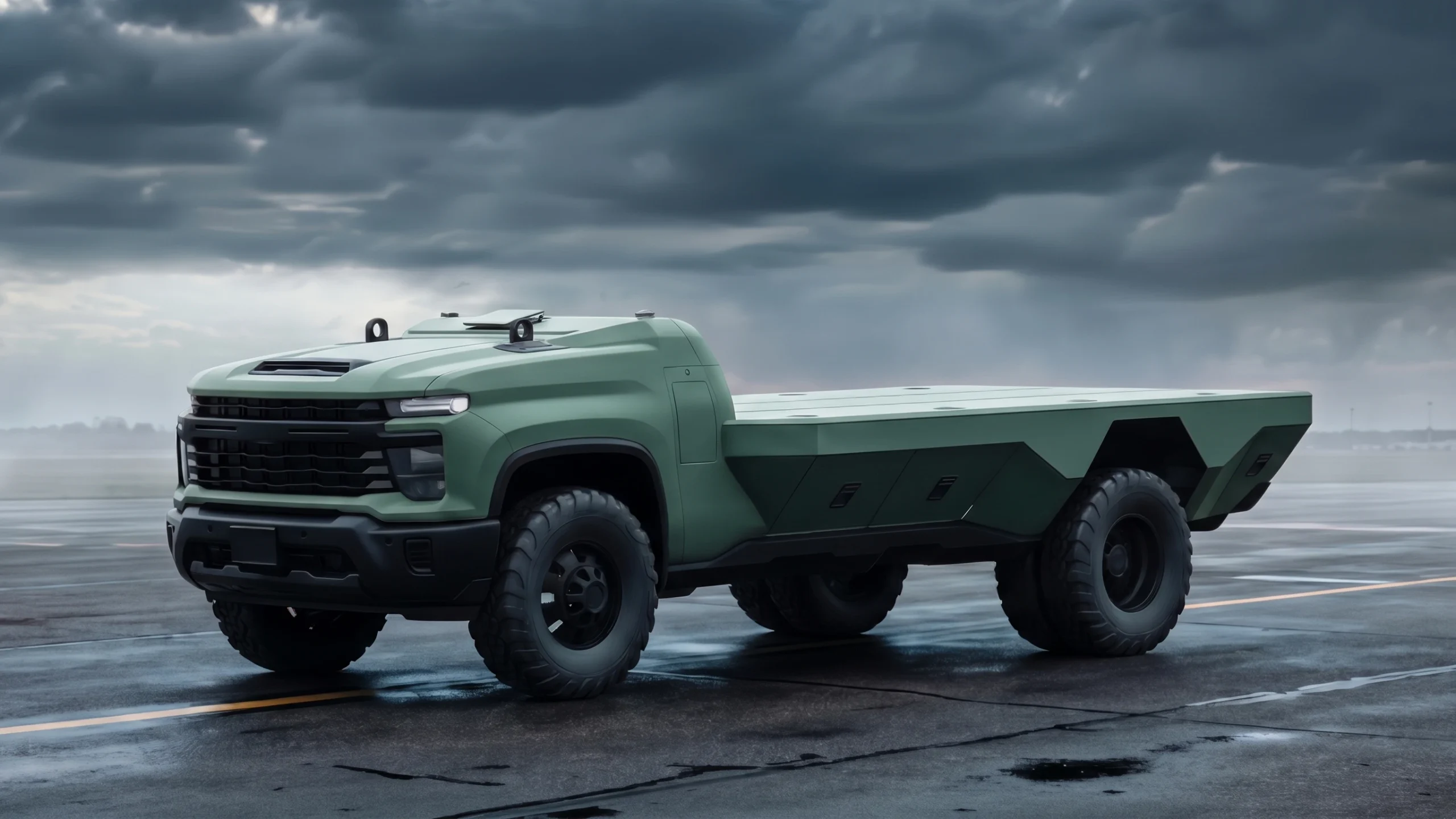
GM Defense unveiled an unmanned ground vehicle (UGV) built on the Chevrolet Silverado 3500 HD commercial truck at the Association of the U.S. Army (AUSA) Annual Meeting and Exposition in Washington, D.C., on October 12, 2026. The General Motors subsidiary says the platform can carry up to 8,000 pounds of payload and expects a technology demonstrator to be ready by June 2027, although no Army test delivery is scheduled.
The rollout comes as the Army reshapes how it buys ground robots, running parallel prototyping efforts for autonomous resupply, engineer breaching, and casualty evacuation in the last tactical mile to define future requirements. GM Defense enters that field with production credibility: its Infantry Squad Vehicle (ISV), derived from the Chevrolet Colorado ZR2, equips Army infantry formations, and General Motors expects the defense unit to generate roughly $700 million in revenue in 2026.
GM Defense UGV Payload, Energy, and Autonomy Architecture
The 8,000-pound payload rating doubles the 4,000-pound figure GM Defense quoted in 2024 for its Next Generation Tactical Vehicle, a crewed concept built on the lighter Silverado 2500 HD ZR2. Onboard energy totals 102 kilowatt-hours from Ultium-based battery technology, the cell architecture General Motors developed for its commercial electric vehicles. That reserve supports silent watch, powering onboard systems quietly while the vehicle is stationary, useful for a robotic truck waiting at resupply points.
Autonomy comes from Scout AI, a startup founded in 2024 whose Fury system relies on camera-only, passive sensing and vision-language-action models. GM Defense describes an open, modular architecture for swapping sensors, autonomy, command and control, and mission software, but has not detailed the demonstrator’s sensor suite. Concept work began only in late spring or early summer 2026.
The display vehicle carried AeroVironment’s LOCUST X3 high-energy laser, which the Army chose for its Enduring-High Energy Laser (E-HEL) program under a $464.8 million agreement announced on September 2, 2026, the service’s first production contract for a laser weapon. LOCUST X3 scales from roughly 20 to more than 35 kilowatts and targets Group 1 through Group 3 unmanned aircraft. Pete Johnson, GM Defense’s vice president of business development for integrated vehicles and a retired Army major general, presented counter-UAS as one of several missions the truck could host, calling it “a blank slate, whatever you want it to be.” GM Defense has not said whether the laser draws on the 102 kWh battery or on a dedicated power module.
Project Sustainment Fit and the June 2027 Demonstrator Timeline
GM Defense is aiming the vehicle at Project Sustainment, the Army’s effort to field medium-sized autonomous vehicles that move supplies forward without exposing soldiers on high-risk routes. Run by the Army’s Capability Program Executive Mission Autonomy, it absorbed the earlier Medium Multipurpose Equipment Transport program. In July 2026, the Army selected AM General, American Rheinmetall, Carnegie Robotics, HDT Robotics, and Stratom for 18-month prototyping agreements, with vehicles slated to join an operational unit for a Transformation in Contact assessment in the second quarter of fiscal 2027.
GM Defense was not part of that first cohort. Johnson acknowledged the company was not ready for the initial phase and told the Army it would follow rather than lead. No program line directly funds the effort, and Johnson conceded that industry and government are both carrying risk. He argued that combat in Ukraine and the Middle East, along with Army planning for the Indo-Pacific, makes the demand signal clear, and that unmanned vehicles employed at higher risk will push requirements toward cheaper, more attritable designs.
Analysis: GM Defense is betting that production scale, more than autonomy software, will decide robotic logistics. A Silverado 3500 HD baseline brings an established commercial supply chain and parts network that could lower unit costs if the Army buys robotic trucks in quantity, and every cargo run shifted to a UGV takes a crewed truck off contested routes. The timing cuts the other way: the June 2027 demonstrator arrives after the first Project Sustainment prototypes reach soldiers, so GM Defense will compete against requirements partly shaped around rival platforms. Its ISV record, where building ahead of a formal requirement accelerated Army feedback, suggests the company considers that sequence manageable.
The next markers are the Transformation in Contact assessment in early 2027 and GM Defense’s June 2027 demonstrator date. Key parameters remain undisclosed, including powertrain configuration, range, curb weight, top speed, and unit cost. Whether the Army opens a follow-on round will decide if this late entry becomes a production opportunity.