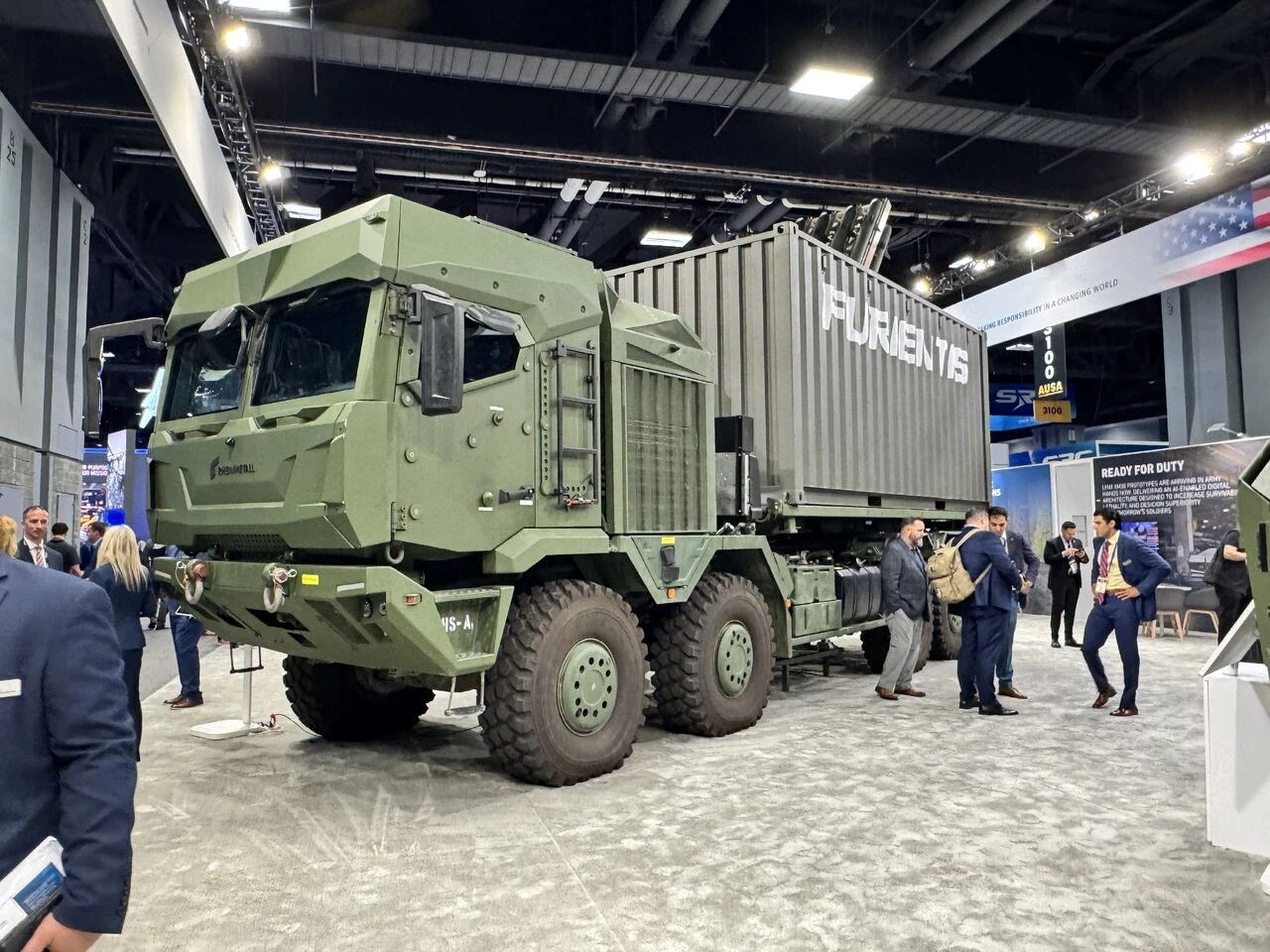
American Rheinmetall is displaying its HX CAML AMP autonomous launch platform armed with low-cost interceptors from Los Angeles-based Furientis at the Association of the United States Army (AUSA) Annual Meeting and Exposition, held October 12-14, 2026, in Washington. The company said in an October 10 LinkedIn post that the pairing already completed a live interceptor firing this fall from a containerized launcher mounted on its HX-based platform.
The test lands as the U.S. Army rebuilds launcher modernization around the Common Autonomous Multi-Domain Launcher (CAML), a modular program that separates the autonomous truck from the munitions it carries. On August 21, 2026, the Army awarded the Georgia Tech Research Institute (GTRI) an Other Transaction Agreement worth up to $33.4 million to serve as Weapon Systems Integrator, and responses to a separate solicitation for the CAML Autonomous Mobility Platform (AMP) were due September 1, 2026. The HX CAML AMP designation places Rheinmetall’s truck squarely against that requirement. No AMP award has been announced, and the Army has not selected a Furientis interceptor.
Inside the Rheinmetall HX CAML Autonomous Mobility Platform
The platform rides on Rheinmetall’s HX family of military trucks, shown at AUSA in an 8×8 configuration. More than 20,000 HX vehicles are in service worldwide, and Rheinmetall’s autonomy kits have been integrated on 24 chassis types across 19 countries, according to the company. That base builds on leader-follower convoy work Rheinmetall has run for the German armed forces under the Interoperable Robotic Convoy (InterRoC) project.
The CAML configuration supports autonomous driving, convoy navigation, predefined route following and remote operation, with automated payload loading and unloading through open interfaces. Rheinmetall says these functions were demonstrated at Redstone Arsenal, Alabama, in June 2026. They map closely onto the Army’s stated AMP requirements: convoy following, waypoint navigation, an optionally piloted mode and a reload architecture that handles pallets with no human intervention. Earlier Army requirement documents called for palletized payloads of 40,000 to 60,000 pounds and 120 kilowatts of onboard power at 600 volts DC. American Rheinmetall has not published payload or power figures for its AMP.
The effector sits in a containerized launcher, the same packaging logic behind Rheinmetall’s Containerized Missile Launcher, which fired FV-014 loitering munitions from a static and moving HX truck in Germany in July 2026. A standard container keeps the truck agnostic: one chassis can, in principle, carry interceptors, strike missiles or loitering munitions, provided each round clears its own integration and qualification testing. That is the core logic of CAML, which aims to field one autonomous carrier for rounds ranging from Tomahawk and the Patriot Advanced Capability-3 Missile Segment Enhancement (PAC-3 MSE) to AIM-9X.
Furientis F1.0 and the Push for Low-Cost Interceptors at Scale
Furientis, founded in May 2025 by former Virgin Galactic deputy chief engineer Brody Franzen and former Virgin Orbit head of engine test Aris Simsarian, designs interceptors around production rate rather than peak performance. Its F1.0 Tactical Interceptor vertically integrates the seeker, control actuation system, airframe and solid rocket motor. The motor uses a proprietary propellant chemistry chosen for production throughput, the airframe is built for determinate assembly, and canard controls provide high maneuverability with compact packaging and low actuation power. Guidance relies on in-house software running on commercial components.
The company targets 1,000 interceptors per factory per year, final assembly in under one hour per round, and flight tests roughly every two weeks. Its reported unit-cost target sits below $250,000 depending on variant, against public estimates of roughly $4 million for a PAC-3 MSE. In early October 2026, Furientis closed a $25 million seed round led by Benchmark and secured its first funded Pentagon prototype agreement, for a 100-mile (160-kilometer) interceptor intended for homeland defense. The contract value was not disclosed. The company began with ship-based interceptors and was named one of five finalists, alongside Anduril and Kratos, in the Tactical Missile Innovation Challenge run by the Naval Postgraduate School with the Office of Naval Research.
Critical gaps remain. Neither company has identified the round fired from the HX CAML, its engagement range, the target, or the test date and location. American Rheinmetall’s announcement also references Furientis hypersonic effectors, a category Furientis has not publicly detailed.
Analysis: The pairing tests whether the Army’s interceptor shortfall can be eased by changing the economics of the launcher as well as the missile. Lockheed Martin is scaling PAC-3 MSE output from about 600 to 2,000 rounds a year under a seven-year framework announced in January 2026, and Boeing signed a roughly $14.7 billion seven-year contract on October 5, 2026, to triple seeker production. Those deals expand supply of a high-end round; they do not fix the cost exchange against drones and cruise missiles. A sub-$250,000 interceptor on an uncrewed, reloadable truck would let commanders reserve PAC-3 MSE for ballistic threats, but only once it is wired into Army radars and the Integrated Battle Command System, an integration neither company has described.
The Army expects further CAML prototype awards in the coming months, including the AMP, while GTRI’s 36-month integration effort leads to CAML Increment Zero prototypes. Oshkosh Defense is pitching its 10×10 Extreme Multi-Mission Autonomous Vehicle for the heavy variant, and Raytheon is pursuing CAML with its DeepFires launcher. For Furientis, the next milestone is flight demonstration under its new Pentagon agreement. Range, seeker and intercept data will decide whether the AUSA display becomes a program.