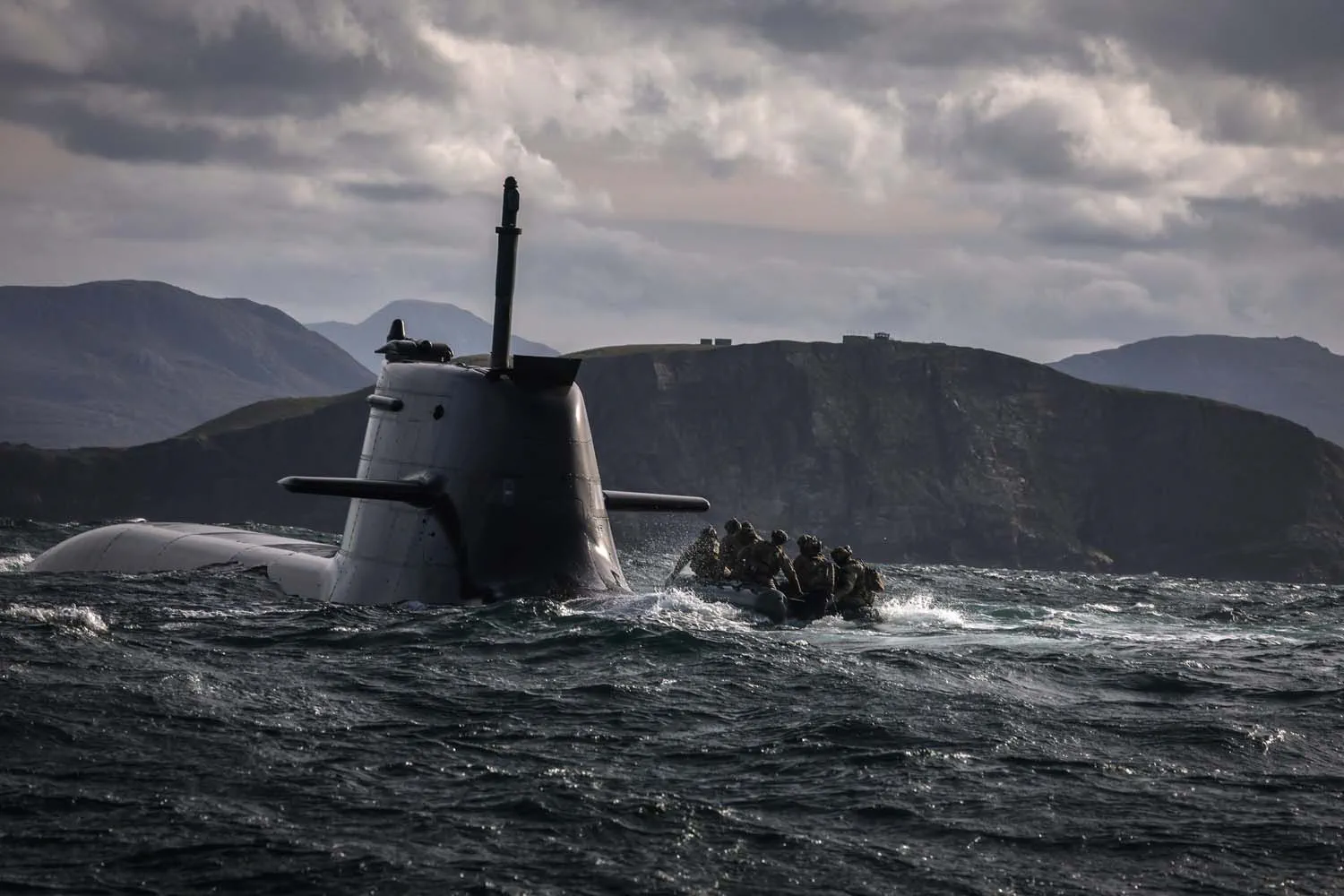
British commandos surfaced off Cape Wrath, the most northwesterly point of mainland Great Britain, aboard a German Navy attack submarine, then used inflatable raiding craft to set up a clifftop observation post and direct the guns of Portuguese frigate NRP Dom Francisco de Almeida onto simulated enemy positions, the Royal Navy said on October 6, 2026. The raid formed part of Exercise Strike Warrior in Scotland.
The Royal Navy describes Strike Warrior as the largest test of all arms of the UK Commando Force in 15 years and the first time since the Afghanistan campaign that every specialist element of the formation has worked together. More than 2,000 personnel from the United Kingdom, the Netherlands, Canada, Germany, Norway and the United States, joined by at least one Portuguese warship, are deployed from the Western Isles to the North Sea with eight warships and 19 aircraft to rehearse allied crisis response in the High North and North Atlantic.
UK Commando Force Raid Links German Submarine and Portuguese Guns
The raid split the kill chain across three navies. According to the Royal Navy, the German submarine identified the targets, the commandos landed undetected and the Portuguese frigate delivered the fires. The landing party came from 148 (Meiktila) Commando Forward Observation Battery, a unit of 29 Commando Regiment Royal Artillery that pairs commando-trained Army gunners with Royal Navy personnel to conduct covert reconnaissance and control naval gunfire from behind enemy lines.
Cape Wrath is the only location designated for shore bombardment during this year’s exercise, according to its environmental assessment, making it the single site where the observer-to-ship link could be exercised against land targets. Earlier in Strike Warrior, the battery’s teams controlled gunfire from two ships of Standing NATO Maritime Group One (SNMG1): Dutch frigate HNLMS Van Amstel and Royal Canadian Navy frigate HMCS St. John’s.
The battery’s operations officer, unnamed for operational reasons, said the unit had not coordinated live assets at this level of complexity in nearly three decades. The serial, the officer said, was meant to show the UK Commando Force, wider UK Defence and NATO’s special operations community which missions the battery stands ready to execute, adding that it is “prepared to employ specialist assets to deliver Multi-Domain Fires and Targeting.”
The program extends well beyond fires. The Royal Navy lists amphibious landings, boarding operations, intelligence and surveillance missions, logistics and sustainment, maritime security and anti-submarine warfare among the serials. Commandos have also flown drones for strikes and battlefield resupply and built underground medical facilities, a measure consistent with operating under persistent aerial surveillance.
Type 212A Submarine and Karel Doorman Frigate: What Each Brings
The Royal Navy did not name the German boat, but the German Navy’s submarine arm at Eckernförde operates only six Type 212A boats. Publicly available specifications indicate the class displaces about 1,524 tonnes surfaced and 1,830 tonnes submerged, carries about 27 crew and fires DM2A4 Seehecht fiber-optic-guided heavyweight torpedoes from six 533 mm tubes. Its distinguishing feature is air-independent propulsion: Siemens proton-exchange membrane fuel cells allow long submerged transits without snorkeling, while an MTU 16V 396 diesel and a 1.7 MW Permasyn motor handle surface running and charging.
For special operations, that endurance and low acoustic signature matter more than torpedo load. A conventional boat able to loiter quietly off a defended coastline shrinks the detection window that a surface ship or helicopter insertion would open. The two navies have rehearsed the technique before: on March 3, 2026, during Exercise Cold Response 26 in Norway, German submarine U35 embarked UK commandos, including specialist observers from 148 Battery, about 200 miles inside the Arctic Circle. Germany and Norway are jointly procuring the larger Type 212CD as the successor design.
NRP Dom Francisco de Almeida (F334) is the former Dutch HNLMS Van Galen, a Karel Doorman-class frigate commissioned in 1994 and transferred to Portugal in 2010. Open-source data list a 122-meter hull, about 3,320 tonnes full load, an OTO Melara 76 mm gun, Harpoon anti-ship missiles, Sea Sparrow surface-to-air missiles and a Goalkeeper close-in weapon system. Van Amstel carries the same 76 mm gun, while St. John’s mounts a 57 mm weapon. None approaches the 5-inch Mk 45 selected for the Royal Navy’s Type 26 frigates, which underlines that the observer teams, not the gun, are the constant in allied fire support.
Analysis: The Cape Wrath serial is less a gunnery event than a proof of a multinational sensor-to-shooter chain in which no single nation owned more than one link. That model suits NATO’s northern flank. The Royal Navy has operated only nuclear-powered submarines since the 1990s, all heavily committed to anti-submarine and deterrent-protection tasks, while conventional boats such as the Type 212A are well suited to shallow coastal waters. The constraint sits at the fires end: 76 mm and 57 mm guns offer limited reach against a defended shore, so the same observer teams will increasingly need to cue longer-range weapons such as the Naval Strike Missile on several Royal Navy escorts.
Strike Warrior ends on October 9. The Royal Navy has not identified the German submarine, disclosed the size of the landing party or confirmed whether the frigate fired live rounds during the serial. After two joint insertions in 2026, the next indicator is whether German submarines become a standing insertion platform in UK Commando Force training cycles, and how quickly British observer teams are linked to missile-armed ships rather than guns alone.